Tyler’s Torah Thoughts for 10 Nisan, 5784
Parsha Metzora’ – “Tzara’at sufferer”: (Leviticus 14:1 – 15:33)
Fifth Portion: Leviticus 14:54 – 15:15
 Good morning! This morning on my walk, I was contemplating the idea of stillness and restraint. How often do we get lost in our mind, when really we need to come into our bodies and into our breath. The Torah over the past week has been focusing directly on our bodies. Looking at the skin – lesions. The skin is amazing if you think about it. It is the container of the infinite possibilities within us. No wonder the lesions are being examined – the boundary between our infinite reality and the infinite reality around us? That’s crucial.
And then we looked at the home – where we live within our skin. Our homes are a second infinite reality – one where our bodies dwell infinitely within the walls of our home.
It will be interesting to see the shift today:
54[All] this is the law for every lesion of tzara’ath, and for a nethek,
55And for tzara’ath of garments and houses,
56And for a se’eith and for a sapachath and for a bahereth;
57To render decisions regarding the day of uncleanness and the day of cleanness. This is the law of tzara’ath.
So line 56 is interesting. What are those? We covered them in verse 13:2
13:2If a man has a se’eith, a sappachath, or a bahereth on the skin of his flesh, and it forms a lesion of tzara’ath on the skin of his flesh, he shall be brought to Aaron the kohen, or to one of his sons, the kohanim.
These were colors of lesions of Tzara’ath on the body. They are literally translated “uplifted”, “additional”, and “clear”.
Those are such interesting names for lesions, aren’t they?
But here is why these verses are here. It was to help us decide.
57To render decisions regarding the day of uncleanness and the day of cleanness. This is the law of tzara’ath.
All of this was to help us get clarity – “clear” on how to make decisions. The law was IN the problem, wasn’t it? It was NOT for condemnation. It was NOT to live in guilt or shame about the lesions. It was about how to declare someone as clean. The Torah contains a quarantine process!
15:1And the Lord spoke to Moses and to Aaron, saying,
2Speak to the children of Israel, and say to them, If any man has a discharge from his flesh, his discharge is unclean.
3And this shall be [the nature of] his uncleanness due to his discharge: [if] his flesh runs with his discharge, or [if] his flesh is plugged up by his discharge, that is his uncleanness.
What is a “discharge from his flesh?”
It’s basically any time something meant to be INSIDE the body, comes OUT of a body in an uncontrolled manner. The discharge is not MEANT to be outside the body. It is MEANT to be in the body. The discharge is unclean. This makes sense, doesn’t it? The word clean just seems to mean – “Meant to be.” And unclean means “Not Meant to Be.”
I am reflecting on how much pride, guilt and shame we add to the words clean and unclean.
Simply put, the discharge was not meant to be outside the body.
And in verse three? That discharge is “not meant to” touch human skin. This is why the man is unclean. There is no judgment on this.
Let’s keep going:
4Any bedding upon which the man with the discharge will lie, shall become unclean, and any object upon which he will sit, shall become unclean.
5And a man who touches his bedding, shall immerse his garments and immerse himself in water and he shall remain unclean until evening.
6And anyone who sits on an object, upon which the man with the discharge will sit, shall immerse his garments and immerse himself in water, and he shall remain unclean until evening.
7And anyone who touches the flesh of the man with a discharge, shall immerse his garments and immerse himself in water, and he shall remain unclean until evening.
8And if the man with the discharge spits upon a clean person, [that person] shall immerse his garments and immerse himself in water, and he shall remain unclean until evening.
9Any riding gear upon which the man with the discharge will ride, becomes unclean.
10And whoever touches anything what will be under him, becomes unclean until evening. And whoever lifts them up shall immerse his garments and immerse himself in water, and he shall remain unclean until evening.
I want to pause here. One of the things I notice here is the “future” orientation of the language. The man wakes up and becomes aware of the discharge. And how he touched it. This is not how it was “meant to be.” So it is a matter of cleaning things up, and then? Try to protect his uncleanness from others. But basically the man becomes a zombie – every thing he touches and someone else touches? Becomes infected.
And you’d think he’d be sent from the camp – but read THIS:
11And whomever the man with the discharge touches, without [the latter] having rinsed his hands, shall immerse his garments and immerse himself in the waters, and he shall remain unclean until evening.
Wait. So – if I touch a guy who is unclean, and I rinse my hands? I’m good? If I don’t, I need to wash and then I will be unclean until evening? That’s interesting, isn’t it?
In this case – with a discharge? We are not put out of the camp. We engage. And. We are unclean until evening.
One of the themes here is “unclean until evening.”
What you may miss here? Basically the Torah is saying “you are unclean for the rest of the day.” In the evening (which is when the Hebrew new day begins) we all get to “begin again.” The beginning of the day is as it is “meant to be.”
Let’s bring it home:
12And an earthenware vessel which the man with the discharge will touch, shall be broken. And any wooden vessel shall be rinsed in water.
The earthenware vessel needs to be broken. The Torah is clear – terracotta pots – once they are “unclean” you can’t get them clean – basically because there is no way to clear the pores from the uncleanness. Wood just needs to be rinsed.
13When the man with the discharge is cleansed of his discharge, he shall count seven days for himself for his purification, and then immerse his garments and immerse his flesh in spring water, and he shall be clean.
So this is interesting. Basically it acknowledges the guy IS unclean until evening, but until the discharge stops flowing? He’s going to go through this each day. And? Once it has cleared, he can achieve full restoration – wait seven days, immerse garments, and flesh in the mikveh, and he will be clean.
The Torah wants us to see ourselves and the world around us as we are “meant to be.” In otherwords – the Torah paints us a picture of our “purpose” the way we are “meant to be.”
The problem is we are dislocated and disoriented from where we are meant to be. There is no judgment on this – only opportunity to return home. To be clean.
14And on the eighth day, he shall take for himself two turtle doves or two young doves, and come before the Lord, to the entrance of the Tent of Meeting, and give them to the kohen.
15And the kohen shall make them: one into a sin offering and one into a burnt offering, and the kohen shall effect atonement for him from his discharge, before the Lord.
And as we are seeing, once we are clean? We sacrifice. This is the atonement – to be fully restored.
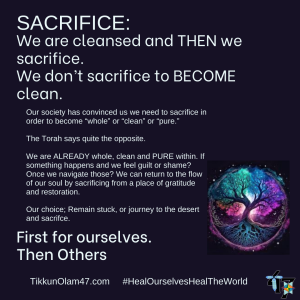
Which is interesting. As a society we think sacrifice MAKES us clean. The Torah says otherwise – once we are CLEAN, we sacrifice.
Just contemplate that. We don’t sacrifice to become clean. We are clean then we sacrifice.
Once we are meant to be, THEN we sacrifice. We don’t sacrifice to BECOME clean.
That is counter-intuitive isn’t it?
Our bodies naturally heal. And – to recover from the mistakes – we accept we are clean, and THEN we sacrifice to the Lord to be RESTORED. REORIENTED.
These are my thoughts. What about you?
Here are my thoughts from two years ago:
Tyler’s Torah Thoughts for 6 Nisan, 5782
So. Today things are going to get a little…interesting. We will finish up with Tzara’at of a house and move into a man’s “discharge.” The Torah is going to cover men’s sexual health, y’all.
Just be forewarned!
Ok; the portion begins with closing out our parts about Tzara’at- a netek. The verses reflect on what we’ve studied and say this;
“this the law for every lesion of Tzara’at- a netek, Tzara’at of garments and houses, ” a (white) blotch, a creamy blotch and a white spot- (in order) to render decisions as to (which is) a day of ritual impurity and (which is) a day of ritual purity. (All) this is the law of Tzara’at.”
Rabbi Hayyim ibn Attar wrote this:
“The Sages teach that when God wants to rebuke a person for his misdeeds with tzara’at lesions, He does not strike the body first. First, God strikes the person’s house; if he does not repent, then God strikes his clothing. If he still does not repent, then God brings lesions on the body (Leviticus Rabbah).
If the home was afflicted first, why are its laws mentioned in the Torah last?
Because when the children of Israel were given the laws for tzara’at sufferers, they inhabited the desert and did not own any houses. Since it was not a relevant commandment at that time, it was mentioned last. It turns out, then, that when God said to Moses, “When you come to the land of Canaan … and I place tzara’at lesion on the houses,'” the message was actually a positive one: When you enter the land I will give you all homes, and then, when I want to reprimand you, I will start with your houses and not with your bodies.
A really powerful message. This was a promise; that the Jews would have houses in the promised land; that would get Tzara’at. Something to chew on – when we are struggling – what can we find gratitude in?
And with that thought we Next we jump into a man’s unhealthy discharge.
God tells Moses and Aaron “if any man has an unhealthy, watery venereal discharge from his body, his discharge is ritually impure.”
In thinking about the concept of discharge, Rabbi Schneerson immediately takes us from “jr high boy” perspective on this passage to “deep spiritual and meaningful” with this writing;
“In addition to the natural “evil impulse” which God implanted into man (see Genesis 8:21), our tendency to evil is further strengthened by sin.
This can occur at three different levels:
(a) Primordial. The sin of the Tree of Knowledge strengthened the evil impulse of Adam, Eve and all their descendants.
(b) Acute. In addition to the above, you can choose to “incite” your evil impulse to sin even more than its own tendency to do so.
(c) Chronic. After doing this for a period of time, the evil impulse will become “addicted to
Is excessive sinful behavior, so that it no longer needs to be “incited.”
A zav is a person who is in a state of ritual impurity due to sickness. In spiritual terms, this corresponds to the “sickness” of increasing the natural strength of the evil impulse by sinful behavior.
More precisely, the three levels of strengthening the evil impulse described above correspond to the three types of zav.
(a) A person who has a single unhealthy discharge becomes a zav even if it was accidental; This Corresponds to the primordial strengthening of the evil impulse which affects every person, through no fault of his own.
(b) The second discharge must, however, be intentional. This corresponds to the acute strengthening of the evil impulse, where a person actively incites himself to sin more.
(c) The third discharge of the zav could be accidental, so long as the previous two discharges were intentional. This corresponds to the chronic strengthening of the evil impulse, which begins intentionally but eventually causes the person to sin “addictively” even without choosing to do so.
Nevertheless, the Torah provides a means of removing even this form of ritual impurity (verses 14-15), teaching us that there is hope for every person to free himself from the confines of his evil impulse.” (End quote)
There is tremendous hope in these passages about a discharge. It is something to keep in mind; freedom and liberation can be had for us: if we only see it and accept it!
Ok back to the portion:
If there is a discharge whether it’s due to discharge running from his body, or clogging up his body, here’s what should happen –
- Any bedding becomes ritually impure. Any object which he will sit becomes ritually impure
- If a person touches the bedding, he should immerse his garments and himself in the mikveh and he will remain ritually impure until evening
- Anyone who sits on an object which the man with a discharge sits, should do the same thing as #2.
- Anyone who touches the body of the man with a discharge should also do the same thing as #2
- If the man with the discharge spits upon a ritually pure person, that person should also do the same thing as #2 above
- Any riding gear upon which the man with the discharge sits becomes ritually impure
- Whoever touches the gear becomes ritually impure until the evening
- Whoever lifts up anything contaminated by the person with a discharge should do the same as #2 above
- Anyone whom the man with the discharge touches without the latter having rinsed his hands and immersed in the mikveh should also do the same as #2 above
- An earthenware vessel which the man with the discharge will touch inside or move should be broken. Any wooden vessel should be immersed in the mikveh
- When the man with the discharge stops having discharges, he should count seven consecutive days free of discharges – then do #2 above.
So let’s stop for a minute and talk about #2 above. It seems to be the common theme. Why does an impure person become purified through immersion in water?
Rabbi Aaron ha-Levi writes this:
After immersing himself in the water, he feels as though he were just formed anew-like in the beginning of creation, when the world was entirely covered by water.
Also, immersion symbolizes to the impure person that he should cleanse his soul from sin, like water, which serves as an agent to cleanse everything it touches.
Interesting thoughts!
The portion closes with the eighth day for the man with a discharge. After immersing himself on the seventh day, God says he should take two turtle doves or two young doves and come before God on the eighth day. He should go to the entrance to the tent of meeting, give them to the priest. The priest will carry out their service – one as a sin offering and the other as a burnt offering, and thus the priest will atone for him from his discharge before God.
So there you have it. An unhealthy discharge from a man. Tomorrow, we will cover seminal emissions in general, and then menstruation. Should be interesting reads! The Torah is both spiritual – but it’s also practical!
Let’s close with this. The Chumash I am reading has this spiritual vitamin for us:
“With health problems, physical, mental or spiritual, the cure lies not in treating the symptoms, but in attacking the cause (although the former may sometimes be necessary for relief in acute cases).”
What do you think?


No responses yet