Tyler’s Torah Thoughts for 29 Nisan, 5784 –Day 14 of Omer
Parsha Kedoshim – “Holy” (Leviticus 19:1 – 20:27)
Third Portion: Leviticus 19:23 – 19:32
Good morning! It was an amazing day yesterday as I entered into my 53rd year of life.
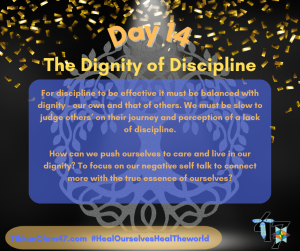 Today, is Day 14 of the Omer – the dignity of discipline. From Chabad:
Discipline, like love, must enhance personal dignity (see week one day seven).
Discipline that breaks a person will backfire. Healthy discipline should bolster self-esteem and help elicit the best in a person; cultivating his sovereignty. And that does not compromise the discipline; on the contrary it fosters and enhances it. Does my discipline cripple the human spirit; does it weaken or strengthen me and others?
Exercise for the day: When disciplining your child or student foster his self-respect.
I think about how we can go overboard and lose our own (and others’) dignity. The human spirit is crucial in this process. I have experienced coaches who cannot balance harsh discipline with soft dignity. Challenge AND Support. These two play together in harmony to spark us in love towards growth.
It is also interesting that we find ourselves on the cusp of the month of Iyar. One of the themes of this new moon cycle (from this article) is that it is the only cycle where “every day counts” because we are counting the Omer. The theme is from “birth to betrothal.” It is a month of healing.
The month cycles are birthed in Nisan – the Passover. The idea is the Jewish people were conceived when Abraham gave the seed of man to Sarah – who had the egg provided by Hashem. Then,
“they floated down the fallopian tube with Isaac, and implanted in the dark womb of Egypt when Jacob came down with his 70 souls. There, they gestated for 210 years until, when they reached a total of 600,000 family units (600,000 root souls), they were born on the seventh day of Passover when they passed through the Red Sea, the spiritual equivalent to the birth canal.”
It is a beautiful imagery – the counting begins – from our birth through the red sea – towards the wedding of Shavuot. 49 days.
The question is asked – why do we do this every year? It’s because we are expanding:
The part of our soul that is not yet integrated is called makif, which means literally, hovering, because it hovers around us, waiting for our vessel to stretch to be able to hold and contain more of its lights. On Passover, some new increment of soul, some new chunk of consciousness, comes in and becomes slowly integrated through the course of the year. Eventually, it must be absorbed so deeply that our instinctive and reflexive way of relating to the world is now conditioned by its truth.
The theme of this month is contemplation – rumination. According to Kabbalah, the part of the body that corresponds is the right kidney. The kidneys are the subconscious/instinctive root of emotion, as opposed to the heart area. The beauty of this is – it’s where the healing of past ancestral and generational trauma occurs.
So, we learn our lessons and try to become more conscious and do our rectifications and integrate them into our kidneys. We chip away at the vein of neurosis that is our family tree and hopefully transit a slightly more cleaned and healthy inheritance on to our children. That is why the greatest gift we can give to our parents is the progress we make in bringing rectification and consciousness to our lives. That’s what it means to carry on their work.
So step 1? In the month of Iyar, we notice our thoughts.
Step 2? We label our thoughts – judging, coveting, predicting the worst. We begin to notice our patterns.
Step 3? Cause “truth” to rule over the “thought.”
Once you have spent some time watching and labeling your thoughts, and have identified the self-sabotaging patterns that are actively arising in the present, it becomes possible to make use of a technique that is called in chassidut yichudim. The idea is that every spiritually unproductive thought is based on a lie. Its power comes from concealing the untruth that lurks at its core. The practice of yichudim is a technique that exposes the lie by speaking the truth that is its undoing. The counter-truth serves as an infinitely potent antidote that dissolves the destructive thought at its root.
For example: Let us say one discovers a pattern of jealous thoughts: I want a husband like hers. I want a child like hers. I want a body like hers.
A possible counter statement might be: G‑d knows my life’s mission even better than I. He designed it, He wills it, and He is bound by an irrevocable covenant to assist its fulfillment from cradle to grave. Not a moment passes where He fails to provide the resources required for my next step in personal and spiritual growth. The blessings that I covet in other people’s lives would only be obstacles to my soul’s work. This moment is perfect. It has all that I need. I KNOW that this is true.
So as we enter the month of Iyar, and we move from birth to betrothal, let us contemplate the areas and patterns of our thoughts – and replace them with loving patterns and ideas, and make every day count!
Let’s dig into today’s portion:
23When you come to the Land and you plant any food tree, you shall surely block its fruit [from use]; it shall be blocked from you [from use] for three years, not to be eaten.
24And in the fourth year, all its fruit shall be holy, a praise to the Lord.
25And in the fifth year, you may eat its fruit; [do this, in order] to increase its produce for you. I am the Lord, your God.
When we enter the land – we need to let it grow for three years before eating the fruit. The fourth year, the fruit is holy, and not until the fifth year can we eat the fruit. Patience. That must have been a challenge!
26You shall not eat over the blood. You shall not act on the basis of omens or lucky hours.
27You shall not round off the corner of your head, and you shall not destroy the edge of your beard.
28You shall not make cuts in your flesh for a person [who died]. You shall not etch a tattoo on yourselves. I am the Lord.
Keeping in mind, these are all requisites for entering the promised land. So tattoos are out when we do.
29You shall not defile your daughter by making her a harlot, lest the Land fall into harlotry and the land be filled with immorality.
30You shall observe My Sabbaths and revere My Sanctuary. I am the Lord.
31You shall not turn to [the sorcery of] Ov or Yid’oni; you shall not seek [these and thereby] defile yourselves through them. I am the Lord, your God.
32You shall rise before a venerable person and you shall respect the elderly, and you shall fear your God. I am the Lord.
These are all good insights. The question comes – do we do this BEFORE we enter the promised land? I think that is an individual choice for each of us to make on our own spiritual journeys. It is important to keep in mind that when we enter, the game changes a bit – because of course it does!
These are my thoughts – what are yours?
Here are my thoughts from two years ago:
Tyler’s Torah Thoughts for 2 Iyar, 5782
Greetings! Today we continue our study in Parsha Kedoshim!
When we enter the promised land; once we’ve been taken from slavery, we get some new and interesting mitzvahs:
When we plant food trees in this new promised, liberated life:
- The fruit of that tree is restricted from you. For 3 years you may not eat it
- On the fourth year, all of its fruit should be holy; only eaten in Jerusalem; in praise of Hashem
- In the fifth year you may eat if it’s fruit
Why should we do this? The Torah says;
“Observe this law in order to increase the trees produce for you. I am a trustworthy God”
So we are given the reason!
Next we get into personal sanctity mitzvahs:
- Don’t eat sacrificial meat when it’s blood hasn’t been sprinkled on the alter
- Do not practice divination nor act on fortuitous times.
- You should not remove the hair from around the circumference of your head
- Do not destroy the extremities of your beard
- Do not make scratches in your flesh to mourn a person who died
- Do not put a tattoo on yourself; I am God.
- Do not defile your daughter, allowing your unmarried daughter to have relations not for the sake of marriage. If you do, the land will become “unfaithful” another land will procure its fruits and the land will be filled with immorality
Ok let’s stop for a minute. This is another place we see patriarchal Judaism raise its head it seems. As a dad of six daughters (well, five daughters and one trans son); it seems difficult to understand in todays society that I’d have any sort of control to “allow” my daughter to have any ”relations.” This is an especially hard passage given the ideas of power and control and toxic masculinity.
However, I’m reflecting on how we can apply this passage in a way that helps. For me, I am wondering as a dad, if the goal here is to have a deep, connective relationship with my daughters so that they won’t go looking for love in other dudes; when they should have acceptance and connection with me as their dad? My job isn’t to control my kids – it’s to love them so they don’t have a hole in their heart that they seek to fill somewhere else.
What do you think? Especially women reading this; I’m curious to your take?
Ok- let’s keep going:
- Revere Hashem’s sanctuary by entering the temple with your staff, shoes, money belt or dust on your feet. Observe the sabbaths rather than building the temple of the sabbath.
- Do not turn to the sorcery of the ‘ov or yidde’oni. You should not seek these and thereby defile yourselves through them.
Ok. Let’s stop again. Rabbi Samson Raphael Hirsch wrote this:
Verse 30 (#8 above) offers the Torah’s positive solutions to the prohibited activities of verse 26. In contrast to acting “on the basis of fortuitous times” (v. 26), i.e., predicting which day is an auspicious time” to start an activity (Babylonian Talmud, Sanhedrin 65b). Scripture says, “observe My Sabbaths” (v. 30)-your activities should be based on the time cycle that God designated, namely the Sabbath.
In contrast to practicing “divination'” (v. 26), i.e., deciding a “lucky time” based on random, irrelevant events, Scripture says, “revere My Sanctuary” (v. 30), My Torah, and do not fear those predictions.
When you do this, “I am God”-you will receive many blessings and be successful.
In addition, Rabbi Simchah Bunem writes about #9 above;
The word ‘ov also can mean “desire” (from the Hebrew word ‘avah), and the word yidde’oni can be translated as ‘knowledge” (deah), Do not turn to desire, nor should you sway to knowledge. As much as being knowledgeable is commendable it is not everything. The final destination, the actual good deed, is the most important thing.
These are interesting commentaries on the Torah above. What do you think?
The portion today closes with this:
- You should rise in the presence of an old person and you should honor the presence of a sage.
In our society today; I’m reflecting on how we really just don’t do that in our culture. We look down upon the old. We think ourselves wiser than sages. That’s crucial for us to consider on our journey.
What are your thoughts on today’s portion?


No responses yet