Tyler’s Torah Thoughts for 16 Iyar, 5784 –Day 31 of Omer
Parsha Be-Har – “On The Mountain” (Leviticus 25:1 – 26:2)
Sixth Portion: Leviticus 25:39 – 25:46
Good morning! Today is the 31st Day of the Omer, and the theme is the Compassion of Humility
From Chabad:
 Examine if your humility is compassionate. Does my humility cause me to be self-contained and anti-social or does it express itself in empathy for others. Is my humility balanced and beautiful? Or is it awkward?
Just as humility brings compassion, compassion can lead one to humility. If you lack humility, try acting compassionately, which can help bring you humility.
Exercise for the day: Express a humble feeling in an act of compassion.
It is an interesting contemplation – humility feels really connected to compassion. How can we separate those out?
The line – “if you lack humility, try acting compassionately, which can help bring you humility.” I also wonder if you lack compassion, try being humble, which can help bring compassion.
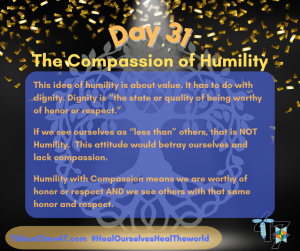
This idea of humility has to do with value. It has to do with dignity. The definition is – “the state or quality of being worthy of honor or respect.”
Humility is NOT seeing ourselves as “less than” others – that would lack internal compassion for ourselves. We would lose our dignity. Humility is seeing ourselves worthy of honor or respect AND seeing others with that same honor and respect. This is true humility with compassion.
With this, let’s dig into the portion today!
39And if your brother becomes destitute with you, and is sold to you, do not work him with slave labor.
40As an employee or a [hired] resident, he shall be with you; until the Jubilee year he shall work with you.
41Then, he shall leave you he, and his children with him, and he shall return to his family and resume the status of his fathers.
42For they are My servants, whom I brought out of the land of Egypt they shall not be sold as a slave is sold.
43You shall not work him with rigor, and you shall fear your God.
So – slavery. It’s in the Torah. We should talk about it, no?
First, this passage is about someone becoming destitute. A member of the family. Who needs help. If someone was in this position? This is kindness, no? It’s a way to stabilize a brother until the Jubilee year. That COULD be 49 years. However, consider the jubilee year previously? Any slave who was restored – and sent back to their original place, likely would NOT have been destitute so quickly. And if they were, that would be an indicator they could not survive on their own.
So, this isn’t really a problem. It’s compassion. It’s dignity. And. The line “they shall not be sold as a slave is sold” is jumping out at us. So let’s see if this gets addressed:
44Your male slave or female slave whom you may have from the nations that are around you, from them you may acquire a male slave or a female slave.
45And also from the children of the residents that live among you, from them you may acquire [slaves] and from their family that is with you whom they begot in your land, and they shall become your inheritance.
46You shall hold onto them as an inheritance for your children after you, as acquired property, and may thus have them serve you forever. But as for your brethren, the children of Israel, a man shall not work his brother with rigor.
Yeah. This is a problem. Now in the Torah – the context? These were acquired from their enemies. When people attacked Israel, they took slaves.
And. We need to recognize – this passage was used to justify chattel slavery in America. And that is a major issue.
For me? It comes down to that last line: “But as for your brethren.” In America, Chattel slavery was based on the dehumanization of a people based on the color of their skin. Our ancestors in America saw certain people PURELY as property. They did not see slaves as human. There are many other passages in the Torah that talk about this – that got ignored to justify one of the most embarrassing, guilt ridden, shameful periods of our history as a country.
If we are indeed souls with a body wrapped around us? This passage would seem to indicate we should not work ANYONE harshly. We are all part of one soul. So this passage hits a little different if we see our humanity. In a sense the Torah has us make a choice. And that makes a lot more sense to me.
And it’s interesting isn’t it? Our Omer theme of the day? Compassion of Humility.
Humility is NOT seeing ourselves as “less than” others – that would lack internal compassion for ourselves. We would lose our dignity. Humility is seeing ourselves worthy of honor or respect AND seeing others with that same honor and respect. This is true humility with compassion.
What are your thoughts?
These are my thoughts from two years ago:
Tyler’s Torah Thoughts for 19 Iyar, 5782
Today is the 34th day of the Omer!
Today’s portion is very short. It deals with Jews who are owned as slaves by other Jews.
The Torah starts with saying if your fellow among you is needy and he is sold to you as a slave, do not make him do demeaning labor – he should be treated like an employee or a hired resident.
So. A few things here. The Torah does talk about slavery; and it would be easy to equate it to the slavery in America. However, this passage right here is why the Torah is different and actually speaks against our history here in America. Slavery wasn’t about the dehumanization of Hashem’s creation. It was a way to have those who had need to be restored.
Rabbi Mordecai ha-Kohen wrote this; “The human master is charged with the task of helping the slave mend his ways and return to his roots, to the dignified status of his ancestors.”
This is an important point. Dignity was built into the Torah understanding of slavery.
Next, the Torah talks about how long they should work; “He should work with you for six years or until the jubilee year (which ever comes first). He should leave along with his children. He should return to his family and resume the dignified status of his ancestors.”
So once again; it’s about freedom and dignity.
God says the reason for all of this is because “The Jewish people are My servants, whom I brought out of the land of Egypt. They should not be sold as slaves.” In a sense, Rashi points out; God says “their contract with me came first.”
Ok. That’s the good part. Now. Here’s the troubling part. And we have to acknowledge it is a little troubling:
The Torah says Jews can acquire male or female slaves from the nations that are around your land and work these slaves with Harsh labor. The Torah says these will be a permanent inheritance.
So let’s talk about this. At the time, the nations around the Jews were all the enemies of the Jews. They weren’t to go beyond – to a different land far away, and bring back slaves.
And the rules of slavery were still the same; it was a way to collect debts. So it was only if a non-Jew owed money and couldn’t pay.
This isn’t to excuse the practice. But it is to provide context. People weren’t born into slavery. And other passages in the Torah talk about treating the non-Jewish slaves well. So these are all important.
I’m curious as to your thoughts; even if you fundamentally disagree!


No responses yet