Tyler’s Torah Thoughts for 7 Sivan, 5784– Shavuot Day 2!
Parsha Naso – “Lift”: (Numbers 4:21 – 7:89)
Fifth Portion: Numbers 7:1 – 7:41
Shavuot readings: Deuteronomy 15:19 – 16:17, numbers 28:26-31
Good morning! Today is the second day of Shavuot! I hope you are enjoying your cheesecake!
As we complete this process and receive the direction from Hashem and the Universe – let’s continue be lifted up in our sovereignty! Let’s dig in:
1And it was that on the day that Moses finished erecting the Mishkan, he anointed it, sanctified it, and all its vessels, and the altar and all its vessels, and he anointed them and sanctified them.
2The chieftains of Israel, the heads of their fathers’ houses, presented [their offerings]. They were the leaders of the tribes. They were the ones who were present during the counting,
3They brought their offering before the Lord: six covered wagons and twelve oxen, a wagon for each two chieftains, and an ox for each one; they presented them in front of the Mishkan.
The Mishkan was now complete. They had finished their work. And people brought their gifts. What was Moses supposed to do with them? Hashem explained:
4The Lord spoke to Moses, saying:
5Take [it] from them, and let them be used in the service of the Tent of Meeting. You shall give them to the Levites, in accordance with each man’s work.
6So Moses took the wagons and the cattle and gave them to the Levites.
7He gave two wagons and four oxen to the sons of Gershon, according to their work.
8And he gave four wagons and eight oxen to the sons of Merari, according to their work under the direction of Ithamar the son of Aaron the priest.
9But to the sons of Kohath he did not give, for incumbent upon them was the work involving the holy [objects], which they were to carry on their shoulders.
Moses divided up the offers according to the work needing to be done. Remember how Kohath went first last time we talked about the sons of Levi? They are last here, and did not get anything – because their work was on their shoulders. No animal was going to touch the holy objects.
10The chieftains brought [offerings for] the dedication of the altar on the day it was anointed; the chieftains presented their offerings in front of the altar.
There were more gifts to be brought. Hashem spoke to Moses:
11The Lord said to Moses: One chieftain each day, one chieftain each day, shall present his offering for the dedication of the altar.
So all the tribes would get their day to make the offering.
12The one who brought his offering on the first day was Nahshon the son of Amminadab of the tribe of Judah.
13And his offering was one silver bowl weighing one hundred and thirty [shekels], one silver sprinkling basin [weighing] seventy shekels according to the holy shekel, both filled with fine flour mixed with olive oil for a meal offering.
14One spoon [weighing] ten [silver shekels] of gold filled with incense.
15One young bull, one ram and one lamb in its first year for a burnt offering.
16One young he goat for a sin offering.
17And for the peace offering: two oxen, five rams, five he goats, five lambs in their first year; this was the offering of Nahshon the son of Amminadab.
Judah goes first. He’s the oldest.
18On the second day, Nethanel the son of Zu’ar, the chieftain of Issachar brought [his offering].
19He brought his offering of one silver bowl weighing one hundred and thirty [shekels], one silver sprinkling basin [weighing] seventy shekels according to the holy shekel, both filled with fine flour mixed with olive oil for a meal offering.
20One spoon [weighing] ten [silver shekels] of gold filled with incense.
21One young bull, one ram and one lamb in its first year for a burnt offering.
22One young he goat for a sin offering.
23And for the peace offering: two oxen, five rams, five he goats, five lambs in their first year; this was the offering of Nethanel the son of Zu’ar.
Issachar went second. And his offering was exactly the same as Judah’s.
24On the third day, the chieftain was of the sons of Zebulun, Eliab the son of Helon.
25His offering was one silver bowl weighing one hundred and thirty [shekels], one silver sprinkling basin [weighing] seventy shekels according to the holy shekel, both filled with fine flour mixed with olive oil for a meal offering.
26One spoon [weighing] ten [silver shekels] of gold filled with incense.
27One young bull, one ram and one lamb in its first year for a burnt offering.
28One young he goat for a sin offering.
29And for the peace offering: two oxen, five rams, five he goats, five lambs in their first year; this was the offering of Eliab the son of Helon.
Zebulun went third, and his offering was the same.
30On the fourth day, the chieftain was of the sons of Reuben, Elitzur the son of Shedeur.
31His offering was one silver bowl weighing one hundred and thirty [shekels], one silver sprinkling basin [weighing] seventy shekels according to the holy shekel, both filled with fine flour mixed with olive oil for a meal offering.
32One spoon [weighing] ten [silver shekels] of gold filled with incense.
33One young bull, one ram and one lamb in its first year for a burnt offering.
34One young he goat for a sin offering.
35And for the peace offering: two oxen, five rams, five he goats, five lambs in their first year; this was the offering of Elitzur the son of Shedeur.
Reuben went fourth, and his offering was exactly like the others.
36On the fifth day, the chieftain was of the sons of Simeon, Shelumiel the son of Zurishaddai.
37His offering was one silver bowl weighing one hundred and thirty [shekels], one silver sprinkling basin [weighing] seventy shekels according to the holy shekel, both filled with fine flour mixed with olive oil for a meal offering.
38One spoon [weighing] ten [silver shekels] of gold filled with incense.
39One young bull, one ram and one lamb in its first year for a burnt offering.
40One young he goat for a sin offering.
41And for the peace offering: two oxen, five rams, five he goats, five lambs in their first year; this was the offering of Shelumiel the son of Zurishaddai.
Simeon went fifth. And again – same offering.
I go back to our concepts of dignity. We are needed and wanted on this earth. And. We are not needed and wanted any more than any other creation here. There is not a competition to be the “best” human. The “best” creation. Yet why do I feel this way?
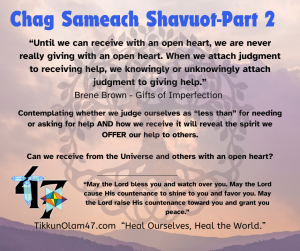
I just started a book club on “The Gifts of Imperfection” by Brene Brown. And one of my takeaways from the first chapter is this quote:
“Until we can receive with an open heart, we are never really giving with an open heart. When we attach judgment to receiving help, we knowingly or unknowingly attach judgment to giving help.”
What is fascinating about today’s portion? The Levites – the spiritual leaders – received the gifts (help) differently. The soul (Kohath) did not receive physical gifts. The body (Gershon) – received some of the gifts. Merari – which represents emotions? Received the MOST gifts. The emotional labor required to just “be”? That is where the most resources may need to go. Just a thought.
But in terms of GIVING help – we all give the same. No one’s gifts are bigger or better than another. That’s ego. And we can check our ego by contemplating how we are at receiving gifts. Because when we attach judgment to receiving (I am “less than” because I need to ask for help) then we attach judgment to giving. And that is a major lesson.
These are my thoughts today – what are yours?
Here is my commentary on the Torah portions from the past two years:
Tyler’s Torah Thoughts for 12 Sivan, 5783
As the month of June begins, and we head into a full moon this weekend, as I read today’s portion, I am struck with the theme of sovereignty.
Each tribe is given it’s due in the portion. Each tribe has it’s role. Has it’s sovereignty. They are not required to forgo their power and sovereignty to another tribe. There is order, and our values may project into the situation that somehow Judah was “better” for going first. But those are values WE bring to the passage – there is nothing there that indicates Judah had “more” sovereignty.
Bringing this to a personal level. Where is OUR sovereignty? Where is OUR power? Is it something external to us? Do we see others, including Hashem as having power and sovereignty over us?
An example of this is feelings. I hear all the time (and sometimes say myself) “That person MADE me feel sad!” or “That event MAKES me happy.”
When we say these things, we are attributing sovereignty to these external things as somehow having power over us.
As a Dallas Cowboys fan, I often find myself sad these days. “They make me sad” is something I have thought. But the REALITY is, I am sovereign over my feelings here. The Cowboys don’t “make” me sad. I choose to care about football. I choose to care about the Cowboys. I choose to care about whether they win or lose. These CHOICES I have made are more the reason of me being sad when they lose.
Now – imagine being in a relationship, even at work. “They make me angry!” Or “They make me happy to come to work!”
That is (in my opinion) giving our sovereignty away. Our feelings belong to us. There are things, events, and people who can TRIGGER an emotional response within us – but we are responsible for our own emotional regulation – because the choices we’ve made have likely led to these responses.
That is not to say events happen we had no “choice” over. Things that happen “to us.” But again, that is giving our sovereignty away. Because it is possible that these events happen “for us” and not “to us.”
And. I recognize there is wickedness in the world. And wicked things happen. Compassion and Empathy dictate we not tell anyone else “that happened ‘for you’ and not ‘to you.” Because THEY Have sovereignty on how THEY define their realities. We merely need to observe their reality, empathize with it. Have compassion and kindness, and ask “what do you need for support here? How can I help you? How can I encourage you?”
We repair OURSELVES. We do the work to see things happening “for us” and not “to us.” That is a lifetime of work. But it’s bringing the sovereignty within. And ultimately, it is Hashem’s sovereignty – through our Neshama that guides us. We aren’t asked to “give away” our sovereignty to Hashem (again. My opinion). We are asked to ACCEPT the sovereignty that already EXISTS within us.
Those are my thoughts. What about you?
Tyler’s Torah Thoughts for 10 Sivan, 5782
So wow. Yesterdays Torah thoughts continue to swirl around in my head. From sin, to making a vow, to the blessing of peace. That is the formula – we are going to sin. We are going to make mistakes. That isn’t a “give up” attitude – it’s a “even when we make the wrong decision, it’s going to be ok” kind of thought.
Ok. Into today’s portion!
The tabernacle is now complete! On the first day of the month of Nisan. Moses finished the Tabernacle, anointed it. The leaders all brought their offerings. The Torah is very specific to point out that These were the leaders of the tribes back in Egypt. These were the leaders who were present for the census.
Rabbi Schneerson wrote something beautiful about the idea of the leaders bringing offerings:
“The leaders first gave gifts to the Tabernacle on behalf of the entire Jewish community (7:1-9), before offering gifts on behalf of their own tribes. The lesson here is: If you wish God to answer your own prayers, petition God first for the needs of all your brethren before mentioning your own needs.
For this reason, Rabbi Shneur Zalman of Lyady writes that before prayer you should say, “I accept upon myself the commandment, Love your fellow as yourself” – because your personal petitions are more likely to be granted if they are prefaced with a sensitivity for the needs of others.”
So putting others first is critical! Thinking about what they need, instead of focusing on what I need is a sure way of praying for our needs!
And now we are back to learning about the descendants of Levi. After the offerings were brought, and this is how Moses divided them:
Gershon (which we’ve discussed represented physical) – received 2 wagons and four oxen.
Merari (representing emotional) received 4 wagons and 8 oxen. Emotional work required more labor.
Kohath (representing spiritual) got nothing because their work involved the holy. They were to carry it on their shoulders.
Next. The altar was dedicated. The leaders also brought offerings for the altar, but Moses didn’t accept them because God hadn’t spoken to him about this.
God then speaks to Moses and tells him – “One leader each day! One leader each day should present his offering for the dedication of the altar!”
The tribe of Judah went first. According to Kabbalah, Judah represents Malkhut – or sovereignty.
Issachar went second. Kabbalah talks about Issachar representing Torah. This teaches us (according to Kabbalah) that in order to connect with the spiritual core of Torah, we need to develop a deep inner submission of Hashem’s sovereignty.
The tribe of Zebulun went third.
The tribe of Reuben went fourth.
The tribe of Simeon went fifth.
And this is where the portion today ends.
Now. What did these leaders bring? The Torah describes in detail for each leader that they brought the same thing. Why? Why not just list the offering and then the order? Why Moses so repetitive? The Torah does this a lot. It’s not terse. It’s deep.
Nachmanides writes that this was to give equal honor to each tribe. They wouldn’t be “and the rest.” Each one gets their own honor. And that makes some good sense.
How often are we looking for shortcuts that dishonor others? Cut off their stories? Ask them to “hurry up and finish” their story? That’s something I’m chewing on from todays passage.
How about you? What are your thoughts?


No responses yet