Tyler’s Torah Thoughts for 22 Av, 5784
Parsha Re’eh – “See”: (Deuteronomy 11:26 – 16:17)
Second Portion: Deuteronomy 12:11 – 12:28
Good morning! I am thrilled to dig into today’s portion. We left off yesterday with some questions about this verse in 12:8:
12:8You shall not do as all the things that we do here this day, every man [doing] what he deems fit.
Moses and the Children of Israel were doing what they saw fit before entering the promised land. We had some questions about what this means for us – for those living outside the land of Israel today. What is OUR responsibility?
If you read my thoughts on today’s portion, I think you will find an answer. Which is pretty cool (in my opinion) that I wrote an answer to a question that had not be asked yet.
This is what I wrote:
Boundaries. Spiritual freedom and liberation doesn’t mean we are free to do whatever we want. It means we are free within the boundaries and direction our lives are headed.
In healthy relationships – respecting boundaries and having boundaries respected? The cornerstone of a healthy relationship. Requiring someone to live by OUR boundaries? That’s a problem. Freeing someone to choose to live in relationship with us – or apart from us – given our own personal boundaries? That is still freedom. It’s internal sovereignty.
Now let’s get a smidge ethereal. In a healthy relationship with Hashem – or the Universe – whatever you want to call this greater power/creator – do we respect the boundaries created by Hashem? Or do we just want to continue to live and do whatever we want with no regards for the boundaries of the Universe?
It’s a personal question that is a challenge to answer. And it doesn’t have to be a yes/no question – it is more a lifelong journey of learning what the boundaries of the Universe are – and then living freely within those boundaries.
We aren’t “free to do what we want.” We are free to do “as we see fit.” I go back to the word “fitness.” This is a word that has come up often.
What is fitness? “The quality of being suitable to fulfill a particular role or task.”
What is the role or task we want to fulfill? If we want to be in the promised land? “Doing what we see fit?” It would lead us in that direction.
We have boundaries. We have freedom. What we do with these? This is the journey we are all on. The question is how conscious are we of this journey?
Let’s dig in:
11And it will be, that the place the Lord, your God, will choose in which to establish His Name there you shall bring all that I am commanding you: Your burnt offerings, and your sacrifices, your tithes, and the separation by your hand, and the choice of vows which you will vow to the Lord.
12And you shall rejoice before the Lord, your God you and your sons and your daughters and your menservants and your maidservants, and the Levite who is within your cities, for he has no portion or inheritance with you.
When we enter the land, there will be a place to establish our connection with Hashem. Where we will bring our offerings. And? We are not living in the promised land today.
13Beware, lest you offer up your burnt offerings any place you see.
14But only in the place the Lord will choose in one of your tribes; there you shall offer up your burnt offerings, and there you shall do all that I command you.
When we enter the land? We can’t offer up our sacrifices wherever we want or see. We are not in the land yet. So, how do we navigate this? Do we pick and choose?
My take? The more we study Torah, the more we meditate and connect with Hashem? The more we will be “fit” to enter the promised land. The more we will make conscious choices on where we sacrifice. And maybe this is the lesson. Who do we sacrifice for? Where do we make our sacrifices? When?
It does sound to me? The Torah is saying to us – be mindful when we sacrifice. Be conscious. Be aware. Don’t just “do what we want” and sacrificing everywhere, anywhere, and for anyone.
This feels like an important lesson as we wind down the spiritual year.
15However, in every desire of your soul, you may slaughter and eat meat in all your cities, according to the blessing of the Lord, your God, which He gave you; the unclean and the clean may eat thereof, as of the deer, and as of the gazelle.
And? The Torah IMMEDIATELY addresses the question of desire. What if we DESIRE to sacrifice?
We can eat and slaughter meat EVERYWHERE we DESIRE to. And we can do this for the clean and unclean.
Full stop.
Sacrifice vs Desire.
If we are sacrificing? We are told here to be mindful. And choose wisely.
If we are engaging our desire? We are told here to be mindful – but trust our intuition for what we desire.
That is really interesting, isn’t it?
16However, you shall not eat the blood; you shall spill it on the ground like water.
And? There is a boundary on our desire. We can eat meat – we just can’t eat the blood.
Sacrifice vs Desire.
If we are sacrificing? We are told here to be mindful. And choose wisely.
If we are engaging our desire? We are told here to be mindful – but trust our intuition for what we desire.
Within our desires? Respect the boundaries of others.
This feels like it is going somewhere.
17You may not eat within your cities the tithe of your grain, or of your wine, or of your oil, or the firstborn of your cattle or of your sheep, or any of your vows that you will vow, or your donations, or the separation by your hand.
18But you shall eat them before the Lord, your God, in the place the Lord, your God, will choose you, your son, your daughter, your manservant, your maidservant, and the Levite who is in your cities, and you shall rejoice before the Lord, your God, in all your endeavors.
And we are now back to sacrifices. Be mindful of where we sacrifice. And? We are called to sacrifice.
19Beware, lest you forsake the Levite all your days upon your land.
And we are given a warning. Be mindful so we do NOT forsake the Levite. In all of this, those who spiritually guide us and support us? We should not forget about THEM.
20When the Lord, your God, expands your boundary, as He has spoken to you, and you say, “I will eat meat,” because your soul desires to eat meat, you may eat meat, according to every desire of your soul.
This is starting to feel cyclical. And it makes sense.
Sacrifice vs Desire.
If we are sacrificing? We are told here to be mindful. And choose wisely.
If we are engaging our desire? We are told here to be mindful – but trust our intuition for what we desire.
Within our desires? Respect the boundaries of others.
Be mindful of our sacrifice.
Don’t forget the spiritual guides on our journey and support them. They provide some accountability.
Engage your desires.
21If the place the Lord, your God, chooses to put His Name there, will be distant from you, you may slaughter of your cattle and of your sheep, which the Lord has given you, as I have commanded you, and you may eat in your cities, according to every desire of your soul.
22But as the deer and the gazelle are eaten, so may you eat them; the unclean and the clean alike may eat of them.
If the place is far from you to offer these? We can eat where we are. The Torah meets our desires where they are. He is not asking us to deny ourselves (except on certain days).
23However, be strong not to eat the blood, for the blood is the soul; and you shall not eat the soul with the flesh.
24You shall not eat it, you shall spill it on the ground, like water.
And. There are boundaries.
25You shall not eat it, in order that it be good for you, and for your children after you, when you do what is proper in the eyes of the Lord.
So with our desires? We need to respect the boundaries of others. That is good.
26However, your holy offerings which you will have, and your vows, you shall carry, and come to the place that the Lord chooses.
27And you shall make your burnt offerings the flesh and the blood upon the altar of the Lord, your God, and the blood of your sacrifices shall be poured upon the altar of the Lord, your God, and you shall eat the flesh.
And the things we do for love? For sacrifice? That has a lot more “guidelines” to it – we can’t just love and sacrifice for others without certain guidelines.
28Keep and hearken to all these words that I command you, that it may benefit you and your children after you, forever, when you do what is good and proper in the eyes of the Lord, your God.
This feels like an important passage. And here’s my takeaway:
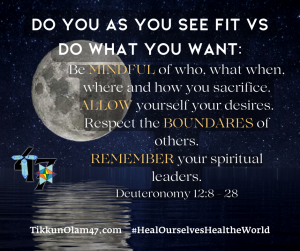
“Do as you see fit vs Do as you want”
Sacrifice vs. Desire
Key concept: To discern when to sacrifice and when to allow ourselves our desires:
-
-
- Be mindful of who, what, when, where and how we sacrifice for others.
- Allow ourselves our desires
- Respecting the boundaries of others
- Remember our spiritual leaders
- They can hold us accountable and challenge us. We should not be hiding who we are from them.
- This includes therapists!
-
What are your thoughts?
Here are my thoughts from the past two years:
Tyler’s Torah Thoughts for 20 Av, 5783
So today’s portion for me is really interesting as someone who has studied many different religions and religious texts. The connection of Deuteronomy 12:22 to the New Testament and Peter’s Dream (and how Constantine and the Council of Nicea taught this passage) is fascinating in the context of anti-semitism.
The Torah establishes – ritually impure and ritually pure people could eat together. Just because someone considered themselves “righteous” wasn’t a reason to REJECT someone else.
Those who see Peter’s dream in the New Testament as a blanket “get out of Kosher free card” really need to contend with Peter’s OWN interpretation of his dream AND the Torah passage here.
I mean Paul does write “all scripture is God Breathed and useful for teaching, rebuking, correcting and training in righteousness.”
It’s fascinating that a passage that was DESIGNED to communicate love and inclusion – all are welcome who respect our boundaries – turned into a passage of exclusion. “We are free to eat ham!” Which, given the boundaries established by the Jews would have caused Jews to not be able to sit at the table and eat with ritually impure people eating ham.
Boundaries. Spiritual freedom and liberation doesn’t mean we are free to do whatever we want. It means we are free within the boundaries and direction our lives are headed.
In healthy relationships – respecting boundaries and having boundaries respected? The cornerstone of a healthy relationship. Requiring someone to live by OUR boundaries? That’s a problem. Freeing someone to choose to live in relationship with us – or apart from us – given our own personal boundaries? That is still freedom. It’s internal sovereignty.
Now let’s get a smidge ethereal. In a healthy relationship with Hashem – or the Universe – whatever you want to call this greater power/creator – do we respect the boundaries created by Hashem? Or do we just want to continue to live and do whatever we want with no regards for the boundaries of the Universe?
It’s a personal question that is a challenge to answer. And it doesn’t have to be a yes/no question – it is more a lifelong journey of learning what the boundaries of the Universe are – and then living freely within those boundaries.
Because our story as Jews? We were slaves in the Egypt. We wandered the wilderness free. And what did we do with that freedom? We created the Golden Calf. We rejected our freedom. And. We were given the Torah – not to enslave us – but to give us direction and purpose – a way to wield the freedom we are given in a manner that heals the world. Not controls it.
Those are my thoughts. What are yours?
Tyler’s Torah Thoughts for 25 Av, 5782 (posted on 26 Av)
Sorry to post this so late. I was in Facebook jail for making a joke in a group. It was worth it to be honest as sometimes you need to push the envelope. But alas. If it is going to squash my ability to post Torah thoughts, then I need to keep that in mind.
Let’s dig in.
Moses is continuing his last lecture. He just finished telling us about the journey into the promised land. He got to the place we would find rest.
Moses starts by telling us – time in the promised land will have conflict. But when the rest comes, we will establish the Temple there.
Once that temple is established, that is where Hashem will rest and that is where we will bring our offerings.
I’m reflecting on whether this temple is within us. Certainly, there is an outward temple. But right now as we journey inward, where in our hearts do we bring our offerings of peace? Our tithes (self care anyone?) our first fruits (things we create as artists?)
Do we even offer our temples these offerings? Do we love our hearts? Do we give of ourselves compassion?
And Moses warns us not to offer these things just anywhere – but to trust Hashem will show us when and where to offer these up. This reinforces the notion that even in the promised land, there will be boundaries.
Then Moses says something interesting about our offerings:
If a blemish develops in an offering and you desire with all your soul to eat it’s meat, here’s what you do:
Now before get into this, I want to stop and consider, maybe the blemish is a result of past trauma? Past woundedness? We know the offering is for our best, but we can’t let go of the trauma.
Moses prescribed what to do, and it’s interesting:
- We can slaughter the offering in any place and eat it’s meat in all our cities because Hashem is giving it to us as a blessing. But we may not use its fleece or milk.
- We can only slaughter it if it is a permanent blemish that will not heal.
Interesting – there may be traumas in our life that won’t heal. They are permanent – but we need to explore their healing first. If we have not attempted to explore the trauma (a.k.a blemish) then we seem to have a responsibility to look at the trauma to see if it will heal.
Ok, Moses continues with which offerings cannot be given in our own cities and which need to be brought to the temple in Jerusalem:
- Grain, oil, wine tithes.
- The firstborn of cattle and sheep
- Vow offerings
- Pledge offerings
- First fruits
I’m chewing on this (pun intended) – why do these need to be brought to God? It also seems like maybe these are the offerings that are external? Maybe some offerings are designed for us internally within our hearts? In our relationship with ourselves? Some offerings are meant to be shared outwardly?
Pledges, vows, and first fruits makes some sense here. If Hashem has blessed us with something spiritual – like an epiphany – the first fruits of that epiphany should be given to Hashem- that may mean publishing it for others to read, sharing it at a place of worship? What fruits internally could you share? What are things you are learning that Hashem has asked you to make more external?
When it comes to vows and pledges, it would also make sense to share them outward for accountability.
Ok. Next Moses is telling us about eating non-sacrificial meat. Moses said our souls will crave meat, and because of this we can eat as much meat as our soul desires. If our soul does NOT desire to eat meat, it would seem we aren’t required to eat it. It is about listening to our soul. And Moses tells us; if God brings us to a place that is far from us, and we cannot bring the peace offerings every day, we can eat from our cattle and sheep. But we must first slaughter them as Hashem commanded in the oral law.
Now; he says something REALLY fascinating – especially for those of you who identify as Christian and are familiar with Peter’s dream about food, that he interpreted as being really about people.
He says – you can eat the meat as you would eat a deer or gazelle. Meaning, a ritually import person may eat with a ritually pure person. However, unlike the deer and gazelle. Sacrificial brats are not permitted.
So Peter’s dream? Not so revolutionary. It’s actually from the Torah and it connected the Pharisees to the idea that when they refused to eat with gentiles? That wasn’t from the Torah. That’s what Peter interpreted; anyone has access to Hashem. That wasn’t blanket permission to eat ham. It was that “ham eaters” could eat with “kosher keepers” and fellowship together.
Moses gives us another limit: don’t eat the blood. The blood is the soul and we may not eat the soul with the flesh.
Now let’s consider this. Why is the blood being the soul something worth chewing on?
Because the soul is infused throughout our entire bodies. The heart isn’t the soul; it pumps the soul. If we are a soul, encased in a body; remove the blood, and the body dies. We can remove a heart – heart transplants happen. The heart is the pump of the soul. But it would seem to Indicate it isn’t the soul itself.
What are your thoughts on this?


No responses yet