Tyler’s Torah Thoughts for 14 Iyar, 5785
The Second Passover
The 29th Day of the Omer
Good morning! As we come to the full moon tonight, we are reminded that we are shining with forgiveness, mercy, and grace. Hashem is indeed the God of second chances. Today is the quintessential day to remember this.
Tonight marks the “Second Passover” a reminder for those who were not in a place to celebrate Passover, they can do it now. It is never too late! Chabad does a great job explaining it here: Chabad second passover.
This falls BEAUTIFULLY in line with our theme this week, and today. We start a new theme of the Omer; Humility. It can also mean surrender. The second chance of passover? Falls in line with the humility we are called on to receive into our hearts. This is what I posted last year in regards to humility:
Humility is modesty; it is acknowledgement (from the root “hoda’ah”). It is saying “thank you” to G‑d. It is clearly recognizing your qualities and strengths and acknowledging that they are not your own; they were given to you by G‑d for a higher purpose than just satisfying your own needs. Humility is modesty; it is recognizing how small you are which allows you to realize how large you can become. And that makes humility so formidable.
Humility is sensitivity; it is healthy shame out of recognition that you can be better than you are and that you expect more of yourself. Although humility is silent it is not a void. It is a dynamic expression of life that includes all seven qualities of love, discipline, compassion, endurance, humility, bonding and sovereignty. Humility is active not passive. Not a state of being but an interaction even in its calm and inaction.
The two basic concepts of humility are modesty and sensitivity. This is not believing we are “less than” others – that would be false modesty and false sensitivity. It is recognizing that the soul of Hashem is in each of us. We are all experiencing different journeys on this earth – in our “meat sacks” of bodies (love that image). When we see someone else – there is a separation because of our bodies – while at the same time? We are united. Because the soul in someone else’s body, is our soul.
Sit with that. That is humility. That is sensitivity. When we are looking at someone? We are looking at a mirror of ourselves. We are asked to TRUST that if our soul was in THEIR meat sack? We would have arrived to this moment with them having made similar decisions. There is no other alternative explanation.
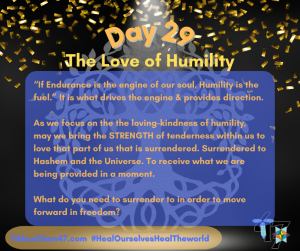 Today? We focus on the first dimension of humility – the LOVE of Humility. How can we receive that the person we connect with today is a version of us and provide them love and kindness on their journey?
This is the question for us today.
Who do you need to give a second chance to? Maybe it is the person within?
Either way – let’s be reminded this week – we are all one.
Here are my thoughts from last year:
What an amazing day. SO MANY things shifting.
First. Today is the “Second Passover.” It is the day of Second Chances. Here is a great primer on the Holy Day from Chabad
Today we get a second chance to restore our relationship within ourselves. And to reconnect with others. Today is ANOTHER Day of freedom. We do not have to be stuck where we were. We can move forward.
Second. Today is Day 29 of the Omer. Which means we enter the fifth week of the Omer.
This week, our theme is – Hod – which means “surrender.” It means “Humility.” From Chabad:
If endurance is the engine of life, humility is its fuel. As gevurah (discipline) gives chesed (love) focus, hod gives netzach direction.
Humility is the silent partner of endurance. Its strength is in its silence. Its splendor in its repose. Humility leads to yielding, which is an essential element of Humility – and the resulting yielding – should not be confused with weakness and lack of self-esteem.
Humility is modesty; it is acknowledgement (from the root “hoda’ah”). It is saying “thank you” to G‑d. It is clearly recognizing your qualities and strengths and acknowledging that they are not your own; they were given to you by G‑d for a higher purpose than just satisfying your own needs. Humility is modesty; it is recognizing how small you are which allows you to realize how large you can become. And that makes humility so formidable.
Endurance draws its energy from the acknowledgement of humility. Human endurance goes only as far as your tolerance level. Acknowledging that your strengths come from a higher place gives you the power to endure far beyond your own perceived capacity. It gives you part of G‑d’s enduring strength.
A full cup cannot be filled. When you’re filled with yourself and your needs, “I and nothing else”, there is no room for more. When you “empty” yourself before something which is greater than yourself, you allow in much more than your limited capacity. Humility is the key to transcendence; to reach beyond yourself. Only true humility gives you the power of total objectivity.
Humility is sensitivity; it is healthy shame out of recognition that you can be better than you are and that you expect more of yourself. Although humility is silent it is not a void. It is a dynamic expression of life that includes all seven qualities of love, discipline, compassion, endurance, humility, bonding and sovereignty. Humility is active not passive. Not a state of being but an interaction even in its calm and inaction.
To me, all of this means that Surrender is the Direction of Victory. Humility is the Direction of Endurance. I once asked a spiritual coach – how can surrender and victory work together? They seem like polar opposites. She replied – it is all within us.
We must surrender within to see victory within. This is the theme this week. What do we need to surrender this week, given our second chance with the second Passover?
Today, we look at specifically, the Chesed of Hod – the Loving-Kindness of Humility. From Chabad:
Examine the love in your humility. Healthy humility is not demoralizing; it brings love and joy not fear. Humility that lacks love has to be reexamined for its authenticity. Sometimes humility can be confused with low self-esteem, which would cause it to be unloving.
Humility brings love because it gives you the ability to rise above yourself and love another. Arrogance in the guise of love means loving yourself, or what is even worse: making others a part and an extension of yourself and your self-love.
Does my humility cause me to be more loving and giving? More expansive? Or does it inhibit and constrain me? Am I humble and happy or humble and miserable?
Exercise for the day: Before praying with humility and acknowledgment of G‑d, give some charity. It will enhance your prayers.


No responses yet