Tyler’s Torah Thoughts for 5 Kislev, 5784
Parsha Toledot: (Genesis 25:19- 28:9)
Seventh Portion: Genesis 28:5 – 28:9
Shabbat Shalom! We finish this parsha “Descendants” in an interesting fashion. Last week, we focused on the life of Sarah which was everything that came after. The life of Sarah ended with Abraham’s death. Descendants ends with Isaac sending away Jacob and Esau walking away from Isaac.
Think about this. Isaac was a miracle child. Hashem provided the egg in Sarah. And Isaac doesn’t get much space in the Torah. Really one Parsha.
We are descendants. We have a choice. What is interesting here – Esau and Jacob do not remain with Isaac. They are required to move. To leave. One leaves on their own – a rejection of their father and mother. The other leaves because dad and mom sent them away.
Both are being influenced by their mother and father.
I am in the place to continue relating to Esau. How much do we rebel against our parents, not realizing by rebelling, we allow them influence and control of our decision making all the while convincing ourselves we are our own person? Let’s dig in:
5And Isaac sent Jacob, and he went to Padan aram, to Laban the son of Bethuel the Aramean, the brother of Rebecca, the mother of Jacob and Esau.
So Jacob leaves. Jacob listened to Isaac. Trusted him. He went to Uncle Laban’s place. What happens to Esau?
6And Esau saw that Isaac had blessed Jacob and sent him away to Padan aram, to take himself a wife from there, and that when he blessed him, he commanded him, saying, “You shall not take a wife of the daughters of Canaan.”
7And Jacob listened to his father and his mother, and he went to Padan aram.
Remembering the message and blessing Isaac gave Esau – the way forward was grief. Grief removes the yoke from our necks. Esau wasn’t ready to grieve. Here’s what he did:
8And Esau saw that the daughters of Canaan were displeasing to his father Isaac.
9So Esau went to Ishmael, and he took Mahalath, the daughter of Ishmael, the son of Abraham, the sister of Nebaioth, in addition to his other wives as a wife.
Let me break this down. BECAUSE the daughters were displeasing to his dad, he took a wife that would be displeasing.
This act of rebellion gave Isaac power in Esau’s life. He couldn’t even see it. The energy; the anger; it was driving Esau. Esau made the decision – at least in THAT moment – that his life was going to be dedicated to making decisions specifically to hurt his father. The engine of Esau’s life was still being driven by Isaac. Esau could convince himself it wasn’t – because he was making “free choices” to disobey. But this is really a mirage.
We’ve been studying trauma this week. How does trauma impact us. The children of trauma. The initial instinct when facing trauma in our life is to run away from it or fight it. But “it” is still the focal point of our life – it is the central power navigating our systems within.
I read this morning something from the “Book of Awakening” by Mark Nepo for tomorrow. I think it gets to the heart of the matter here:
NOVEMBER 19
That Feminine Thread
In how you have come
is the secret
to how you must go.
In Greek mythology, there is a story of a man, Theseus, who in order to find his way home, had to find his way through a labyrinth that led him to a dark center, where he had to kill a powerful beast, a Minotaur. The only way he could return to the light of daily life was to trace back the thread he had unraveled on his way in, which was given him by a kind woman, Ariadne.
Stories like this carry wisdom we must encounter if we are to become whole.
Each of us has a beast at center which we must confront if we are to live peacefully in our days. But like Theseus, making our way back into the light is only possible if we retrace with kindness and love our dark way in.
This is how after years of feeling mistreated, I can find myself mistreating others and, suddenly, I feel humbled.
This is how in giving myself away to be loved, I finally, after years, arrive at the dark loveless center of that way, and the only way out is to follow the small thread of accepting who I am until it leads me back to where I began, except this time I weep to know my place in the world.
For Esau; we see the Genesis (pun intended) of the Minotaur within. Isaac is the Minotaur living within Esau – driving Esau’s actions. Esau isn’t even aware of it.
What about us? Who are the Minotaurs within we need to confront? That we’ve blocked out; avoided? For me? For a long time? It was an image of my mother and father. A lot of my decisions in life were generated as a reaction to their influence from the past. I was reacting to the current moment with energy and emotion from my past. They were still driving the boat with me.
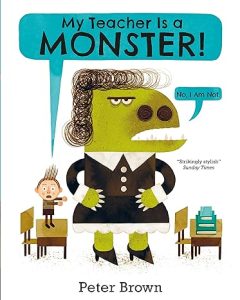 On Thursday, I had dinner with my 5 year old, 8 year old, and 16 year old. At dinner, the five year old had me read a book from school that has now codified this lesson for me. It is called “My Teacher is a Monster” by Peter Brown.
The idea of the book is the protagonist sees his teacher as a monster. It’s a perception. And one weekend, he ran into the “monster” in a park. He began a journey of connection to the monster, and we see the “Monster” become human through the pictures and stories between the two. By the end of the book, the teacher isn’t a monster – she’s human.
However, in a twist ending – the final question was “Is Miss Kirby still a monster?” And as you turn the page, Robert did something he wasn’t supposed to and she was once again a monster.
The takeaway here is we are all human. We are Esau. We are Jacob. It’s not either/or. It’s both/and. We are monsters. We are human. We have moments our monster comes out. We have moments are human is out.
Why do I share this story with you? Because MY teacher is a monster. My mom. My dad. They are no longer here. And from the ages of 8 until about 50, I saw them as monsters. The past two years, I have begun to get to know them more – and my relationship with them. And they have become much more human to me. I see their good. I see their humanity and struggles. They taught me. The question is WHAT did they teach me? What are they teaching me?
My teacher is a monster. No they are not. We have a choice. Learn from our trauma – or run from it. Fight it. Grow from our trauma. Or be afraid of it.
Our Trauma is not a monster. And it is. We can get to know it – see the humanity of it – or we can fight it. Run from it.
Healing is seeing our teacher (Trauma) as human and not a monster. THIS is the takeaway (in my opinion) of Toledot. Descendents.
Because. Spoiler alert? How we relate to the teacher? That is what we will pass on to our kids. Will they see US as a monster? Or will they see US as human? How we relate to the teacher will train others on how to relate to the teacher.
And. One more spoiler alert? The teacher is Hashem. The Universe. God. Love. Choose your terms. That’s freedom. That’s liberation!
What are your thoughts?
Here is my commentary from the past two years:
Tyler’s Torah Thoughts for Kislev 2, 5783
Todays portion is very short. As Toledot comes to a close, we see Esau marrying a daughter of Ishmael.
The thoughts a year ago are salient. The idea of “playing it safe” when promoting ourselves as righteous is really something I’m chewing on.
Where is the line of being “self-righteous” and “promoting ourselves as righteous” when we are trying to live authentic lives around a spiritual connection with Hashem?
This seems like a quandary. When we live in a world with people who don’t care about their relationship with Hashem, caring about our relationship kind of stands out. We aren’t perfect (we aren’t called to be) – but as we strive for closeness with Hashem, others may interpret that as promoting ourselves as righteous.
This is where I’ve landed over the past year. We cannot worry about the external judgment of others. We must focus internally on ourselves. Are we living authentic lives? That is the key.
We must lift the “veil of righteousness” to live our true selves out in to the world.
May that be the intention for the month ahead. And May that be from a place of internal harmony.
Tyler’s Torah thoughts for Kislev 2, 5782.
This weeks portion ends with Isaac sending Jacob away (after being pushed by Rebekah to do so). Jacob leaves and heads to Paddan-aram- to Laban’s house, who is the nephew of Rebekah (Laban’s dad was the brother of Rebekah). This makes Jacob and Laban cousins, right?
Esau’s jealousy rages. And the portion ends with him openly going against what his father wants (he heard Isaac tell Jacob not to take a wife from the daughters of Canaan). Esau goes to uncle Ish (Ishmael) and marries Mahalath (his cousin) – and added her to his “collection” of wives.
Why? Why was this the way for Esau to get back at Isaac (and Jacob). It doesn’t seem to make sense.
Rabbi Schneerson writes; “Earlier, we read of Esau’s deceptive acts towards his father, climaxing here at the end of the Torah portion, where he marries one of Ishmael’s daughters to appear righteous in Isaac’s eyes. However, just as he married his first wives in an attempt to appear righteous (see verse 26:34 – where Esau marries Judith), so too here, ‘he added wickedness upon wickedness,’ marrying once again to maintain his deceptive veil of righteousness – this time to a member of Abraham’s family.
So the Torah’s description of Esau, at the end of the Torah portion, comes to alert us to the moral corruption exemplified by Esau. We are warned to steer clear of this lowly activity: promoting ourselves as righteous while the truth is something very different indeed.”
So this has me chewing on ways I have promoted myself as righteous while really knowing how I struggle to live my life the way i desire. My initial thought is to play it safe; avoid ever promoting myself as righteous!
What are your thoughts? See comments below for this weeks Haftorah portion.
Todays Haftorah comes from Malachi 1:1- 2:7.
This passage begins with Hashem declaring (through Malachi) that the story of Jacob and Esau is evidence of Hashem’s love directly for us. Hashem doesn’t just love us because of the Patriarchs and Matriarchs. He doesn’t say to us; “Well, your great great great great great…..great Grandfather and Grandmother were righteous, and I made a promise to them, so I have to love you.” No!!!
If this were the case, Esau would have received more love because of Abraham and Isaac. It’s an interesting proof. Remember, this is a prophecy to Israel. Hashem is declaring he loves us; not because of our parents merit, but because of us! That is a really cool thought. He knows US and loves US because of US.
Now; we have to understand some context here. Malachi was speaking to Israel after they had betrayed Hashem in many different ways – specifically sacrificial service, honoring Hashem less than idol-worshiping nations, slandering the altar, and offering low quality animals to the temple. But even after ALL OF THAT, Malachi’s message is that Hashem STILL loves us.
Hashem is giving Israel another chance; basically saying if they don’t turn around, Hashem is going to release a curse upon them ; and turn the blessings into curses! Malachi tells them; “you are already suffering from being cursed by and for you do not take it to heart to be careful about My honor.” He then tells the people their seeds won’t grow, dung will be blown into our faces like the dung of our sacrifices. We will be disgraced.
And if we grumble as to “why?” Why do we need to do all of this? What if we don’t want to? Although we are not owed an explanation, we are given one out of love; “I sent you this commandment of honoring My sacrifices in order for you to be REWARDED (emphasis mine) from My covenant with Aaron….My covenant was with him and it brought him life and peace.”
I reflect on this as a father. How often I want what is best for the kids; and ask them to do things they don’t want to do because it’s in their best interests; I believe it will bring them life and peace later on; and how often they resist. And yet, my love for them continues. This is a reflecting of the love Hashem has for us! Even when we resist Him, He cares! That’s amazing!


No responses yet