Tyler’s Torah Thoughts for 30 Nisan, 5784 –Day 15 of Omer
Parsha Kedoshim – “Holy” (Leviticus 19:1 – 20:27)
Fourth Portion: Leviticus 19:33 – 19:37
Good morning! Tonight is Rosh Chodesh Iyar! As I shared yesterday, Iyar is an AMAZING month. We have so many special days coming up.
- Each day counts because we count the Omer EVERY day of Iyar.
- In addition, we have the second Passover on the 14th day of Iyar. It is a tremendous “second chance” at making the year count.
- We also have a Holy Day – Lag B’Omer (33rd Day of counting the Omer on the 18th of Iyar) – the Day of My Joy – we light fires to kindle our spirits!
So many BEAUTIFUL things coming our way this month. It is a time of healing. So let’s make each moment COUNT!
Speaking of counting – we are on Day 15 of the Omer. We are entering our third week of counting. This week’s theme is “Tiferet” or compasison.
From Chabad:
Tiferet – compassion – blends and harmonizes the free outpouring love of chesed with the discipline of gevurah. Tiferet possesses this power by introducing a third dimension – the dimension of truth, which is neither love or discipline and therefore can integrate the two.
Truth is accessed through selflessness: rising above your ego and your predispositions, enables you to realize truth. A clear and objective picture of yours and others needs. The imbalance of love and discipline (and for that matter, any distortion) is a result of a subjective, hence limited perspective; introducing truth, by suspending personal prejudices, allows you to express your feelings (including the synthesis of chesed and gevurah) in the healthiest manner.
This quality gives tiferet its name, which means beauty: it blends the differing colors of love and discipline, and this harmony makes it beautiful. For tiferet to be complete it needs the inclusion of the following seven facets: love of compassion, discipline of compassion, compassion of compassion, endurance of compassion, humility of compassion, bonding of compassion and sovereignty of compassion.
This is the harmony of loving kindness and strength. It is the integration of these energies and it is BEAUTIFUL. What a way to start the new moon – and integration of kindness and strength; of love and discipline – in COMPASISON.
Today, we are looking at the love aspect of compassion.
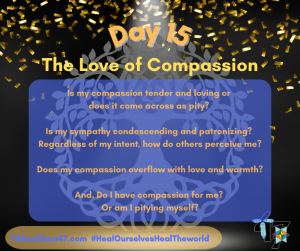 From Chabad:
Ask yourself: Is my compassion tender and loving or does it come across as pity? Is my sympathy condescending and patronizing? Even if my intention is otherwise, do others perceive it as such? Does my compassion overflow with love and warmth; is it expressed with enthusiasm, or is it static and lifeless?
Exercise for the day: When helping someone extend yourself in the fullest way; offer a smile or a loving gesture.
I love the idea of focusing tenderness (as opposed to pity). This is an important aspect of loving kindness and compassion. Compassion from a place of putting ourselves above someone else isn’t truly love.
And? Do we have compassion and tenderness for ourselves? Or do we sit in our own pity?
Let’s dig in:
33When a stranger sojourns with you in your land, you shall not taunt him.
34The stranger who sojourns with you shall be as a native from among you, and you shall love him as yourself; for you were strangers in the land of Egypt. I am the Lord, your God.
Full stop.
We are to have compassion for those who live with us who may be from here. Why? Because we were strangers in Egypt.
How we treat others matters to Hashem. I might argue this is a significant outpouring of our love. How we treat “the other.” Do we see others as being human? Or do we dehumanize the other because they are not us?
We should not taunt the stranger. What is taunting? The definition is quite simple – “a remark made in order to anger, wound, or provoke someone.”
Where are we taunting others?
More importantly? Where do we taunt ourselves? When I think about how I speak about me sometimes – especially in the past – where was my language taunting to my inner self? “I was stupid” or “I am an idiot” or “I am so unhealthy a toxic.” Why do we say these things to ourselves? Why do we taunt ourselves?
If we are to treat the stranger in a way that is kind and compassionate? We should be treating ourselves in the same way.
Let’s keep going:
35You shall not commit a perversion of justice with measures, weights, or liquid measures.
36You shall have true scales, true weights, a true ephah, and a true hin. I am the Lord, your God, Who brought you out of the land of Egypt.
37You shall observe all My statutes and all My ordinances, and fulfill them. I am the Lord.
We are called to measure carefully and honestly. And? What do we use to measure our own hearts? Do we use a perversion of justice where we set measures we cannot achieve to get a poor result? Or do we measure honestly? From a place of humanity? From a place of compassion? Empathy? Kindness?
Something to reflect on this morning as we focus this week on compassion.
Here are my thoughts from two years ago:
Tyler’s Torah Thoughts for 3 Iyar, 5782
Today is a very short passage; more on Honesty and Respect:
We start by discussing converts.
I get this question a lot in my DMs; for a non-Jew, Is converting to Judaism possible? Given that it is a bloodline (and based off Matrilineal lineage) how do you “convert?”
Today, there are a lot of options; and really (like all things Jewish) the answer is “it depends.” To convert within Reform Judaism is a much different process than converting to Orthodox Judaism. But, one thing is clear; conversion is an option.
The Torah teaches us today that we should NOT verbally harass converts by reminding them of their past. The converts who live with us (as Jews) should he considered to be native Jews. We are to love converts as we love ourselves! (Verse 19:33-34).
And WHY should we do this? Because the Torah tells us; “Because you too were once strangers in the land of Egypt. Just as I am your God, I am his God too.”
God is God. He doesn’t belong just to us – He aligns himself with all. This is a very comforting message!
Next, we talk about perversion of Justice with false measures, weights, or liquid measures. Our scales should be accurate.
There’s a lot written about this verse:
Maimonides writes:
“If you deny the precept of accurate measures, it is as if you denied the exodus from Egypt, which was the beginning of the Torah’s commandments.”
Rabbi Vidal Yom Tov writes:
“By sinning surreptitiously, a person who possesses inaccurate measures disregards God’s supervision of all the details of this world. He is thus denying the exodus from Egypt, and its associated miracles, which proved God’s providential care and direct involvement.
And finally, Rabbi Schneerson sums this up beautifully;
“The Egyptian persecution of the Jewish people was done under a pretense. They appeared to be following God’s will, for God had decreed, “They will enslave them and oppress them’ (Genesis 15:13). In truth, however, the Egyptians were carrying out an act of wickedness, for they chose to harm the Jewish people. They were not carrying out God’s will at all, for if the Egyptians had chosen not to harm the Jewish people, God would have found another way to carry out His decree.
This subterfuge, of appearing to be righteous while at the same time carrying out an act of wickedness, resembles the sin of having false weights and measures, as the use of false measures is an attempt to “dress up an act of theft as an act of honesty.
Therefore, “If you deny the precept of accurate measures, it is as if you denied the exodus from Egypt,” since the Exodus freed us from the dishonest subterfuge which was typified by the Egyptian people.”
That’s a really great point!
Todays portion once closes with once again reminding us that we are to observe Hashem’s suprarational commands and rational ones. Hashem knows some of the commands won’t make sense to us. But we are to connect with Him anyway!
Interesting reading today. What are your thoughts?


No responses yet