Tyler’s Torah Thoughts for 1 Iyar, 5784 –Day 16 of Omer
Parsha Kedoshim – “Holy” (Leviticus 19:1 – 20:27)
Fifth Portion: Leviticus 20:1 – 20:7
Good morning! It is the First Day of the Month of Iyar! It is time for healing! We have been reborn, we are new – and now it is time to heal. One of the themes right now is moving from complexity to simplicity. How can we get out of our heads, and into our hearts for healing? This is the question for the cycle ahead.
Today is also the 16th Day of the Omer. Today’s theme is “The Discipline of Compassion.” From Chabad;
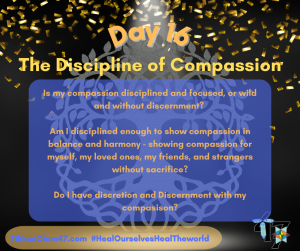 For compassion to be effective and healthy it needs to be disciplined and focused. It requires discretion both to whom you express compassion, and in the measure of the compassion itself. It is recognizing when compassion should be expressed and when it should be withheld or limited.
Discipline in compassion is knowing that being truly compassionate sometimes requires withholding compassion. Because compassion is not an expression of the bestower’s needs but a response to the recipient’s needs.
Am I more compassionate with strangers than with close ones? If yes, why? Is the compassion coming from guilt? Does my compassion for others compromise my own needs? Am I helping others at the expense of helping myself?
Perhaps the contrary is the case: Does my compassion for my family and close ones overshadow others needs? Is my compassion impulsive and careless? Do I assess the measure of compassion necessary for a given situation? Is it commensurate with the recipient’s needs? Can I possibly be hurting him with my compassion? Does my compassion overwhelm others? Is it respectful? Do I give too much or too little? Do others take advantage of my compassionate nature? When I see a needy person do I impetuously express compassion out of guilt or pity without any discretion? Do I commit the “crime” of compassion by helping him with something harmful (give him money to buy a harmful substance etc.)? Do I apply myself to determine this person’s needs and help him in the best way possible?
Exercise for the day: Express your compassion in a focused and constructive manner by addressing someone’s specific needs.
This is interesting right? How often do we feel “guilty” in our compassion? How are we discerning where to place our compassion – and how to we balance our compassion? If we rank our compassion – where would these people fall:
- Strangers
- Acquaintances
- Friends
- Family
- Loved Ones
- OURSELVES
I don’t know about you, but being disciplined to show compassion for myself is a big one.
I love the word “discretion” here. I think discernment is another word. How can we be compassionate and still protect our space and boundaries!
With this, let’s dig into today’s portion:
1And the Lord spoke to Moses, saying,
2And to the children of Israel, you shall say: Any man of the children of Israel or of the strangers who sojourn among Israel, who gives any of his offspring to Molech, shall surely be put to death; the people of the land shall pelt him with stones.
3And I will set My attention upon that man, and I will cut him off from amidst his people, because he gave of his offspring to Molech in order to defile My holy ones and to profane My holy Name.
The idea here is that sacrifice was good, but we should NOT be sacrificing our offspring. Again, where is our compassion. If we are compassionate towards strangers, but show no compassion for our own children? That is a major problem.
4But if the people of the land ignore that man when he gives of his offspring to Molech, not putting him to death
5I will set My attention upon that man, and upon his family, and I will cut him off, and all who stray after him to stray after Molech, from amidst their people.
So not only those who sacrifice their offspring, but for the community who stands by in silence.
Justice is a very concept in the Torah.
6And the person who turns to Ov or Yid’oni, to stray after them I will set My attention upon that person, and I will cut him off from amidst his people.
This is interesting -what is Ov or Yid’oni?
Simply put? According to Chabad, it is “a form of idolatry, in which the person takes a bone from the bird called yadu’a, places it in his mouth, burns incense, utters certain words, and performs certain actions, until he reaches a state similar to unconsciousness, when he goes into a deep sleep and predicts the future.”
That is fascinating.
7You shall sanctify yourselves and be holy, for I am the Lord, your God.
The key here is that the Torah is calling us to set apart. To distinguish ourselves from the people around us.
What are your thoughts?
Here are my thoughts from two years ago:
Tyler’s Torah Thoughts for 4 Iyar, 5782
Good morning! Today is the 19th day of counting the Omer. In this third week of counting the Omer, compassion is the theme. One of the reflective pieces for me in compassion is not just compassion for others; but compassion for ourselves on our journeys.
I read this quote in my journal from a year ago:
“Each Day is a Journey. And the Journey itself is Home” – Basho
Craig Bidiman once painted me a canvas with this quote on it; and it was really impactful then. It’s even more impactful now.
The journey I’m on is not just home; the journey I’m on is going home as I plan to go to my 30th High School reunion (Westtown) twice removed (thanks COVID) next weekend. It is an odd thing to reflect on my journey so far; and to see the expansion of my life all the way to Chico, CA, and now bringing me back to the East coast, and eventually home to Westtown.
SPOILER WARNING: Vulnerability coming your way…
Westtown is where I went after my father passed when I was 15. My mom and I weren’t getting along (to put it mildly) and so going to a boarding school for my Junior and Senior year of High School was a way to keep both of us safe.
I’ve long been embarrassed about who I was those two years. But some of the people who were important to me during that time have reminded me – all of us were going through some really rough things as kids. The conversations have been a big part of my healing journey.
I’m excited to return home next week. To see the house I grew up in. To go to the synagogue I attended as a child (the synagogue is celebrating their 100th anniversary this year). To visit the graves of my parents. To spend time with people who were pivotal during some really rough years for me.
This is the landscape this morning as I dig into this portion of the Torah:
Today we learn about the consequences for breaking the mitzvahs – either not doing the mitzvahs – or doing the opposite.
God speaks to Moses and tells him to tell us (the children of Israel):
If anyone (converts or native born) gives any children in worship of the pagan deity of Molech should be put to death by the court. If the courts don’t have the authority, the public should assist by pelting him to death with stones.
Stop. Wow. Why was the punishment so harsh?
This was interesting:
Rabbi Samson Raphael Hirsch writes:
“Molech was worshiped by handing over a child to the priests who would pass the child through a fire. The worship was based on a heathen belief that fate rules the world. It is not that they gave their children over to idol-worship, abandoning the service of God; they saw themselves as giving up their most precious possession–their children-to the “decree of fate.”
Not only did this slander God, it violated the holiness of children who are God’s assets. It was a denial that a child is meant to blossom under God’s providence.”
This is why the punishment was so harsh!
But Hashem was still merciful. To the people and the courts. It seems as if He is providing for the possibility the public won’t be able to deal with it. He tells us;
“I will devote My time away from all My affairs and deal with this man individually and I will cut him off from his people even if he gave his grandson to Molech.”
And then the Torah goes further:
“If the public ignores that man, when he gives even his illegitimate offspring to Molech, not putting him to death, then I will devote My time with this man and his family. But I will only cut him off, and all who follow after him to go astray after Molech, from among the people, but I will not cut off his family too.”
I’ll confess – this passage is hitting me differently as it seems Hashem is bringing me “back” to “my people.” There is comfort knowing that I am reconnecting with the people of my past, who I cut myself off from. This passage encourages me that I’m on the right track.
So – there you have it. A little personal today in my Torah thoughts. Would love to know your thoughts on the passage and how you connect with it!!!


No responses yet