Tyler’s Torah Thoughts for 10 Iyar, 5784 –Day 25 of Omer
Parsha ‘Emor – “Speak” (Leviticus 21:1 – 24:23)
Seventh Portion: Leviticus 24:1 – 24:23
Shabbat Shalom! As we finish the Parsha of the week, let’s focus on the 25th Day of the Omer. We have now crossed the half-way mark of counting up to 49 days of the Omer. Today is an AMAZING day of the Omer. Our theme? Victory of Victory. Endurance of Endurance. From Chabad:
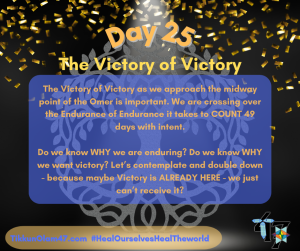 Examine the endurance aspect of endurance, its expression and intensity. Everyone has willpower and determination. We have the capacity to endure much more than we can imagine, and to prevail under the most trying of circumstances.
Ask yourself: Is my behavior erratic? Am I inconsistent and unreliable? Since I have will and determination, why am I so mercurial? Am I afraid of accessing my endurance and committing? Do I fear being trapped by my commitment? If yes, why? Is it a reaction to some past trauma? Instead of cultivating endurance in healthy areas, have I developed a capacity for endurance of unhealthy experiences? Do I endure more pain than pleasure? Do I underestimate my capacity to endure?
Exercise for the day: Commit yourself to developing a new good habit.
Today’s theme is really focusing on WHY we are Enduring. WHY do we want Victory? WHAT does Victory look like to us? Is that something we can envision, or is it more abstract? Can we make the “why” we are enduring more concrete? Can we receive from the Universe full Victory?
Let’s dig into the portion today:
24:1And the Lord spoke to Moses, saying,
2Command the children of Israel, and they shall take to you pure olive oil, crushed for lighting, to kindle the lamps continually.
3Outside the dividing curtain of the testimony in the Tent of Meeting, Aaron shall set it up before the Lord from evening to morning continually. [This shall be] an eternal statute for your generations.
4Upon the pure menorah, he shall set up the lamps, before the Lord, continually.
We are setting up the eternal flame. I envision this being within us. We have within us a light that can never be extinguished. As a Child of Israel, this light won’t go out.
5And you shall take fine flour and bake it [into] twelve loaves. Each loaf shall be [made from] two tenths [of an ephah of flour].
6And you place them in two stacks, six in each stack, upon the pure table, before the Lord.
Next we have the loaves. 12 of them. We have within us the nourishment to provide unlimited sustenance.
7And you shall place pure frankincense alongside each stack, and it shall be a reminder for the bread, a fire offering to the Lord.
And Incense. A reminder of our sweet aroma. Eternally.
Light.
Sustenance.
Aroma.
This is a self assessment worth having. How is my light? Dim or Bright? Am I sustaining? Do I feel full or empty? How is my smell to others? Am I sweet or stinky?
8Each and every Sabbath day, he shall set it up before the Lord [to be there] continuously, from the children of Israel an eternal covenant.
9And it shall belong to Aaron and his sons, and they shall eat it in a holy place, for it is holy of holies for him, among the fire offerings of the Lord, an eternal statute.
And. This self assessment? It was designed for TODAY.
Today is an opportunity. We are midway counting the Omer. How is your light? Your sustenance? Your smell?
We shift gears now into a story:
10Now, the son of an Israelite woman and he was the son of an Egyptian man went out among the children of Israel, and they quarreled in the camp this son of the Israelite woman, and an Israelite man.
11And the son of the Israelite woman pronounced the [Divine] Name and cursed. So they brought him to Moses. His mother’s name was Shelomith the daughter of Dibri, of the tribe of Dan.
12They placed him in the guardhouse, [until his sentence would] be specified to them by the word of the Lord.
13Then the Lord spoke to Moses, saying:
14Take the blasphemer outside the camp, and all who heard [his blasphemy] shall lean their hands on his head. And the entire community shall stone him.
15And to the children of Israel, you shall speak, saying: Any man who blasphemes his God shall bear his sin.
16And one who blasphemously pronounces the Name of the Lord, shall be put to death; the entire community shall stone him; convert and resident alike if he pronounces the [Divine] Name, he shall be put to death.
Whoa. And Israelite man quarreled with the son of a half Egyptian, half child of Israel. The Egyptian Israeli cursed Hashem in public. This was a serious offense.
Remember – the goal of these portions was that the Children of Israel would be free. Egypt was slavery. It was grace that Hashem allowed the Egyptians to be with the Israelites. AND. Hashem did not want the Children of Israel taking on the customs of those around them. This was about freedom.
17And if a man strikes down any human being he shall be put to death.
18And one who slays an animal shall pay for it [the value of] a life for the life [he took].
19And a man who inflicts an injury upon his fellow man just as he did, so shall be done to him [namely,]
20fracture for fracture, eye for eye, tooth for tooth. Just as he inflicted an injury upon a person, so shall it be inflicted upon him.
21And one who injures an animal shall pay for it. And one who strikes a person shall be put to death.
So basically we have Justice established here. You receive the punishment related to the injustice.
22One law shall be exacted for you, convert and resident alike, for I am the Lord, your God.
And. There was one set of laws (ways to connect with Hashem) for everyone – it didn’t matter whether you were a child of Israel or a child of someone else.
23And Moses told [all this] to the children of Israel. So they took the blasphemer outside the camp and stoned him, and the children of Israel did just as the Lord had commanded Moses.
This is a tough lesson. I am curious to your thoughts!
Here are my thoughts from two years ago:
Tyler’s Torah Thoughts for 13 Iyar, 5782
Shabbat Shalom!!!!
Today is the 28th day of the Omer. It is the final day of the theme of determination as we turn tomorrow towards the theme of Humility.
One of the things I realize this morning before getting into the Torah portion is the idea that Determination without Humility is stubbornness. As Jews we are often connected with stubbornness; we are, after all (as Exodus 32:9 points out) a “stiff-necked people.” Which the Talmud points out we don’t like being rebuked.
The truth of the matter is; we aren’t stubborn. We are determined. The key is humility!
Ok let’s dig into the portion!
The final portion of this weeks Parsha is a mix of things, but basically seems to be in a few parts.
The first part centers around the menorah and Bread in the temple.
God tells Moses to have the people being clear Olive oil crushed for lighting so that the menorah would be lit continually- from night to night.
Then they were to make 12 loaves of bread, placed in 2 stacks of six on the table before God.
Then pure frankincense in a ladle was to be placed on each stack of bread.
Rabbi Samson Raphael Hirsch wrote this interesting commentary on this passage:
“Here the Torah tells us that we are to have the candelabrum (menorah) set up continually before God, and in verse 8 we are told that multisurface bread also had to be set up “before God continually.” By having the “light” and “bread” displayed in this way, we demonstrate that it is God who bestows us with our physical and spiritual needs.
I find a lot of comfort in knowing the system was set up to remind us of God’s provision – he provides for our needs – lighting the darkness spiritually, and feeding us physically.
What follows this section is almost like a court case. We learn that the son of a Jewish woman who was the son of an Egyptian man- who converted to be fully Jewish in order to live fully with the children of Israel. He wanted to pitch his tent in the camp of Dan.
The son quarreled in the camp with a member of the tribe of Dan who opposed his claim. According to Talmud, They went before Moses court and the son lost the case.
In response, the Torah records the son “pronouncing the Divine name and cursed.”
The Torah tells us they brought him to Moses; and identified the man: His mothers name was Shelomith, Daughter if Dibri, of the tribe of Dan. They placed him under guard until his sentence would be clarified by the word of God.
God speaks to Moses; “Take the blasphemer outside the camp. All the judges and witnesses who heard this blasphemy should lean their hands on his head. Then they should stone him on behalf of the entire community.”
Whoa. That is pretty harsh sentencing for blaspheming God. But I also find it interesting that we get following this, More decrees about punishments:
- Any man who blasphemes God will bear the consequences of his sin by being cut off from his people if he was not warned before hand.
- One who blasphemously pronounces the explicit name of God in a curse and was warned not to do so, should be put to death. The entire community should stone him, concert and native alike.
So let’s pause. Even here, Hashem seems to indicate the key is intention. Death comes to those who KNOW what they are doing and cursing God. That’s the difference between life and death.
Ok. Back to the decrees:
- If a man strikes any human being – including a woman or child, and the victim dies, he should be put to death.
- One who strikes an animal fatally should pay for it. He should pay the value of the animals life as compensation for its life.
- If a man inflicts an injury upon his fellow man, he should be penalized according to the severity of what he did: fracture for fracture, eye for an eye, tooth for a tooth. He should be penalized according to the injury.
Let’s pause here, because there is a common misperception about this. In context with the passage before about the animals, the Torah isn’t saying to take the eye of someone who injures and eye. It’s “pay for the value of an eye for the injury to another’s eye.” That’s the concept.
- One who strikes an animal should pay compensation for its injury
- One who strikes (one of his parents while they are still alive, causing a bruise) should be put to death.
Now. The Torah mentions the judges and witnesses took the blasphemer outside the camp and threw a stone at him. And this is going to get a little gruesome. The Talmud mentions that the children of Israel did the other procedures of first pushing him off a high place, then additional stoning until he died, and the hanging of the corpse. So- one stone, pushed off a cliff, more stones until death, then hanging.
For our Christian friends- does this help explain the confusion around the story of what happened to Judas? Maybe?
So. Rabbi Moses Feinstein wrote this- and I think it’s a good way to begin to close my thoughts:
“Moses is told by God that the punishment for the blasphemer is death (24:14), but the execution did not occur until after Scripture named the punishments for murdering, injuring, and damaging the property of another person.
The message here: Only through loving other people can you truly love God. The way to show your love to God-to the extent that you want to kill the man who blasphemed God–is by first perfecting your love for your fellow man.”
I really like this as a close. Our job is to love our fellow human. This is the way to love God. And that love for each other needs to be perfected.
The spiritual vitamin for today is this:
“If you have to make a choice between good intentions and good deeds. The actual good deeds must take precedence.”
The Torah is clear; our intentions aren’t relevant.
Those are my thoughts; what are yours?
As always on Shabbat – Haftorah thoughts are below
Haftorah thoughts:
Todays Haftorah is relatively short. It’s Ezekiel 44:15-31
It focuses on the priests. So keep this in mind.
The Haftorah starts by separating out the descendants of Zadok from the tribe of Levi. All of the other priests at the time were delegitimized. Ezekiel writes why: “They kept watch in the Sanctuary in the times of Solomon, even when the Jewish people strayed.”
The Haftorah gives them special honor for remaining faithful when others weren’t. We are then reminded of the priestly rituals – Yom Kippur, and what they should wear, how they should groom themselves (never shave their heads not let their hair grow longer than thirty days- they need to keep their heads trimmed), to not drink wine when they enter the inner court of the Sanctuary.
Also, who they should (not) marry; they should not take widows or divorcees as wives – only virgins of Jewish lineage. The exception is a woman who was a widow that did not need to perform a release from a levirate tie (hallitzah)- she could be taken as a wife by a priest, but not the high priest.
For more on what hallitzah, check out this resource: https://www.chabad.org/…/Levirate-Marriage-Yibbum-and…
Next, the Haftorah lays out the functions of the priesthood:
- Teaching the people about the differences between the holy and mundane.
- Teaching people the differences between ritual impurity and purity known to them
- Acting as judges in financial disputes
- Judge according the the laws and not their own personal views
The rest of the Haftorah is a reiteration of their roles and what they can and can’t do (contact with dead, inheriting land, etc).
My biggest takeaway from this passage comes back to remaining faithful when others around us aren’t faithful. How do we stand strong for what we believe in? That’s the thoughts I’m chewing on. By remaining faithful we are given more responsibility and trust.
It is true in our relationships with one another; it is true in our relationship with Hashem!
May you have peace on this Shabbat!


No responses yet