Tyler’s Torah Thoughts for 9 Iyar, 5784 –Day 24 of Omer
Parsha ‘Emor – “Speak” (Leviticus 21:1 – 24:23)
Sixth Portion: Leviticus 23:33 – 23:44
Good morning! Today is day 24 of the Omer! We are looking at the compassion of endurance. From Chabad:
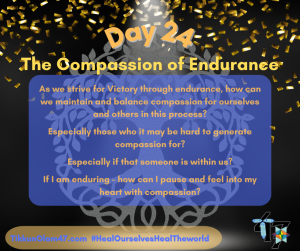 Healthy endurance, directed to develop good qualities and modifying bad ones, will always be compassionate. The compassion of endurance reflects a most beautiful quality of endurance: an enduring commitment to help another grow. Endurance without compassion is misguided and selfish. Endurance needs to be not just loving to those who deserve love, but also compassionate to the less fortunate. Does my determination compromise my compassion for others? Am I able to rise above my ego and empathize with my competitors? Am I gracious in victory?
Exercise for the day: Be patient and listen to someone that usually makes you impatient
The takeaway for me is when I get so focused on my determination and quest for victory it compromises my compassion for others? That is where a re-orientation is needed. We can strive to endure. We can strive for victory, but if I lose compassion for myself and others? The victory won’t be as meaningful.
How can we have compassion in our endurance for others? Especially those who it may be hard to generate compassion for? Especially if that someone is within us? I find it difficult to generate self-compassion at times. If I am enduring – how can I pause and feel into my heart with compassion?
This is the spirit we are approaching the portion today. We have been working through the Holy Days. So far, we’ve experienced:
- Rest (the Sabbath)
- Freedom (Passover)
- Mattering (Counting Omer)
- Direction (Shavuot)
- Sweetness and Change (Rosh Hashanah)
- Sovereignty and Royalty (Yom Kippur)
Let’s dig in:
33And the Lord spoke to Moses, saying,
34Speak to the children of Israel, saying: On the fifteenth day of this seventh month, is the Festival of Succoth, a seven day period to the Lord.
35On the first day, it is a holy occasion; you shall not perform any work of labor.
36[For] a seven day period, you shall bring a fire offering to the Lord. On the eighth day, it shall be a holy occasion for you, and you shall bring a fire offering to the Lord. It is a [day of] detention. You shall not perform any work of labor.
We have the Holy days of Sukkot. The theme of Sukkot is Harvest. And that makes sense, right? After we focus on our sovereignty and Royalty, as we’ve gone through this process after being freed? It is time we come to the Harvest of Sukkot.
Let’s keep reading:
37These are God’s appointed [holy days] that you shall designate them as holy occasions, [on which] to offer up a fire offering to the Lord burnt offering and meal offering, sacrifice and libations, the requirement of each day on its day;
38apart from the Lord’s Sabbaths, and apart from your gifts, and apart from all your vows, and apart from all your donations that you give to the Lord.
39But on the fifteenth day of the seventh month, when you gather in the produce of the land, you shall celebrate the festival of the Lord for a seven day period; the first day shall be a rest day, and the eighth day shall be a rest day.
It’s interesting. We get a repeat of this. We once again focus on Sukkot.
40And you shall take for yourselves on the first day, the fruit of the hadar tree, date palm fronds, a branch of a braided tree, and willows of the brook, and you shall rejoice before the Lord your God for a seven day period.
This is the Lulav that we use on Sukkot.
41And you shall celebrate it as a festival to the Lord for seven days in the year. [It is] an eternal statute throughout your generations [that] you celebrate it in the seventh month.
42For a seven day period you shall live in booths. Every resident among the Israelites shall live in booths,
43in order that your [ensuing] generations should know that I had the children of Israel live in booths when I took them out of the land of Egypt. I am the Lord, your God.
44And Moses told the children of Israel [these laws] of the Lord’s appointed [holy days].
So we see not ONLY is Sukkot about the Harvest? It is a reminder this is temporary. We live in Booths to remember that this all began at Passover – when we left Egypt from Slavery. This is beautiful and completes the Holy cycle:
- Rest (the Sabbath)
- Freedom (Passover)
- Mattering (Counting Omer)
- Direction (Shavuot)
- Sweetness and Change (Rosh Hashanah)
- Sovereignty and Royalty (Yom Kippur)
- Harvest (Sukkot)
- Temporary – Begin Again (Sukkot)
Where are YOU at on this journey? Energetically we are counting the Omer and learning how much we matter. How important we are. We are waiting for direction. Does that resonate?
Let me know your thoughts!
Here are my thoughts from two years ago:
Tyler’s Torah Thoughts for 12 Iyar, 5782
Today is the 27th day of the Omer
Good morning! Today’s portion talks about the Holy days of Sukkot – and the last day of Sukkot which is a different Holy day, Shemini Atzeret.
Fun fact about Shemini Atzeret; our third daughter, Johana was born on Shemini Atzeret!
Let’s dig in!
Here is what the Torah says about Sukkot:
- On the 15th day of the seventh month is a Festival of tabernacles – a period of seven days for God
- The first day is a holy celebration- we should not perform and manual work
- For seven days we should bring a fire offering to God
- The eighth day will be a holy celebration for us, and we should bring a fire offering to God.
The Torah then adds this interesting tidbit:
This is a time (the eighth day) when God holds back the Jewish people to be with Him for another day.
So remember – Sukkot is about the harvest season coming to completion. Shavuot is the start.
Hashem loves us SOOOOOO much that when the Harvest comes to an end, He wants just one more day with us. He doesn’t want to let us go. We are wanted. We are desired. That’s very comforting (at least to me).
- We should not perform any manual work
We then get a summary of all of the festivals – and what we should be doing and what we should be celebrating as holidays.
Because Sukkot is a smidge different. Because when other holy days fall on a sabbath? We are to bring the holy day offering AND the sabbath offering. But on Sukkot, we do NOT bring the peace offerings for Sukkot on the sabbath.
I’m reflecting and chewing on why that would be. Maybe it’s a recognition that this is hard work. Yes, we are talking about the harvesting of literal crops. But I also reflect on the deeper meaning of the spiritual, emotional, and mental health work we do; that there is a planting of healing practices and ideas, there is the growth and development of those ideas in our lives, and then the harvest comes and we reap the benefits and rewards of the work we do on ourselves. Maybe this passage represents God understanding just how tough the work is, and as we come to the end of the cycle of growth and harvest, we get an extra bit of rest before putting everything into practice? Just a thought.
The Torah then tells us Sukkot is eight days but the first and last are rest days. If there is a sabbath in the middle, we get three rest days out of eight.
The Torah then talks about the lulav and etrog. The four species.
The eighth day is Shemini Atzeret. We are to shake the lulav for seven days; but not on Shemini Atzeret; because remember – that’s an “extra” day God just wants to be with us!
Something interesting the Talmud talks about with the four species:
The four species represent four types of people. A citron (etrog), which possesses a good taste and a pleasant smell, represents the Jew who possesses both Torah learning and good deeds.
The date palm branch (lulav) has a good taste but no fragrance, signifying those whose who have Torah knowledge but lack sufficient good deeds.
Those who possess good deeds but are lacking in Torah knowledge are represented by the myrtle (hadasim), which has a fragrant odor but lacks taste.
The willow (aravot), which is inedible and has no aroma represents those people lacking both in Torah and good deeds (end quote)
What I love about this idea is that we can see ourselves as one of the species AND see ourselves connected to the larger Jewish community. There isn’t a judgment on us as to how we live. We are still welcome into the booths and holy days! And. God wants to spend one more day with us.
The portion here closes with the idea that for the seven days of Sukkot we should be living in booths (sukkahs). Every native Jew and convert should live in booths. Why? The Torah tells us; “so that your ensuing generations should know God caused the children of Israel to live in clouds of glory that resemble booths when He took us out of the land of Israel.”
Fun fact for my Christian friends. The likelihood of Jesus being born on December 25th is small. The more likely reality is the manger described in the book you read? Likely a booth. Jesus was Jewish; and the family would have been going to Jerusalem to celebrate Sukkot – and to bring their offerings.
But somehow, over the years, The Jewishness of this event was washed away for December 25th. And Santa Claus. And Yule Logs. And Christmas trees. I wonder why? Just a question.
Anyway! Enjoy your day!


No responses yet