Tyler’s Torah Thoughts for 28 Iyar, 5784– Day 43 of the Omer
Parsha Be-Midbar – “In The Desert”: (Numbers 1:1 – 4:20)
Fourth Portion: Numbers 3:1 -3:13
Omer Theme: Love of Dignity
Good morning! We are in the middle of the week, but heading towards the new moon and the new month of Sivan! We are getting ready to turn the page on this birth stage and move into direction. What direction are you seeking as we enter the next cycle? What do we need from Hashem for affirmation? Clarity? Support? Understanding? We can ask for these – and the Holy Day of Shavuot may bring us what we need!
Today is the 43rd Day of the Omer. We are moving into our final week of the Omer. This final week has the theme of Dignity/Sovereignty (Malchut). From Chabad:
Sovereignty – the last of the seven attributes – is different than the previous six. It is a state of being rather than an activity.
Leadership is a passive expression of human dignity which has nothing of its own except that which it receives from the other six emotions.
On the other hand, malchut manifests and actualizes the character and majesty of the human spirit. It is the very fiber of what makes us human. When love, discipline, compassion, endurance and humility are properly channeled into the psyche through bonding – the result is malchut. Bonding nurtures us and allows our sovereignty to surface and flourish.
Malchut is a sense of belonging. Knowing that you matter and that you make a difference. That you have the ability to be a proficient leader in your own right. It gives you independence and confidence. A feeling of certainty and authority. When a mother lovingly cradles her child in her hands and the child’s eyes meet the mother’s affectionate eyes, the child receives the message that I am wanted and needed in this world. I have a comfortable place where I will always be loved. I have nothing to fear. I feel like a king in my heart. This is malchut, kingship.
Today’s Theme is Chesed of Malchut – Or the Love of Dignity
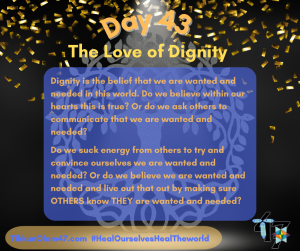 Healthy sovereignty is always kind and loving. An effective leader needs to be warm and considerate. Does my sovereignty make me more loving? Do I exercise my authority and leadership in a caring manner? Do I impose my authority on others?
Exercise for the day: Do something kind for those entrusted with your leadership
So here is the important takeaway – and it is interesting in this last week of the Omer – we are looking at Kingship. Sovereignty. Manifested Dignity. It is one thing to “feel” dignity within. It is another to manifest it externally.
Do we seek out others to “give us” dignity? Or do we live out in love our dignity manifested into reality?
This:
Malchut is a sense of belonging. Knowing that you matter and that you make a difference. That you have the ability to be a proficient leader in your own right. It gives you independence and confidence. A feeling of certainty and authority. When a mother lovingly cradles her child in her hands and the child’s eyes meet the mother’s affectionate eyes, the child receives the message that I am wanted and needed in this world. I have a comfortable place where I will always be loved. I have nothing to fear. I feel like a king in my heart. This is malchut, kingship.
Do we send the message to others that they are wanted and needed in this world? Do we believe that WE are wanted and needed in this world?
Let’s dig into the Torah! Today, we shift – we look at the heart. The tribe of Levi. These are the children of Israel who moved AFTER the Harmony and Kindness led. When navigating conflict – how can we communicate harmony and kindness. And then? Dig into the dignity of our heart. This is Levi:
1These are the descendants of Aaron and Moses on the day that the Lord spoke to Moses at Mount Sinai.
2These are the names of the sons of Aaron: Nadab the firstborn Abihu, Eleazar, and Ithamar.
3These are the names of the sons of Aaron, the anointed kohanim, whom he consecrated to serve as kohanim.
4Nadab and Abihu died before the Lord when they brought alien fire before the Lord in the Sinai desert, and they had no children. Eleazar and Ithamar, however, served as kohanim in the presence of Aaron, their father.
It’s important to note. Part of the Heart of Israel died. And it was also strengthened. As someone who had a heart attack in 2016? I relate to this. My heart broke open – and my life changed.
5The Lord spoke to Moses saying:
6Bring forth the tribe of Levi and present them before Aaron the kohen, that they may serve him.
7They shall keep his charge and the charge of the entire community before the Tent of Meeting, to perform the service of the Mishkan.
8They shall take charge of all the vessels of the Tent of Meeting and the charge of the children of Israel, to perform the service of the Mishkan.
The purpose of the tribe of Levi? Service. Our heart is designed to serve. The service of the Mishkan. The Mishkan was the tabernacle. It was the heart of hearts. The deepest heart. Our heart is designed to serve the deepest longings of our heart. Our heart is entrusted to care for our deep heart. The holiest of holiest within us. The heart is designed to service the soul.
Let me say that again. The heart is designed to service the soul. And this makes sense, right? What does the heart do? It pumps blood. That is the function. The soul is in the blood. The heart flows the soul. It cares for the soul. And if it stops? The body dies. This is the life force of all of us.
9You shall give over the Levites to Aaron and his sons; they shall be wholly given over to him from the children of Israel.
10You shall appoint Aaron and his sons, and they shall keep their kehunah; any outsider [non kohen] who approaches shall be put to death.
So the Levites – the heart of Israel, was given solely to the service of Aaron and his sons. To just serve the tabernacle.
11The Lord spoke to Moses, saying.
12As for Me I have taken the Levites from among the children of Israel in place of all firstborns among the children of Israel who have opened the womb, and the Levites shall be Mine.
13For all the firstborns are Mine; since the day I smote all the firstborns in the land of Egypt, I sanctified for Myself all the firstborns of Israel, both man and beast they shall become Mine, I am the Lord.
The Levites were a stand in for all the “firsts” of the Children of Israel. The Heart is connected to the first born. The heart is one of the first things developed as a child.
All of this starts within. We are wanted and needed in this world. We have dignity. Do we manifest dignity, or do we ask others to dignify us? This is the choice we need to make.
These are my thoughts. What are yours?
Here are my thoughts from the past two years:
Tyler’s Torah Thoughts for 27 Iyar, 5783. 41st Day of the Omer
Today’s Omer theme is “Bonding of Bonding.” Or “Yesod of Yesod.”
From Chabad:
Examine the bonding aspect of bonding. The forms it takes and its level of expression. Every person needs and has the capacity to bond with other people, with significant undertakings and with meaningful experiences.
Do I have difficulty bonding? Is the difficulty in all areas or only in certain ones? Do I bond easily with my job, but have trouble bonding with people? Or vice versa? Do I have problems bonding with special events in my life? Examine the reasons for not bonding. Is it because I am too critical and find fault in everything as an excuse for not bonding? Am I too locked in my own ways? Is my not bonding a result of discomfort with vulnerability? Have I been hurt in my past bonding experiences? Has my trust been abused? Is my fear of bonding a result of the deficient bonding I experienced as a child? To cultivate your capacity to bond, even if you have valid reasons to distrust, you must remember that G‑d gave you a Divine soul that is nurturing and loving and you must learn to recognize the voice within, which will allow you to experience other people’s souls and hearts. Then you can slowly drop your defenses when you recognize someone or something you can truly trust.
For bonding to be possible it must embody the other six aspects of bonding. Successful bonding must also include actualizing the bond in constructive deeds.
One additional point: Bonding breeds bonding. When you bond in one area of your life, it helps you bond in other areas.
Exercise for the day: Begin bonding with a new person or experience you love by committing designated time each day or week to spend together constructively.
I have some interesting thoughts this morning about bonding. I heard this quote on my 10% Happier Meditation App this morning:
“Nothing is permanent and stable. Everything in our experience is not reliable – it can’t be gone to for some stable, permanent kind of happiness, well-being, or security.”
And yet. This is what we do often. This is what I do often. I look to my bonds and bonding as a reliable source of happiness, well-being, and security. My relationship with friends and loved ones. With my kids.
What is stable and permanent? Nothing. All we have is the moment. What is stable and solid in this moment? My feet touching the ground. My butt in my chair. My breathing. That’s solid. In this moment.
My bonds with others? They are both permanent and impermanent at the same time.
My mom and dad are both passed on. It’s been a long time. My dad died 36 years ago. My mom 16 years ago. Those bonds (for better or worse) don’t REALLY exist anymore. And yet they do.
I go back to what Chabad said this morning:
Examine the reasons for not bonding. Is it because I am too critical and find fault in everything as an excuse for not bonding? Am I too locked in my own ways? Is my not bonding a result of discomfort with vulnerability? Have I been hurt in my past bonding experiences? Has my trust been abused? Is my fear of bonding a result of the deficient bonding I experienced as a child?
If I am honest? Some of these questions impact how I navigate these bonds. I cling to the bonding with my children – and grieve the lost when they reject the desire to spend time with me. Why? The answer to the questions of being hurt in my past bonding experiences drives this more than I would want it to. This is why our internal healing is so important.
If the bonds aren’t as “real” in a given moment, I question whether it’s my fault. What am I doing wrong? Instead of recognizing that bonds come and go like waves – they come in and feel real and then release and retreat. They aren’t permanent.
I connect this with today’s torah portion because of the two types of trees. The Cedar is a strong but bears no fruit. The palm is not as strong, but produces fruit. Our bonds come and go like waves because these bonds should produce fruit. AND when those bonds may not be producing fruit? They still exist. It’s how conscious we are to these bonds.
What are your thoughts?
Tyler’s Torah Thoughts for 2 Sivan, 5782 (June 1, 2022)
Today is the 46th day of the Omer.
Todays portion continues the journey of discussing where the Israelites were at. After going through all the tribes and where they were camped, todays portion starts with the descendants of Aaron. We are reminded that two of Aaron’s sons died with no children left behind.
This is the Segway into talking about the tribe of Levi.
The Torah tells us: God spoke to Moses saying “draw the tribe of Levi close and stand them before Aaron the priest.”
Rabbi Israel Ba’al Shem Tov wrote this around the idea of drawing the tribe of Levi close:
“Thus it is written, “The righteous man flourishes like a palm tree. He grows tall like a cedar in Lebanon” (Psalms 92:13; Numbers Rabbah)
A person could be righteous in one of two ways:
-
- A cedar is strong, tall and beautiful, but it bears no fruit. This corresponds to a person who studies Torah and observes commandments primarily for his own personal spiritual growth. or
- (b) A palm tree- not as tall and strong as the cedar, but which bears sweet, delicious fruit -is analogous to a person who is willing to sacrifice some of the time which he could have used for his own personal spiritual growth, for the sake of helping others.
This second type of person brings much healing to the world, and his reward is doubled and redoubled, far beyond the first type. Make sure that your “tree” of spiritual growth always bears some fruit!” (End quote).
The idea that studying Torah is good, but studying Torah and serving others is better? That’s the point here!
We learn more about the Levites and why God separated them in the rest of the portion:
We learn their purpose:
- Taking charge of some of Aaron’s duties
- Taking charge of some of the duties of the entire community
- Guarding the tabernacle by standing in front of the tent of meeting
- guarding the vessels of the tent of meeting
The Levites were given to Aaron and his sons to safeguard their priesthood.
God then tells us why He chose the Levites:
Since the firstborn of Israel worshiped the golden calf, instead of taking the first born of every womb, Hashem instead took the Levites to be His.
If we want to know why Hashem would take the first born, He tells us too; because since the day He struck the firstborn of all of the Egyptians, He took every first born to be Holy to Hashem.
Some interesting thoughts and power here! What are your thoughts?


No responses yet