Tyler’s Torah Thoughts for 4 Sivan, 5784– Day 48 of the Omer
Parsha Naso – “Lift”: (Numbers 4:21 – 7:89)
Second Portion: Numbers 4:29 – 4:49
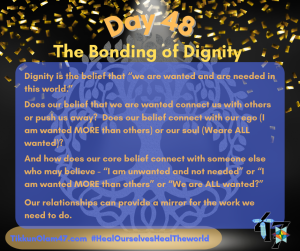
Good morning! Well, first off, I realized this morning, I covered today’s portion yesterday – so we are ahead of ourselves. I am assuming I did this – not as a mistake – but for a purpose. I am assuming it is because as we come to the final two days of the Omer (tonight at Sundown is the final Omer count) we are meant to focus. Today’s Omer theme is the “Bonding of Dignity.” From Chabad:
 Examine the bonding aspect of your sovereignty. Healthy independence should not prevent you from bonding with another person. On the contrary: self-confidence allows you to respect and trust another’s sovereignty and ultimately bond with him. And that bond will strengthen your own sovereignty, rather than sacrifice it.
Does my sovereignty prevent me from bonding? Could that be because of deeper insecurities that I am unaware of? Do I recognize the fact that a fear of bonding reflects on lack of self-confidence in my own sovereignty? Do I talk to the one with whom I bond and discuss my fears that bonding will compromise my boundaries?
Exercise for the day: Actualize your sovereignty by intensifying your bond with a close one.
Bonding is connecting. Does our dignity, our sovereignty connect us? Or does it separate us. I continue to dig into the idea of dignity and sovereignty being connected to a belief we are needed and wanted in this world. Does this belief connect us to others or distance us?
Keep in mind our beliefs are not always conscious – these may be subconscious thoughts running in the background tab of our brains.
I think it comes down to a few different factors:
- Do I truly believe I am needed and wanted in this world?
- I do not believe I am needed and wanted
- And, this belief comes from a place of ego (I am MORE needed and wanted than others)?
- And, I believe all of us are needed and wanted in this world – equally – and with different purposes (souls).
When we engage with others, they are struggling with these same questions:
- Do they truly believe they are needed and wanted in this world?
- They do not believe they are needed and wanted
- And, this belief comes from a place of ego (They are MORE needed and wanted than me and others)?
- And, they believe all of us are needed and wanted in this world – equally – and with different purposes (souls).
Let’s play this out.
Scenario 1: I do not believe I am needed and wanted
- When I meet someone who believes the same? We may find camaraderie and it may work to move us in the direction of feeling more needed and wanted – but in the end we know this other person doesn’t feel needed and wanted – so it will just reinforce we are not needed and wanted.
- When I meet someone who believes they are needed and wanted from a place of ego? I may be drawn to them. Because if someone who believes they are needed and wanted MORE than anyone else wants to spend time with me? And THEY want me and need me? That feels good, right?
- When I meet someone who believes all of us are needed and wanted? That isn’t going to feel very good – because at the end of the day, I am forced to confront my inner belief. I either have to believe I am needed and wanted – not because this person is telling me – but because it is the core of who I am. I will either need to reconcile my beliefs about being needed and wanted? Or I won’t enjoy spending time with this person who believes I am needed and wanted by virtue of being here.
Scenario 2: I believe all of us are needed and wanted
- When I meet someone who does NOT believe they are needed and wanted, it is going to feel like rejection if I become unaware of what is happening. They aren’t rejecting me as much as my core belief in the dignity and sovereignty of all. I will need to continue initiating if the relationship will continue – it may not connect us together right away. Over time though, those who keep coming back? They will see this unfold.
- Or – I am going to be triggered and believe maybe I am not needed or wanted and struggle to maintain my belief because of the rejection I feel from a lack of reciprocation.
- When I meet someone who believes they are needed and wanted from a place of ego? They are going to reject me because I am a likely threat to their perceived power. Their dignity and sovereignty comes from a place of ego – and if I believe we all have equal value, they aren’t going to hang much with me.
- Or – I am going to be triggered into believing I am NOT needed or wanted in this world and desperately seek this person’s affirmation I am.
- When I meet someone who believes all of us are needed and wanted? It can be disorienting at first. It is a power and connection we may not have a lot of experience with. We can attach all sorts of ego and meaning to THIS connection instead of just bonding with this person without controlling this bond.
- Or – I am going to be triggered because my prediction of the future of the relationship does not align with where the relationship ends up. I will feel rejected and my beliefs about being needed and wanted in this world will be challenged.
And. The truth is? We all go through all of these cycles. We are never in one of these places forever:
- Do I truly believe I am needed and wanted in this world?
- I do not believe I am needed and wanted
- And, this belief comes from a place of ego (I am MORE needed and wanted than others)?
- And, I believe all of us are needed and wanted in this world – equally – and with different purposes (souls).
So where are you today? As we approach Shavuot and the direction being given to us? How do you KNOW where you are at? And how much of your beliefs are shaped by your own soul or the impact of others around you? Or? Woundedness from the caretakers in our lives who are put here to remind us we are needed and wanted in this world.
And. The woundedness we created by not communicating this to those entrusted in our care?
Wow. Lots today. These are raw thoughts. There is a lot more here. I am seeing a matrix develop around these concepts. I am curious to know your thoughts? But the idea of whether our dignity is bonding us or connecting us with others is crucial. May our eyes be opened to what is going on!
Here are my thoughts from the past two years:
Tyler’s Torah Thoughts for 9 Sivan, 5783
It’s Memorial Day in America! A time to remember those who have given their lives for the service of our country.
I reflect on today’s Torah portion, and I am struck as to how our emotions have been sacrificed in order for us to survive the trauma we face.
And. Much like the “controversy” over the military and whether those sacrifices we remember on Memorial Day were justified, the humanity lost is what matters.
Humanity lost. That is what happens when we sacrifice our emotions.
My commentary a year ago was around submissiveness. And, when we think about the word “submissive” we often think “subservient.”
Let’s look at these definitions:
First let’s look at submissive.
Definition of submissive:
Next let’s look at subservient:
- prepared to obey others unquestioningly.
- less important; subordinate
- serving as a means to an end.
One thing I am reflecting on here is power. We often think of being submissive as “weak.” But in the context of Torah, there is power. The key words in the definitions above?
“Ready.”
“Prepared.”
“Takes.”
These are all powerful words. It’s a choice. The assumption is – once you choose submissiveness, you can never get it back. But that is something I think we have “fallen” into. The truth is – Hashem does NOT ask us to be enslaved to him. Hashem asks us to be READY to conform.
We don’t need to be meek. I think the Torah is CLEAR – there is no meekness for the Jews. In the Torah, when people are passive? It usually doesn’t go well. In addition, the Torah is clear – we are NOT less important than anyone else. If Hashem is in us – if we have the Neshama, we cannot be “less important” than Hashem. This is not to say we are gods. We aren’t. We are souls. Those souls are a part of Hashem. We are limited with our human bodies to experience our time on this earth.
I wrote this a year ago, and it seems salient:
“This healthy equilibrium of greatness and submissiveness required for worship was reflected by the role of the Levites in the Tabernacle, God’s House. The descendants of Kohath and Gershon were honored with the important tasks of carrying the most holy items, whereas Merari’s descendants were “simple people” who were given the more menial tasks. Nevertheless, the overseeing of the Tabernacle required the combination of both these roles-teaching us that pride and simple submissiveness need to be found in every heart.”
Balance. This is the key. Instead of SACRIFICING our emotions for freedom and survival? We are called to BALANCE our emotions to remain human. Compassion. Empathy. Kindness. TOWARDS OURSELVES FIRST. This is our humanity. This is our healing.
What are your thoughts?
Tyler’s Torah Thoughts for 7 Sivan, 5782
I hope your Shavuot was meaningful! As I shared previously- in our journey in the Holiday cycle – the Jews left slavery and Egypt at Passover. 7 x 7 weeks later they were roaming the wilderness and then Hashem gave them the Torah. They were still not in the promised land yet: but they had directions now on what to do to get there.
As we continue our journey in the wilderness – grounded in our freedom, let’s continue to keep an eye on what the Torah says to us about where we should go moment by moment, day by day.
The past two days have been about Kohath (spirituality) and Gershon (Physical). Today we come to the final descendant of Levi: Merari.
I have shared how it does seem the emotions are connected to Merari. Their job was internal. The beams and supports inside the tent of meeting. On of the interesting questions the Rabbis have wrestled with is why Merari does not get the “singled out” treatment. For Gershon and Kohath, it says to single out those from their descendants. But today, for Merari, it merely says “count Merari’s descendants, verifying their family lineage, according to their paternal houses.”
Rabbi Shneur Zalman wrote something interesting about this:
In the cases of Kohath’s descendents (4:1) and Gershon’s descendents (ibid., v. 21), the Torah states that they were “singled out” (literally “their heads were lifted up”). God honored them in this way because Kohath carried the ark, and Gershon was the firstborn. But in the case of Merari’s descendents (v. 29), who were simple people and whose task was merely to carry the beams, supporting rods, pillars and sockets, Scripture does not refer to them as being “singled out” (Numbers Rabbah).
Any relationship with God must, of course, be based on submissiveness, where you surrender your own will and choose to follow the Divine will. But once this foundation of submissiveness is established, you also need to build up your knowledge, skills and determination. For God put you in this world to transform it, and this will simply not occur unless you nurture the qualities of ambition and desire for achievement. As long as you have a firm foundation of submissiveness, your achievements will not “go to your head” and lead you to believe that your successes are to your own credit. Your ambitions will always be permeated with the awareness that God desires you to be successful in carrying out His plan for this world, and it is God who is continually enabling you to do so.
This healthy equilibrium of greatness and submissiveness required for worship was reflected by the role of the Levites in the Tabernacle, God’s House. The descendants of Kohath and Gershon were honored with the important tasks of carrying the most holy items, whereas Meraris descendants were “simple people” who were given the more menial tasks. Nevertheless, the overseeing of the Tabernacle required the combination of both these roles-teaching us that pride and simple submissiveness need to be found in every heart.
That is really interesting and I think shows us that our emotions should submit to our spirit and physical bodies. How often is that turned around where we allow our emotions to drive the body and our spirit (soul).
This is work I am currently doing for myself. I have seen how the emotions inside of me have driven the brain most of my life. As I become more aware of the emotions, and allow them a venue to express themselves, the body and soul are able to better understand the tribe of Merari and work to lead.
The portion closes with the census of these three groups; Kohath, Gershon, and Merari – the number of descendants 30-50:
Kohath had 2750 (8600 were older than 1 month) – 32%
Gershon had 2630 (7500 were older than 1 month) – 35 %
Merari had 3,200 (6200 were older than 1 month) – 52%
It is interesting that Merari’s percentage of men who could serve was significantly higher than the other two descendants.
The total of those men fit to serve were 8,580.
Given what we’ve discussed – it seems as if the emotions are bigger in number and percentage where the body and soul may let the emotions drive us because of sheer numbers. But the Torah also seems to indicate that the body and soul should be driving our emotions instead.
I’m really reflecting and chewing on this.
One of my first thoughts is the critical nature of the mental health profession. As someone who has been in weekly therapy for the past 2.5 years with an AMAZING therapist, a lot of my work is body(brain) and soul work that has made a difference in how I navigate my emotions – and whether they drive the train, or whether I surf them like a wave. It’s a significant difference but it is worth discussing more!
What are your thoughts?


No responses yet