Tyler’s Torah Thoughts for 5 Sivan, 5784– Day 49 of the Omer
Parsha Naso – “Lift”: (Numbers 4:21 – 7:89)
Third Portion: Numbers 5:1 – 5:10
Good morning! Today is an exciting day spiritually! It is the final day of the Omer – we have made sure each of the days between Passover and Shavuot were wanted and needed by counting them. One by one. Tonight, at sundown, we celebrate the giving of the Torah over the next two days. What is the purpose of the Torah? I love what Chabad writes here:
The Lubavitcher Rebbe explains that the purpose of the Torah is to create a dwelling place for Hashem in this plane, the lowest of all the created worlds. And just as the essence of a person is in his home more than anywhere else, so also, Hashem wanted His essence to be drawn into this world in order for this to be His ‘home’. This divine desire can only be actualized by the Torah being fulfilled in this world. When we do Hashem’s commandments and learn His Torah with our physical bodies and minds, we literally bring Hashem’s essence into this plane, something an angel is incapable of doing.
Our purpose is to create space for our souls to dwell in this plane. To hold space for souls to expand. This is Shavuot! This is the direction and giving of the Torah we are going to receive. Where are we called over this next year to create and hold space?
And. It is not Shavuot yet! We still need to finish our Omer count! Today is Day 49. The final day. The theme is “Dignity of Dignity.” From Chabad:
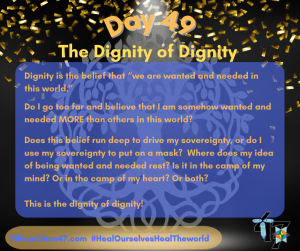 Examine the sovereignty of your sovereignty. Does it come from deep- rooted inner confidence in myself? Or is it just a put-on to mask my insecurities? Does that cause my sovereignty to be excessive? Am I aware of my uniqueness as a person? Of my personal contribution?
Exercise for the day: Take a moment and concentrate on yourself, on your true inner self, not on your performance and how you project to others; and be at peace with yourself knowing that G‑d created a very special person which is you.
The root of our sovereignty (as we discussed yesterday) is the belief we are wanted and needed in this world. Does this deep belief drive my sovereignty, or do I use my sovereignty to put on a mask? Do I go too far and believe that I am somehow wanted and needed MORE than others in this world? This is the dignity of dignity!
As we wrap up the Omer, Chabad writes this:
Upon concluding these forty nine days we come to the fiftieth day – Mattan Torah, when we have fully achieved inner renewal by merit of having assessed and developed each of our forty nine attributes.
What is the significance of the fiftieth day Mattan Torah? After we have achieved all we can accomplish through our own initiative, then we receive a gift (mattana in Hebrew) from above that which could not achieve with our limited faculties. We receive the ability to actually reach and touch the divine; not only to be cultivated human beings who have refined each of their personal characteristics, but divine human beings, who are capable of expressing above and beyond their defined human emotions, but actually express that which is unexpressable and undefinable in human terms; the most intimate emotions that transcend the forty nine defined attributes.
This idea that we have spent the past 49 days assessing and developing each of these 49 attributes of love is important. We have done all we can these past 49 days with our own initiative. Now – we are ready to receive a gift from above (the Torah) which we could not have received 49 days ago. We are royalty. We are divinity. Hashem is in us, and we only need touch our own hearts to encounter the souls of the universe. This is a BEAUTIFUL picture for us.
We are worthy and capable of expressing beyond our emotions to express things that are really beyond humanity – we have done the work these past 49 days to be truly intimate with ourselves – and can receive more – because our capacity is more. This is the beauty of the Omer. This is the beauty of the Torah. We are READY – Let’s GOOOOOO!!!!!!!
This is the spirit we carry with us as we dig into today’s portion:
1The Lord spoke to Moses saying:
2Command the children of Israel to banish from the camp all those afflicted with tzara’ath or with a male discharge, and all those unclean through [contact with] the dead.
3Both male and female you shall banish; you shall send them outside the camp, and they not defile their camps, in which I dwell among them.
As Hashem was separating the people – it would seem making sure those who were ready would not be held back by those who were not. As much as we want to connect with Hashem, life sometimes gets in the way. Sometimes we need a break. We need rest. For our own health, and the health of the community.
4The children of Israel did so: they sent them outside the camp; as the Lord had spoken to Moses, so did the children of Israel do.
And the people did as they were instructed to do. This was a way to connect with Hashem.
5The Lord then spoke to Moses saying:
6Tell the children of Israel: When a man or woman commits any of the sins against man to act treacherously against God, and that person is [found] guilty,
7they shall confess the sin they committed, and make restitution for the principal amount of his guilt, add its fifth to it, and give it to the one against whom he was guilty.
So – if we commit a sin against someone else? We are called to confess the sin, and make restitution. Restorative justice is something we talk a lot about in the field of education. This is the root of that. And? We don’t just restore someone to where they were – we had 20% as compensation.
As we approach Juneteenth, I would be remiss NOT to connect this passage to how our country treated (and in many ways still do) black folx. When our ancestors in this country stole people from their families and brought them to our country to work as dehumanized life here? I believe most of us see that as a sin committed against man.
Have we made restitution for the amount of our guilt? I don’t see it. Looking in my history books – where is the restitution for the way we treated folx in our country for a long long time?
We may not have acted treacherously directly – but the flag we pledge our allegiance to? And the country for which it stands? Certainly has. That is something to reflect on as we enter Shavuot.
8But if the man has no kinsman to whom to make restitution, the debt which is restored to the Lord, [is to be given] to the kohen. [This is] besides the atonement ram through which expiation is made for him.
9Every offering of all the children of Israel’s holy things which is brought to the kohen, shall be his.
10Everyone’s holy things shall belong to him; whatever a man gives to the kohen shall be his.
And the Torah even tells us what to do if the man who was sinned against no longer is able to collect the debt is around. It was to be given to the priests.
There is a lot here to prepare for the direction and giving of direction – the Torah.
And. As a reminder – all of us. We are wanted and needed here. We have a purpose to live out. And that? Is beautiful!
What are your thoughts?
Here are my thoughts from the past two years:
Tyler’s Torah Thoughts of 10 Sivan, 5783
Today the Torah talks about sickness. And this year, as I read these passages, I read them a bit differently than the past. It felt so “harsh” reading these passages – thinking that when someone is sick, we should “kick them out” of the camp. Like they aren’t welcome.
Having gone through COVID the past three years? Isolation isn’t something negative – it’s a way to protect the population. It was compassionate.
And. The story, as I read it, changes the meaning for me if I humanize the context. If one of my children got sick, and they were required to go outside the camp? I would NOT let them go alone. I am imagining, and the Torah doesn’t tell people who are Healthy NOT to leave the camp. But if someone I cared about was sick – I would like to think I would go outside the camp to be with them as they recover. We aren’t be asked to abandon sick people – we are just trying to protect the community. It’s a both/and situation.
Compassion. Kindness. This is what we often think the Torah lacks. Yet, it is there for us to find. What are your thoughts?
Here is my commentary from a year ago:
Tyler’s Torah Thoughts for 8 Sivan, 5782
Todays portion starts with those in the camp with Tzara’at – basically those who are sick should go outside the camp.
So as we’ve been talking about our spirit, bodies, and emotions, one of the things I’m reflecting on here is the idea of rest when we are sick. It feels a little bit like punishment to send those who are sick Outside the camp. But I wonder instead if it was rest.
Just something I’m reflecting on.
Next we talk about men and woman who commit the sin of dishonesty and they are found guilty – they should confess the sin they committed, and pay back the amount they are guilty of, adding 20%. And give it to who they are guilty against.
But if they die, and there is no relative who can pay it back? the debt is returned to God.
So again; I’m a healthy body, mind, soul – when a mistake is made, the goal is to return and recover.
The portion closes with whatever is brought to the priests belongs to the priests.
That means that what we give to God and his people belongs to them.
What are your thoughts?


No responses yet