Tyler’s Torah Thoughts for 11 Tammuz, 5784
Parsha Balak: (Numbers 22:2 – 25:9)
Fourth Portion: Numbers 22:39 – 23:12
Good morning!
Before we jump into the Torah, it is important to remember that the month of Tammuz is a Paradox of Darkness and light. This is the month we were supposed to receive the Torah. But we chose the golden calf instead. This created a month of darkness. But our goal is to learn to see in the dark, and make choices that lead us continually in love.
This morning, in Mark Nepo’s “Book of Awakening” he talks about woundedness and trauma. Like the Israelites choosing the Golden Calf over the Torah? Trauma happens. We can’t avoid it.
Mark Nepo writes this; “Terrible things are hard enough to experience the first time. Beyond their second, third, fourth experience as trauma, their impact can easily make us become terrible if we do not keep our want for love alive.
The most deepest challenge of being wounded is not turning our deepest loving nature over to the life and way of the wound.”
He makes a great conclusion here:
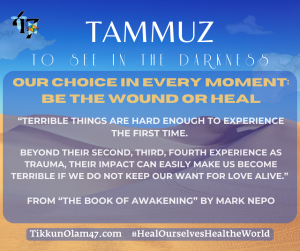 “The Choice is to become the wound or heal.”
So in our past trauma – we can choose to become the trauma, or become healing. In each and every moment. Going from a broken heart that continues to be broken to maintain that identity, or to be a healing heart which sees moments as part of a healing journey. Which journey will you choose – the contraction of a broken heart or the expansion of a healing heart?
With that, let’s dig in:
39Balaam went with Balak, and they arrived at Kiryath Huzoth [a city of streets].
40Balak slaughtered cattle and sheep and sent [some] to Balaam and to the dignitaries with him.
41And in the morning Balak took Balaam and led him up to Bamoth Baal, and from there he saw part of the people.
So we start out here – and Balak is still afraid. His heart is broken. He takes Balaam up to show him the people who are scaring him. Like many of us? He paid good money for Balaam to validate his reality.
23:1Balaam said to Balak, “Build me seven altars here, and prepare for me seven bulls and seven rams.”
2Balak did as Balaam had requested, and Balak and Balaam offered up a bull and a ram on [each] altar.
3Balaam said to Balak, “Stand beside your burnt offering, and I will go. Perhaps the Lord will happen to appear to me, and He will show me something that I can tell you,” and he went alone.
So Balaam has him sacrifice – which is interesting given we’ve discussed the role of sacrifice in grief. Balaam walked away to see if Hashem would meet with him:
4God chanced upon Balaam, and he said to Him, “I have set up the seven altars, and I have offered up a bull and a ram on [each] altar.”
“God chanced?” I am reflecting on that. Does Hashem “chance?”
I love words. Looking at the definition of “chance” as a verb we get two definitions:
- A possibility of something happening
- The occurrence and development of events in the absence of any obvious design
I think we look at the word chance meaning “accidental” which is connected to it being used as an adjective.
The bottom line? I believe the Torah is trying to tell us – this was NOT Hashem’s design here. Hashem’s design was for Balaam not to go. And. He allowed it to unfold.
What is Hashem going to do with this meeting that was not “part” of the “design?”
5The Lord placed something into Balaam’s mouth, and He said, “Return to Balak and say as follows.”
This is fascinating. Were they words? An object? It’s not clear.
6When he returned, Balak was standing next to his burnt offering, he and all the Moabite dignitaries.
7He took up his parable and said, “Balak the king of Moab has brought me from Aram, from the mountains of the east [saying], ‘Come, curse Jacob for me and come invoke wrath against Israel.’
So Balaam returns – regardless of what Hashem put in his mouth – these are the words he heard. In terms of communication, this is amazing, because it starts with Balaam clearly defining what he heard Balak ask him to do. Message sent from Balak was the message received by Balaam. There is no doubt. There is no miscommunication.
Balaam is saying – there really isn’t an argument here – I got what you wanted. And. Here is the response:
8How can I curse whom God has not cursed, and how can I invoke wrath if the Lord has not been angered?
9For from their beginning, I see them as mountain peaks, and I behold them as hills; it is a nation that will dwell alone, and will not be reckoned among the nations.
10Who counted the dust of Jacob or the number of a fourth of [or, of the seed of] Israel? May my soul die the death of the upright and let my end be like his.”
Balam is basically telling Balak – Can’t do what you asked me to. Hashem has not been angered. He doubles down and says basically “look, I hope my soul dies and my end is like Israel’s because they are going to face a really good ending!”
11Balak said to Balaam, “What have you done to me? I took you to curse my enemies, but you have blessed them!”
12He answered, saying, “What the Lord puts into my mouth that I must take care to say.”
Balak does not understand (or believe?) that Balaam is not the source of the blessing or cursing. It’s Hashem. That’s the miscommunication.
So no one can curse us – unless Hashem wills it. We know the Torah is full of stories of Hashem being angered and there being consequences for the people. Today we learn how a powerful king tried to use the energy to curse the people, and he couldn’t because Hashem wasn’t angry.
We can trust the Universe. When things aren’t going the way we want to? Its for our protection. Otherwise? We are same.
Choose the healing heart – not the wounded broken heart.
These are my thoughts. What are yours?
Here are my thoughts from the past two years:
Tyler’s Torah Thoughts for 11 Tamuz, 5783
Good morning! Today’s double portion continues the story of Balak and Balaam. Balak wants Balaam to curse the Israelites. Balaam is here (remember) because he wants a profit. Hashem told him to go with Balak if he believed it was going to be “profitable.” However, Balaam was warned to only say the words Hashem told him to.
In this double portion, Balak shows Balaam Israel – Balaam surveys Israel and Balaam speaks the words Hashem gives him – blessings.
And I realize this morning – one the key passages in today’s reading?
Balaam says “He (God) observed no evil idolaters among Jacob, and has seen no transgressions. Even when Jacob rebels, God, his God, is with him: he has the King’s affection.”
He. Has. The. King’s Affection.
Even. When. He. Rebels.
I am sitting with that.
How much do we spend our lives looking for OTHERS to give us affection? To bless us? To want us? To desire us?
And yet, we already have the King’s Affection. He loves us. Not just in some way we can’t understand or feel. We have his AFFECTION!
So – what do we do with this? Realize – we may have “enemies” who desire us to suffer. To be cursed. And yet? The King won’t allow it.
The Torah talks about many times where Hashem did allow the Israelites to suffer. But it was because (in my opinion) he was leading them in a direction, and they wanted to go against Him.
I picture a dog pulling his leash. The owner knows more where he wants to take the dog. Where it is safe. I have a friend who I walk dogs with. It’s a country road with lots of cars coming and going. The dogs are unaware of the cars approaching. We need to pull on their leashes to get them to the side of the road to feel safe.
I would imagine, the dogs feel the tug on their leash and it feels oppressive. Like “WTH! I just want to be free and go over THERE!!!” And yet, the owner of the dogs know that going over there is not going to lead them to freedom – it will end their time on this earth.
How often do we mistake our suffering with resisting the universe guiding us? How often do we mistake our suffering with someone ELSE trying to get the better of us?
The King will not allow us to suffer unless it is a blessing. EVEN WHEN WE REBEL. If we do suffer – it’s because we are trusting something OTHER Than Hashem.
So – the rejection letter you got for that job you wanted? Maybe that’s pulling you away from a car moving towards you? The notice you got to vacate your apartment? Maybe that is because something else is opening up for you that is a blessing?
At some point we need to trust the moment.
Balak is a UNIQUE parsha in that it is told from the perspective of someone OTHER than Israel. We are seeing it from Balak and Balaam’s point of view. With Hashem. They are unable to do much with this current strategy. BECAUSE WE HAVE THE KINGS AFFECTION!!!
So no – others’ judgment doesn’t define your reality – unless you allow it to. How we judge ourselves? That is what defines reality.
I will close with this quote I read this morning from Mark Nepo’s Book of Awakening:
“In exchange for the promise of security, many people put a barrier between themselves and the adventures in consciousness that could put a whole new light on their personal lives” – June Singer
I love this quote. It seems to us that OTHERS’ definitions of who we are feels much more secure than the adventures in consciousness within that could transform our lives. Imagine the adventures in consciousness we’ve been on with the Torah over the past two years! I believe this is indeed the light of the Torah – leading us from the security of slavery into the freedom that comes from the adventures in consciousness.
Those are my thoughts! What are yours?
Tyler’s Torah Thoughts for 14 Tamuz, 5782
Good morning!
Before we jump into the Torah, it is important to remember that the month of Tammuz is a Paradox of Darkness and light. It is the month we were supposed to receive the Torah. But we chose the golden calf instead. This created a month of darkness. But our goal is to learn to see in the dark!
Tonight is the full moon. That means the moon shines its brightest in Tammuz tonight. Today is the middle of the dark month of Tammuz, leading us to a night where the moon shines brightest. This is something to really behold!
And what is the moon? Does the moon produce light? No. It reflects light. It reflects it most this month tonight. So is it with us. Maybe?
We don’t necessarily produce light. The source of light is within us: the Neshama. Our goal is to reflect that light brightly for the world to see in the dark. We are designed for the purpose of reflecting light so that we may see, and so that others may see in the darkness as well.
What do we need to shine? The moon doesn’t require anything to shine, other than the sun. It naturally shines at certain times of the month and it doesn’t at other times. Do we judge the moon for the light or lack of light? We do not.
Maybe our light goes in phases as well? Maybe we should be curious about our own light instead of judging ourselves harshly about the light we aren’t producing. Because even after the new moon, a sliver of the moon’s crescent can still produce light in the sky for us to see.
My hope is the Torah studies we have been engaged with reflect light in all of our lives.
Let’s dig in!
We experienced yesterday Balaam encountering an ass and listening to God. He goes to Balak and they meet.
So Balaam goes with Balak to Kiriath-Huzoth. Balak slaughters and animal and a sheep and sent them to Balaam and his dignitaries.
Then Balak took Balaam and brought him up to Bamoth-Baal. Balaam could see part of the people from there.
Balaam then speaks to Balak and asks him to Build Balaam 7 altars, prepare 7 bulls and 7 rams.
Balak did this. Then Balaam and Balak offered up a ram and bull on each altar.
Question: did Balaam do this because God asked him to? Or did he do this on his own? I don’t know. Maybe we will find out.
Ok. Balaam tells Balak to stand with the burnt offerings while he goes for a walk. He tells Balak, maybe God will show Balaam something for Balak.
Balaam goes and God appeared. God put words in Balaam’s mouth. “Return to Balak and say as follows…” we don’t get more than that. Yet. The Torah leaves us hanging.
Balaam returns to Balak and tells him this parable:
“From Aram, Balak has brought me; the King of Moab has brought me from the east mountains. Balak says “curse Jacob for me, come and bring anger against Israel. But how can I condemn one whom God has not condemned? How can I bring anger, if God has not been angered? I see them from the head of the rocks, I look at them from the hills. It is a nation that will dwell alone, and will not be reckoned with the nations.
Who has counted the infants of Jacob? Or the number of the divisions of Israel? May my soul sue the death of the upright, and let my end be like his.”
Full stop. What is going on here? First, the Hebrew word for infants used here is ’afar.
Rabbi Schneerson had some interesting writings on this:
‘Afar refers to the infants of the house of Jacob, about whom it was written, “I will make your descendants like the soil (‘afar) of the earth (Targum Onkelos). Targum Onkelos renders, “The infants of the house of Jacob.”
Another interpretation: Afar yaakov means “the soil of Jacob” suggesting that the number of commandments they fulfil with soil are innumerable: “You may not plow with an ox and a donkey together” (Deuteronomy 22:10), “You should not sow your field with a mixture of seeds” (Leviticus 19:19), the ashes of the Red Heifer (Numbers 19:1) the soil of the sotah (‘wayward wife”-ibid., 5:17), and others similar to these (Rashi, 11’ century).
There is an inner connection between Rashi’s two interpretations of verse 10, that the verse refers to “infants” or “soil.” The highest possible level of observing the commandments is with humility and complete dedication, regardless of understanding. This is alluded to by soil, which is: (a) lowly, representing humility; and, (b) plain, alluding to a pure and simple service of God.
By observing commandments in the manner of “soil,” Rashi’s second interpretation, you elicit Rashis first interpretation, that God will look upon you with the inherent love that a father has for his “infant.”
It’s an interesting word picture. If we serve and do good (mitzvahs, commandments) from a place of humility and plainness, God will look upon us like a father looks upon his infant!
And Balak recognized this. He was like “wtf, Balaam!” He basically said “I asked you to curse the Israelites, but you just blessed them!”
Balaam’s response was once again reminding Balak that he could only say that which God puts into his mouth. And that is how things end.
My takeaway here is around how darkness (cursing) can’t happen to the Israelites unless God does it. The judgments of others – the cursing of us from others means nothing if the Creator of the universe sees our light. This inspires me more to be light! How about you? To be like the full moon and shine in the darkness!
What are your thoughts?


No responses yet