Tyler’s Torah Thoughts for 13 Tammuz, 5784
Parsha Balak: (Numbers 22:2 – 25:9)
Sixth Portion: Numbers 23:27 – 24:13
Good morning! We are well on our journey in Tammuz to see in the dark. The light of the moon will shine bright this weekend – as the full moon is set for Saturday night/Sunday morning (6am eastern). So this weekend – whatever we are dealing with, whatever we are learning? Will come to the fullness in a few days! Are we ready?
I will warn you, energetically? On the other side? We are headed for some sad times. Starting on the 17th of Tammuz? We had into the “Bein haMetzarim” time – which means “between the straits” or “between the days of distress.” We get three weeks of sadness – yay! (Sarcasm). The 17th is a fast day.
The reason we are being prepared to see in the dark? This is why.
The 17th is when Moses broke the Ten Commandments when he saw the Golden Calf. It commemorates the destruction of the directions given. We had gotten so far off track, the rules were broken by Moses.
Now consider this; maybe? The rules were broken out of MERCY for us? Because had the rules been given, in that context – how many would have been sentenced to death?
What if in Moses’ anger? Destroying the Torah was mercy? Because we had another chance?
So we do not NEED to despair for the 17th of Tammuz. We have time to search our hearts and see what work we need to do to prep for this sadness.
Sadness is real. It’s a human emotion. And we need to embrace it – instead of run from it. Allowing ourselves the sadness – instead of DISTRACTING ourselves from the sadness by numbing ourselves? That’s the issue for us. We don’t have to do that.
Sit in our sadness. Are we ready to? We are safe in our sadness.
So. All this to say – Who is ready for the real “summertime sadness?”
Let’s dig in!
27Balak said to Balaam, “Come now, I will take you to a different place. Perhaps it will please God, and you will curse them for me from there.
28So Balak took Balaam to the peak of Peor, overlooking the wastelands.
So twice Balak took Balaam to see the children of Israel to curse them. And twice, Hashem had Balaam bless them. So now Balak takes him to the wastelands. The worst of the worst. SURELY there would be reason to curse the Children of Israel here, right?
29Balaam said to Balak, “Build me seven altars here and prepare for me seven bulls and seven rams.
30Balak did as Balaam told him, and offered up a bull and a ram on [each] altar.
24:1Balaam saw that it pleased the Lord to bless Israel; so he did not go in search of omens as he had done time and time again, but turned his face toward the desert.
I do find this interesting. In the past, I read this passage and was concerned for Balaam. I think reading this now? I wonder if this was Balaam learning his lesson.
Going back to the beginning, Balaam heard Hashem’s words – “don’t go with these men.” Balaam re-approached Hashem – which was likely a mistake because he already got his answer. This did not go well for Balaam.
Here is would seem Balaam already KNEW Hashem wasn’t going to curse Israel, so there was no need to ask anymore.
Let’s reflect on this.
Those of us with kids? I think we can relate. How many times do our kids pester us because they want a certain answer? They are attached to an outcome? It can get frustrating as a parent – like – WTF dude, I’ve told you three times we are not going to the McDonald’s play place for dinner, please stop asking.
In mercy? I can also see how there have been times I have told the kids “well, you didn’t get that because you didn’t ask!”
How confusing for a kid to know “when do I ask dad for what I want? When do I not?”
Let’s stop here for a minute.
When do we ask Hashem (the Universe) for something? Do we do it daily? Why? He knows.
Balaam seems to have learned the lesson – if you know the answer, don’t ask. Hashem is powerful enough to bring a talking donkey into our world if we get it wrong.
There is safety here.
We don’t often feel safe in asking, do we?
- What if I am asking for something selfish?
- What if I am being greedy?
- What if I am not asking it in the right way?
- What is the right formula to ask and get what I want?
The lesson here may be – ask for what you want – and let go of the expectation you’ll get it.
And. Don’t give up either – because Balam asked Hashem. And he had his answer. He didn’t just look at Balak and say “mahdude – you already know what is going to happen here. Why are we doing this. I am going home.” No. That is not what he did. He went, and followed through on what he KNEW Hashem wanted. To bless the children of Israel.
Let’s keep going:
2Balaam raised his eyes and saw Israel dwelling according to its tribes, and the spirit of God rested upon him.
3He took up his parable and said, “The word of Balaam the son of Beor and the word of the man with an open eye.
4The word of the one who hears God’s sayings, who sees the vision of the Almighty, fallen yet with open eyes.
5How goodly are your tents, O Jacob, your dwelling places, O Israel!
6They extend like streams, like gardens by the river, like aloes which the Lord planted, like cedars by the water.
7Water will flow from his wells, and his seed shall have abundant water; his king shall be raised over Agag, and his kingship exalted.
8God, Who has brought them out of Egypt with the strength of His loftiness He shall consume the nations which are his adversaries, bare their bones and dip His arrows [into their blood].
9He crouches and lies like a lion and like a lioness; who will dare rouse him? Those who bless you shall be blessed, and those who curse you shall be cursed.
Balam triples down on blessing Israel, because he ALSO basically cursed Balak. Bold move.
10Balak’s anger flared against Balaam, and he clapped his hands. Balak said to Balaam, “I called you to curse my enemies, but you have blessed them these three times.
And isn’t this interesting? Balak was so consumed with anger? He didn’t even address the curse Balaam placed on him.
8God, Who has brought them out of Egypt with the strength of His loftiness He shall consume the nations which are his adversaries, bare their bones and dip His arrows [into their blood].
9He crouches and lies like a lion and like a lioness; who will dare rouse him? Those who bless you shall be blessed, and those who curse you shall be cursed.
So we talked about sadness. Here we see the impact of anger. Anger consumes us to the point we don’t see clearly.
As we approach this time energetically – we need to head this. Sit in our sadness. Pause in our anger. Allow ourselves to feel anger. And be curious as to the source of the anger.
For Balak? He wasn’t getting what he wanted. This drove him to anger. Desire leads to expectation. Expectation leads to entitlement. Entitlement leads to anger.
Detaching from outcomes? Desire leads to sadness. Sadness leads to release.
Desire isn’t the problem. Wanting isn’t a problem. It’s the attachment to results that is the problem.
Let’s keep going:
11Now, hurry back to your place. I said I would honor you greatly, but the Lord has deprived you of honor.”
12Balaam said to Balak, “But I even told the messengers you sent to me, saying,
13’If Balak gives me his house full of silver and gold, I cannot transgress the word of the Lord to do either good or evil on my own; only what the Lord speaks can I speak.’
It is interesting – Balak STILL doesn’t get it. Balak (like Pharoah in many ways) is stuck in his anger. Anger over not getting what he wanted. Avoiding the sadness and release of results.
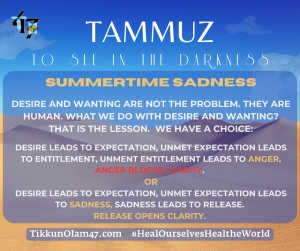
And this is the takeaway. As we enter into the saddest part of the Jewish calendar. As we enter into “Summertime Sadness.” This is the message:
Desire and wanting are not the problem. Desire and wanting are human. What we ATTACH to the desire and wanting are what blocks us.
We have a choice.
Desire leads to expectation. Expectation leads to entitlement. Entitlement leads to anger.
Or
Desire leads to expectation. Expectation leads to sadness. Sadness leads to release.
The choice is ours.
Summertime sadness? It’s healing. Don’t fight. Embrace.
These are my thoughts. What are yours?
Here are my thoughts from the past two years:
Tyler’s Torah Thoughts for 12 Tamuz, 5783.
Shabbat Shalom!
Today’s portion has a lot. It’s messiah. It refers to immorality and poop and bare anuses.
I want to focus on Messiah. Because I feel like across the various religions, this is a great source of controversy.
Balaam tells Balak a parable that basically refers to the Messiah.
“The word of Balaam son of Beor. the word of a man with an open eye. The word of the one who hears God’s sayings, and knows the thoughts of the Supernal One, who sees God’s vision lying down, yet with open eyes.
I see him, but not now. I perceive him, but he is not near.
A star will shoot forth from Jacob, and a staff will arise from Israel. He will crush the princes of Moab, he will devastate all the descendants of Seth. Seir, his enemy, will be possessed, and Israel will grow strong.
A ruler will come from Jacob, and destroy the remnant of a city.”
Keep in mind. Balaam is NOT a member of the tribe of Israel. And yet he connected with Hashem.
First key point: ANYONE CAN CONNECT WITH HASHEM
Jews don’t have exclusive connection with Hashem. Yes, we are chosen by Hashem – to be set apart. But this doesn’t mean we are “better” than anyone else. Balaam heard from God.
Next. When it comes to Messiah, one of my favorite unifying ideas around messiah? We are ALL messiah.
Second key point: WE ARE ALL MESSIAH
From my commentary last year:
Kabbalah talks about this passage from Balaam as a story about Messiah. It asks the question: “Who is the Messiah?”
Here’s the answer:
It’s you.
At least that was the conclusion reached by Rabbi Menahem Nahum of Chernobyl (1730-97) in his work “The Light of the Eyes.”
Of course, Judaism always maintained that there will be a particular Messiah, a man descended from King David who would bring about the political restoration of Biblical Israel. What Rabbi Menahem Nahum added to this idea is that the global change in consciousness necessary to make this possible depends not only upon the Messiah himself but on the individual too. Each one of us, he argued, contains a spark of the Messiah (what the Torah refers to here as a “star”), an inner sanctum of the very purest spirituality which it is our task to “locate” and make an active part of our lives.”
Maimonides writes about two messiahs in reference to the star and staff:
In the Torah passage of Balaam, he prophesies about two Messiahs-the first Messiah, David, who saved Israel from her oppressors; and the final Messiah, who will arise from his descendants and ultimately save Israel.
There it is written, “I see him, but not now” – this refers to David;
“I perceive him, but he is not near” (verses 17-18)-this refers to the King Messiah;
“A star will shoot forth from Jacob”- this refers to David;
“And a staff will arise from Israel” – this refers to the King Messiah;
‘He will crush the princes of Moab”-this refers to David, as the verse states, “He smote Moab and measured them with a line” (Il Samuel 8:2);
“He will devastate all of the descendants of Seth”- this refers to the King Messiah, about whom it is written, “He will rule from sea to sea (Zechariah 9:10);
“Edom will be possessed” – this refers to David, as the verse states, “Edom became the servants of David, etc.” (Il Samuel 8:6; ibid.,14);
“Seir.…. will be possessed”- this refers to the Messiah, as the verse states, “Saviors will ascend Mount Zion to judge Mount Esau” (Obadiah 1:21)
Some really interesting thoughts here on Messiah. I’m curious to know your thoughts!
I think about other perspectives on Messiah. Even in Christianity, there is a concept about “Jesus being in you.”
This relates (in my opinion) with this idea;
“Each one of us, he argued, contains a spark of the Messiah (what the Torah refers to here as a “star”), an inner sanctum of the very purest spirituality which it is our task to “locate” and make an active part of our lives.”
All of us have the opportunity to locate this messiah within us. And if we do that? We can change the collective consciousness and messiah would be more present here on earth, right?
I love that Jewish thought engages with the collective consciousness. How our consciousness can connect with others’.
Think about it. What are you conscious of? We have power. I can be conscious of my feet touching the ground if I choose. I can be conscious of the tree on my walk if I choose. Understanding we have control of our consciousness? That is the beginning of spiritual liberation and freedom.
Are we looking for the messiah within? Or are we looking externally for our “salvation?” These are the questions (in my opinion) that can bring us TOGETHER instead of arguing over who messiah is.
I am curious on your thoughts on this.
Finally. Let’s talk about Angel Poop. Yes. Literal Angel poop. From my commentary a year ago:
Hasidic thought teaches that the angels too have “waste matter.” Just like the digestive system gradually sifts out the nutritious elements of the food, eventually leaving nothing but waste, the angels “sift out” the most lofty and pleasurable Divine emanations, which they transfer to the Garden of Eden (Paradise), and allow the “wastage” to fall to earth. The spiritual wastage is the source of all physical pleasures found in this world.
The pursuit of physical pleasures (spiritual wastage) is thus a subtle form of “Baal-peor.”
For it is fitting for man who is made in God’s image, to focus primarily on filling his life with more lofty spiritual pleasures.” (End quote)
Think about this. The physical pleasures of THIS world is the Spiritual Waste in paradise. Now. Initially, this may seem like something “external.” But if you think about it, if messiah is us, when we tap into that spiritual spark inside of us (Our Neshama), we will experience joy and pleasure far beyond the moments of physical pleasure we normally experience.
I have experienced this myself.
Third Key Point: PHYSICAL PLEASURES ARE GOOD. SPIRITUAL PLEASURES ARE EVEN BETTER
Because even the poop from angels? That is probably better than anything found on this earth.
How do we navigate this? To me? It’s balance.
George Mumford speaks about balance – Too much Wisdom, we become cynical. Too much trust? Pollyanna.
We need to balance our spiritual journey and our physical ones. Yes, we are messiah. No, we cannot live fully in a spiritual realm because we are at the same time here on earth. We are grounded in this realm. So how do we balance this?
By spending time in all of these realms. Engaging physically with the world around us. Grounding ourselves in this reality. AND spending time within. Searching for the spark within us that is pure and spiritual. Our souls.
If more of us did this, our collective consciousness could “move mountains” as Jesus wrote about. Wise Jewish Middle-Eastern dude he was.
So those are my thoughts. What are yours?
Tyler’s Torah Thoughts for 16 Tamuz, 5782
Wow! What a morning of spiritual engagement for me! I’m very excited to dig into the Torah to see what we can learn! Let’s dig in!
Balak has taken Balaam to two places to see the Israelites in hopes that Balaam would curse the Jews.
Something a friend said about this weeks Parsha; It’s one of the lenses used to prove how the Torah is supernatural. Because we have Balak and Balaam, who are telling the story, who are both not Jewish. How do we know about the story without them being a part of Israel? The only answer is God!!!
It’s also a sign that non-Jews CAN connect with God. Because Balaam was able to talk to God and listen to God. That should be encouraging for all of us!
So Balak takes Balaam to a third place. Balak says “hopefully it will be right in God’s eyes and you will condemn them for me from there.” Balak took Balaam to the peak of Peor, overlooking the waste lands.
They build seven altars again. But this time it seems Balaam gets a little cocky. He sees that blessing Israel was good in God’s eyes, so he didn’t go to God.
But that is going to be a mistake (I think?) Because from the beginning, God’s message to Balaam is to listen because He was going to give Balaam the words to say. Balaam did not heed this. Let’s see what happens;
So Balaam has a heart to curse the Jews; he started to focus and manifest a ton of negative energy – thinking about the golden calf, thinking and hoping that would discredit the Jews.
This is interesting given this month of Tamuz is all about the positivity Hashem was giving the Israelites; but they rejected it because of their impatience and they built a golden calf instead, turning this month into a month of mourning.
Tonight starts the three weeks until Tish’a B’Av. The ninth of Av, which is the saddest day on the Jewish calendar. More on that to come, but that we are focused on the golden calf is interesting!
So getting back to the portion – Balaam goes to raise his eyes to Israel on the mountain hoping to cast an evil eye; but he saw Israel settled according their tribes, even in the wasteland. And he saw them the way God saw them and changed his mind.
He launched into a parable – That basically led to Balaam saying “those who bless Israel will be blessed, and those who curse Israel will be cursed.”
Let’s sit with that. Just for a minute. As Jews, we will take in the energy given to us. If people pour positive energy into us, we return positive energy. If they pour negative energy we return negative energy.
I’m just sitting with that energy transfer. Almost like a crystal or a stone. Which is also interesting given the tribes are each represented by a stone in the Torah. And those stones are put together on the breastplate of the priests. It really makes me wonder!
Back to the portion.
Balak (as you can imagine) becomes FURIOUS! He claps his hands together (is this a clap back?) and Balak says “I called you to curse my enemies and you’ve just now blessed them three times! Go home. I was going to give you tremendous honor, but God has deprived you of honor.”
Stopping here. The question is whether God can deprive us of honor? Obviously, He can’t. He can deprive us of the honor of humanity, for sure. But that comes back to the idea of whether we are bodies with a soul inside of us, or whether we are souls enclothed in a body.
Our soul is what craves God’s honor. Our bodies crave the honor of humanity.
Balaam respond to Balak and says “no big deal dude, I’ve told you from the beginning what I was going to do; I am speaking the words God is telling me to speak. I can’t transgress the word of God to do good or evil in my own” (I may be paraphrasing here).
And to give you a spoiler alert for tomorrow? We are going to talk about messiah. Because that’s where this is headed. And I think we are going to be surprised at what the Torah says, and what it might mean! Stay tuned!
What are your thoughts?


No responses yet