Tyler’s Torah Thoughts for 14 Iyar, 5784 –Day 29 of Omer – The Second Passover
Parsha Be-Har – “On The Mountain” (Leviticus 25:1 – 26:2)
Fourth Portion: Leviticus 25:25 – 25:28
What an amazing day. SO MANY things shifting.
First. Today is the “Second Passover.” It is the day of Second Chances. Here is a great primer on the Holy Day from Chabad
Today we get a second chance to restore our relationship within ourselves. And to reconnect with others. Today is ANOTHER Day of freedom. We do not have to be stuck where we were. We can move forward.
Second. Today is Day 29 of the Omer. Which means we enter the fifth week of the Omer.
This week, our theme is – Hod – which means “surrender.” It means “Humility.” From Chabad:
If endurance is the engine of life humility is its fuel. As gevurah (discipline) gives chesed (love) focus, hod gives netzach direction.
Humility is the silent partner of endurance. Its strength is in its silence. Its splendor in its repose. Humility leads to yielding, which is an essential element of Humility – and the resulting yielding – should not be confused with weakness and lack of self-esteem.
Humility is modesty; it is acknowledgement (from the root “hoda’ah”). It is saying “thank you” to G‑d. It is clearly recognizing your qualities and strengths and acknowledging that they are not your own; they were given to you by G‑d for a higher purpose than just satisfying your own needs. Humility is modesty; it is recognizing how small you are which allows you to realize how large you can become. And that makes humility so formidable.
Endurance draws its energy from the acknowledgement of humility. Human endurance goes only as far as your tolerance level. Acknowledging that your strengths come from a higher place gives you the power to endure far beyond your own perceived capacity. It gives you part of G‑d’s enduring strength.
A full cup cannot be filled. When you’re filled with yourself and your needs, “I and nothing else”, there is no room for more. When you “empty” yourself before something which is greater than yourself, you allow in much more than your limited capacity. Humility is the key to transcendence; to reach beyond yourself. Only true humility gives you the power of total objectivity.
Humility is sensitivity; it is healthy shame out of recognition that you can be better than you are and that you expect more of yourself. Although humility is silent it is not a void. It is a dynamic expression of life that includes all seven qualities of love, discipline, compassion, endurance, humility, bonding and sovereignty. Humility is active not passive. Not a state of being but an interaction even in its calm and inaction.
To me, all of this means that Surrender is the Direction of Victory. Humility is the Direction of Endurance. I once asked a spiritual coach – how can surrender and victory work together? They seem like polar opposites. She replied – it is all within us.
We must surrender within to see victory within. This is the theme this week. What do we need to surrender this week, given our second chance with the second Passover?
Today, we look at specifically, the Chesed of Hod – the Loving-Kindness of Humility. From Chabad:
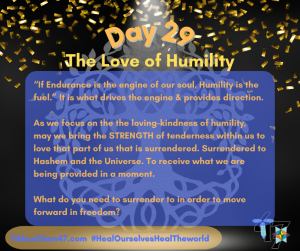 Examine the love in your humility. Healthy humility is not demoralizing; it brings love and joy not fear. Humility that lacks love has to be reexamined for its authenticity. Sometimes humility can be confused with low self-esteem, which would cause it to be unloving.
Humility brings love because it gives you the ability to rise above yourself and love another. Arrogance in the guise of love means loving yourself, or what is even worse: making others a part and an extension of yourself and your self-love.
Does my humility cause me to be more loving and giving? More expansive? Or does it inhibit and constrain me? Am I humble and happy or humble and miserable?
Exercise for the day: Before praying with humility and acknowledgment of G‑d, give some charity. It will enhance your prayers.
With this, let’s dig in to the portion:
25If your brother becomes destitute and sells some of his inherited property, his redeemer who is related to him shall come forth and redeem his brother’s sale.
The Torah navigates what happens when someone becomes destitute. When he loses his inheritance. His redeemer – a family member – will come in and redeem the sale – to keep it in the family.
26And if a man does not have a redeemer, but he gains enough means to afford its redemption,
27he shall calculate the years for which the land has been sold, and return the remainder to the man to whom he sold it, and [then] he may return to his inheritance.
28But if he cannot afford enough to repay him, his sale shall remain in the possession of the one who has purchased it, until the Jubilee year. And then, in the Jubilee year, it shall go out and revert to his inheritance.
In the Jubilee year, even the destitute man receives his inheritance. This is the second chance. This is the humility. Because to RECEIVE this? Would be incredibly challenging.
What are your thoughts?
Here are my thoughts from two years ago:
Tyler’s Torah Thoughts for 17 Iyar, 5782
Today is the 32nd day of the Omer. Tonight begins the Jewish Holiday of “Lag B’Omer” which literally means the 33rd in the Omer. It is a time where we let go of mourning (the Omer is a mourning period) and allow celebrations to occur. The origins of this holiday aren’t very clear.
One of the traditions is to have a bonfire; tonight would be the night that would happen.
Ok. Let’s dig into the Torah portion for today!
We get more on the idea of hereditary land and property.
- If a fellow Jew becomes destitute and he sells some (or all) of his hereditary land, a close relative should come as his advocate and buy the land back from the purchaser, redeeming his relatives undesirable purchase.
- If a man doesn’t have a close relative as an advocate and he later becomes wealthy to afford its redemption, he should calculate the number of years it’s been sold and give back the balance to the man to whom he sold it. He can then return to his hereditary land.
- If he cannot find sufficient funds to repay the purchaser then what he sold will remain in the possession of its purchaser until the jubilee year. Then the land will return to its rightful owner.
As I reflect on this passage – in some senses we are talking a literal sale of land. But the Torah sometimes speaks metaphorically.
A friend and I were discussing the idea of a midlife crisis. This generally occurs around 49/50 years old (give or take). We talked about how we tend to overdramaticize this process and what is really happening is a mid life transition. That feels more natural.
Part of me wonders if the idea of the jubilee year in our lives (when we turn 49) we are meant to return to our youth and roots. We are supposed to let go of everything we’ve “purchased” and move back to a place that feels more natural and like “home.” Our society tends to see this almost unnatural. But in reality this could be a normal stage of life.
Just something I’m reflecting on this morning!
What do you think?


No responses yet