Tyler’s Torah Thoughts for 16 Tammuz, 5784
Parsha Pinchas: (Numbers 25:10 – 30:1)
Second Portion: Numbers 26:5 – 26:51
Good morning! As our workweek begins, we are called to count. There is lots of counting in Judaism. In the Torah. We have the Omer count. We have the census once Jacob goes to Egypt. We have the census at the beginning of numbers (603,550). And today? We count again.
Pinchas means “Lantern” – this parsha is meant to be a light for us. What is the light showing us? I see a few things. This was something that has stuck with me the past few years reading this portion:
“There is a basic difference between our Jewish tradition and those of other faiths, such as Christianity or Islam. For, whereas in the latter cases, the traditions go back to one individual or a limited number of individuals, our traditions go back to a revelation, which was experienced by a whole people at once, so that at no time did we have to place our trust in the veracity of one, or a few, individuals.”
The idea here is – LOTS of people experienced these events unfolding. It wasn’t limited to a few. There is access to ALL. It is expansive.
One Man – Abraham came two – Ishmael and Isaac
Two men – From Isaac came Jacob and Esau.
70: From Jacob came 70 into Egypt.
603,550: From those who entered Egypt, 603,550 were freed.
The light is shining on our expansion. One of my favorite quotes from the movie “The Power of One” is “A waterfall begins with a single drop of water.”
Within us – we can see the spiritual seed of one growing and expanding. Let’s see what today’s count illuminates:
5Reuben, Israel’s firstborn: The descendants of Reuben were: the family of the Hanochites from Hanoch; the family of the Paluites from Palu,
6the family of the Hezronites from Hezron, and the family of the Carmites from Carmi.
7These were the families of the Reubenites, and they numbered forty three thousand, seven hundred and thirty.
Reuben was 43,730. At the beginning of Numbers, Reuben was 46,500 – this was a 6% reduction
8The sons of Palu were Eliab.
9The sons of Eliab were Nemuel, Dathan and Abiram they are Dathan and Abiram, the chosen of the congregation who incited against Moses and Aaron in the assembly of Korah, when they incited against the Lord.
10And the earth opened its mouth and swallowed them and Korah, when that assembly died, and when fire destroyed two hundred and fifty men, and they became a sign.
11Korah’s sons, however, did not die.
And lest you think this reduction is solely because of Korah? His lineage did not die. That is an important thing to shed light on! Let’s keep going:
12The descendants of Simeon according to their families: the family of the Nemuelites from Nemuel, the family of the Jaminites from Jamin, the family of the Jachinites from Jachin,
13the family of the Zerahites from Zerah, the family of the Shaulites from Shaul.
14These were the families of the Simeonites twenty two thousand and two hundred.
Simeon – 22,200. At the beginning? 59,300. This is a SIGNIFICANT Reduction! 63%
15The descendants of Gad according to their families: the family of the Zefonites from Zefon, the family of the Haggites from Haggi, the family of the Shunites from Shuni,
16the family of the Oznites from Ozni, the family of the Erites from Eri,
17the family of the Arodites from Arod, the family of the Arelites from Areli.
18These were families of Gad according to those of them counted, forty thousand and five hundred.
Gad – 40,500. At the beginning? 45,650. 11% reduction
19The sons of Judah were Er and Onan, but Er and Onan died in the land of Canaan.
20The descendants of Judah according to their families: the family of the Shelanites from Shelah, the family of the Perezites from Perez, the family of the Zerahites from Zerah.
21The descendants of Perez were: the family of the Hezronites from Hezron, the family of the Hamulites from Hamul.
22These were the families of Judah according to those of them counted, seventy six thousand and five hundred.
Judah – 76,500. At the beginning? 74,600. A 2.5% increase.
23The descendants of Issachar according to their families: the family of the Tolaites from Tola, the family of the Punites from Puvah,
24the family of the Jashubites from Jashub, the family of the Shimronites from Shimron.
25These were the families of Issachar according to those of them counted: sixty four thousand and three hundred.
Issachar – 64,300. At the beginning? 54,400. An 18% increase.
26The descendants of Zebulun according to their families: the family of the Sardites from Sered, the family of the Elonites from Elon, the family of the Jahleelites from Jahleel.
27These were the families of Zebulun according to those of them counted, sixty thousand and five hundred.
Zebulun – 60,500. In the beginning they were 57,400. 5% increase.
28The descendants of Joseph according to their families: Manasseh and Ephraim.
29The descendants of Manasseh: the family of the Machirites from Machir and Machir’s son was Gilead; the family of the Gileadites from Gilead.
30These were the family of the descendants of Gilead: The family of the Iezerites from Iezer, the family of the Helekites from Helek,
31the family of the Asrielites from Asriel, the family of the Shechemites from Shechem,
32the family of the Shemidaites from Shemida, the family of the Hepherites from Hepher.
33Now Zelophehad the son of Hepher had no sons, only daughters, and the names of Zelophehad’s daughters were Mahlah, Noah, Hoglah, Milcah and Tirzah.
34These were families of Manasseh, and those of them counted were fifty two thousand and seven hundred.
Manasseh: 52,700. At the beginning? 32,200. A 64% increase.
35These were the descendants of Ephraim according to their families: the family of the Shuthalhites from Shuthelah, the family of the Bachrites from Becher, the family of the Tahanites from Tahan.
36And these were the descendants of Shuthelah: the family of the Eranites from Eran.
37These were the families of the descendants of Ephraim according to those of them counted, thirty two thousand and five hundred; these were the descendants of Joseph according to their families
Ephraim: 32,500. At the beginning? 40,500. A 20% reduction.
Total for Joseph? 85,200. A 17% increase.
What is interesting here is the order. At the beginning of the Book of Numbers? Ephraim was talked about before Manasseh. Here Manasseh was first. I am curious if it was because of the significant increase.
38The descendants of Benjamin according to their families: the family of the Belaites from Bela, the family of the Ashbelites from Ashbel, the family of the Ahiramites from Ahiram,
39the family of the Shuphamites from Shupham, the family of the Huphamites from Hupham.
40The sons of Bela were Ard and Naaman; the family of the Ardites [from Ard], the family of the Naamites from Naaman.
41These were the descendants of Benjamin according to their families, and those of them counted were forty five thousand and six hundred.
Benjamin: 45,600. At the beginning? 35,400. A 29% increase.
42The descendants of Dan according to their families: the family of the Shuhamites from Shuham. These were the families of Dan.
43All the Shuhamite families according to those of them counted, were sixty four thousand and four hundred.
Dan – 64,400. At the beginning? 62,700. 3% increase.
44The descendants of Asher according to their families: the family of Jimnah from Jimnah, the family of the Ishvites from Ishvi, the family of the Beriites from Beriah.
45The descendants of Beriah: the family of the Heberites from Heber, the family of the Malchielites from Malchiel.
46The name of Asher’s daughter was Serah.
47These were the families of the descendants of Asher according to those of them counted, fifty three thousand and four hundred.
Asher: 53,400. At the beginning? 41,500. 29% increase.
48The descendants of Naphtali according to their families: the family of the Jahzeelites from Jahzeel, the family of the Gunites from Guni.
49The family of the Jezerites from Jezer, the family of the Shillemites from Shillem.
50These were the families of Naphtali according to their families, and those of them counted were forty five thousand and four hundred.
Naphtali – 45,400. At the beginning? 53,400. A 15% decrease.
51These are those counted of the children of Israel: six hundred and one thousand and seven hundred and thirty.
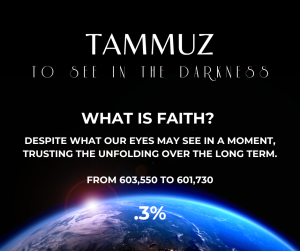
So total? 601,730 were counted. At the beginning? 603,550. This is a .3% reduction. That’s it.
So some thoughts here.
First. Korah’s rebellion? Wasn’t as impactful on the overall numbers. There were tribes that had a significant reduction (Simeon had the largest reduction by 63%). And there were tribes with significant increase (Menasseh had a 64% increase).
Yet overall? There was a balance. Consistency.
Remember the fear of Pharaoh? That Israel was going to grow so much they’d take over? The Children remained consistent in this wilderness process. As wild and crazy as the journey has been? There has been stability in the background for the family of Israel.
What is our takeaway? When we focus on a moment? We can judge it as unstable and chaotic. In the long term? Those moments are all a part of the stability of what is happening behind the scenes.
This is the tough trust we need to have with Hashem:
Despite what we may see with our eyes in a moment? We can trust the unfolding. This? May be the best definition of faith.
Here are my thoughts from the past two years:
Tyler’s Torah Thoughts for 14 Tamuz, 5783
Today’s portion of Pinchas is really interesting. It is a Census.
Why a Census? Every time in the Torah I read a census? I think to myself – “Why is Hashem wanting to remind us that we matter? That we count?”
Everyone counted during the census. 601,730. in this particular census. We know that from one of the early census – when Jacob and his sons came to Egypt, there were 70 of them. There was SIGNIFICANT growth from the moment Jacob (Israel) came to Egypt, to this point of the Torah. Think about this.
Joseph sold into slavery, freed and runs into Potiphar’s wife. Put BACK into prison. Interprets a dream and is made King of Egypt to get them through 7 years of famine.
Dark times turn for Israel as they went from BELOVED of Egypt to slaves in Egypt. And. A decree that all Jewish boys born would be killed.
Moses is saved – he is brought up as a prince in Egypt – but then kills a man and runs to exile. Meets with Hashem, returns with Aaron and demands Pharaoh free the slaves. Pharaoh makes life harder.
Hashem destroys Egypt by killing the first born among them. Israel is freed from Egypt.
They are supernaturally taken care of – splitting of the sea, provision in the wilderness.
They reach the promised land – and 12 men are sent in – 10 report back “we can’t do it” two say “yes we can”
Israel turns around and wanders again
We get to Mt Sinai – Moses goes and talks to Hashem – Hashem speaks to the people – but it’s too much. They reject Hashem.
Instead of being patient and waiting for Moses – Israel builds the golden calf. Worships this statue.
And yet, the number of Israel continues to grow. To flourish.
Balaam and Balak try to curse Israel. They hatch a plan – that seems to work. Israel starts to inter marry with a foreign nation. A plague happens.
What a roller coaster we have experienced. And. yet we continue to grow.
My takeaway today? The census is connected to the space within our hearts. Our capacity to love ourselves and love others. If we are seeing a continuum – we went from 70 to 601k. Our hearts expanded. as we ready the Torah – where we were when we started the process, if we kept on this journey? I would imagine our hearts have expanded to this degree.
And. In addition? The stability of Israel, of Judaism, comes from this notion I wrote about from my chumash a year ago:
“There is a basic difference between our Jewish tradition and those of other faiths, such as Christianity or Islam. For, whereas in the latter cases, the traditions go back to one individual or a limited number of individuals, our traditions go back to a revelation, which was experienced by a whole people at once, so that at no time did we have to place our trust in the veracity of one, or a few, individuals.”
Our trust in NOT in Moses. It is in Israel. Our hearts. Expansion. We are learning (in my opinion) the Torah is teaching us to trust OUR OWN Neshama. The Neshama within. We don’t look to external sources for success. External metrics from reassurance. The assurance we have comes from our relationship with our Neshama. Our Hashem. Not “my” Hashem. Not “my” Neshama.
Because although there IS a reality to “my” Neshama, I believe Hashem wants us to look BEYOND and see “our” Neshama. The collective of all of the Neshama’s around us. Although I exist, at the same time there is no “I”, there is no “my”, there is no “me.”
There is only “us.” There is only “we.” There is only “ours.”
That’s something to take count of. That’s something to take a census of.
Those are my thoughts – what are yours?
Tyler’s Torah Thoughts for 19 Tamuz, 5782
Good morning! As we start this new week, I’m excited for what is ahead of us! May your week be full of positive energy and fulfillment! Let’s dig in!
Today’s portion is a census. It would seem pretty boring on the surface.
Rashi writes this about the census:
The nations would taunt Israel, saying, “Why do they trace their lineage by tribe? Do they really think that the Egyptians did not have their way with their mothers?”
So God placed His name, spelled yod-he, upon them–the letter he at one side and the letter yod at the other (e.g., Hanokh becoming Ha-HanokhY), as if to say, “I testify that these people are indeed the sons of their fathers”
This is why the text changes; Enoch becomes The Enochite family (as an example).
In the Zohar:
“The letter yod was added to Phinehas’ name and the letter “He” was added to Joseph’s name (see Psalms 81:6) because they were both zealous about the prohibition of cohabiting with a non-Israelite woman-Phinehas killed Zimri and Joseph resisted the persistent attempts of Potiphar’s wife
So we are seeing there may be more here than just a census.
When we get to Numbers 26:9, we learn about Dathan and Abiram. They were the sons of Eliab, the son of Pallu, the son of Reuben. Dathan and Abiram were the communal delegates from Korah’s group that incited the people against Moses. We also learn something here; Korah’s sons did not all die. In the Psalms we read “a song of the sons of Korah.”
This is how the Torah treats the tribe of Reuben. It serves as a reminder of what happened, AND gives us a glimmer of hope at the same time.
After Reuben we learn about Simeon’s descendants.
After Simeon we get to Gad.
Then Judah
Then Issachar
Then Zebulun
Then Joseph – which of course was split between Ephraim and Manasseh.
Then Benjamin
Then Asher
Then Naphtali.
Something the Chumash I am reading points out about Judaism (as compared to Islam and Christianity as examples is this):
“There is a basic difference between our Jewish tradition and those of other faiths, such as Christianity or Islam. For, whereas in the latter cases, the traditions go back to one individual or a limited number of individuals, our traditions go back to a revelation, which was experienced by a whole people at once, so that at no time did we have to place our trust in the veracity of one, or a few, individuals.”
There is a comfort there.
The portion today ends with the total number of the children of Israel was 601,730.
What are your thoughts?


No responses yet