Tyler’s Torah Thoughts for 21 Iyar, 5783. 36th Day of the Omer.
We have a new week of the Omer. And a new theme! This week’s theme is “Yesod” or “Bonding.”
From Chabad:
Week Six – Yesod
Bonding is the ultimate emotional connection. While the first five qualities (love, discipline, compassion, endurance and humility) are interactive, they manifest duality: the lover and the beloved. The emphasis is on an individual’s feelings, not necessarily on mutuality.
Bonding, on the other hand, is a complete fusion of the two. Without bonding no feeling can be truly realized. Bonding means connecting; not only feeling for another, but being attached to him. Not just a token commitment, but total devotion. It creates a channel between giver and receiver. Bonding is eternal. It develops an everlasting union that lives on forever through the perpetual fruit it bears. Bonding is the foundation of life. The emotional spine of the human psyche. Every person needs bonding to flourish and grow. The bonding between mother and child; between husband and wife; between brothers and sisters; between close friends. Bonding is affirmation; it gives one the sense of belonging; that “I matter”, “I am significant and important”. It establishes trust – trust in yourself and trust in others. It instills confidence. Without bonding and nurturing we cannot realize and be ourselves.
Bonding channels all five previous qualities into a constructive bond, giving it the meaning “foundation”. Whereas all other human feelings are individual emotions, separate stories of a building, each a necessary component of human experience, bonding channels and integrates them all into one bond which creates a foundation upon which the structure of human emotions firmly stands. Bonding is giving all of yourself not just part; it is not one emotion but all of them. So Yesod completes the spectrum of the first six emotions.
The foundation of Yesod is different from an ordinary foundation. It does not just rest beneath the higher levels of the structure, but encompasses them all. An effective bedrock of the emotional psyche cannot remain separate but must include and permeate all the emotions. Only then can bonding be constructive and everlasting.
So this idea of “bonding” in love. How we attach to others and the healthy and unhealthy ways we bond with another soul is something I am reflecting on. I have done a lot of research into attachment styles – secure, avoidant, anxious (and various combinations of these attachment styles). I feel that Hashem and the Torah provide us excellent opinions on how to form secure attachments. Even at the age of 51. So let’s look this week on attachment. Here’s the first factor, love and kindness.
From Chabad:
Day One of Week 6: Chesed of Yesod
Love is the heart of bonding. You cannot bond without love. Love establishes a reliable base which allows bonding to build on. If you have a problem bonding, examine how much you love the one (or the object) you wish to bond with. Do I try to bond without first fostering a loving attitude? Is my bonding expressed in a loving manner?
Exercise for the day: Demonstrate the bond you have with your child or friend through an act of love.
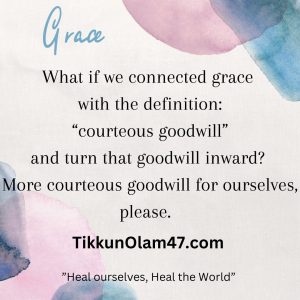
My IMMEDIATE thought goes inward. If we have a problem bonding, maybe it isn’t the one (or the object) we wish to bond with? Maybe it is more about the bonding and love we have within? Maybe if we aren’t kind to ourselves, we cannot bond with others in kindness. If we are self-critical, maybe that becomes the glue that bonds us to another – as opposed to lovingkindness. So we want secure attachments? Start with ourselves. That’s my thought. The word “Grace” gets used a lot in our culture. “We need to give ourselves grace.” When I looked at the definition, something caught my eye. It’s “Courteous Goodwill.” We don’t share enough “courteous goodwill” for ourselves. I then rewrote (or maybe provided commentary on) the song Amazing grace over on facebook:
Tyler’s Torah Thoughts for 24 Iyar, 5782
Today is the 39th day of the Omer!
Good morning friends! Todays passage is going to once again be challenging for us given our current values.
Let’s dig in.
The Torah starts by talking about vows; and the ”value” of an adult or child’s life to God’s sanctuary – and the pledge that must be given.
- Between 20-60 years old, 50 sheckles for a man. 30 for a woman.
Ugh. Before I comment let’s keep going
- Between 5-20 years old, 20 Sheckles for a boy and 10 for a girl
- Between 1 month and 5 years, 5 sheckles for a boy, 3 for a girl.
- Over 60? Male is 15 sheckles and female is 10.
If he is too poor to pay, then the one who makes the pledge should bring the person to the priest and the priest should evaluate them based on how much the person pledging can afford.
Ok. So. There are some thoughts to he had here.
- The different financial “values” on gender is problematic on one hand. But also communicates some things on the other hand.
- it is clear in Torah that all of us (male and female) have infinite value. So this seems purely rooted in a form of capitalism (maybe?)
- These are what one would PAY the priest. You could argue that it cost more to pledge a man because they were LESS valuable financially – in other words – I have two people- you tell me you’ll take them off my hands if I pay you $50 and the other you’ll take off my hands if I give $30. That seems counter intuitive when it comes to value.
What are your thoughts?
We move from money to consecrating animals to the Temple.
The Torah says whatever is consecrated if an animal that part become holy. For example if a limb of an animal is brought – that becomes holy.
If someone tries to bring a blemished animal? Then basically the priest will determine the consecration value.
The animal will be offered to be sold. If someone else purchases it, then it will be sold for what the priest set the price at. If the original owner wants to redeem it, they need to add a fifth to its value!
So you better be sure you want to do this. Because it will cost you to go back.
The same goes for consecrating houses.
I think the main idea in today’s portion is about dedicating things to holy purpose. Whether it be a person, an animal, or even a house. If you are saying you want holiness – to be set apart, you better be sure!
Thoughts?


No responses yet