 Tyler’s Torah Thoughts for 3 Adar II, 5784
Parsha Pekudei: (Exodus 38:21 – 40:38)
Fourth Portion: Exodus 39:33 – 39:43
Good morning! As we are now more than halfway finished this final Parsha of Exodus, we are shifting towards movement. As this story has been all about being in Slavery, and the process of freedom and liberation. And the process of wandering in the wilderness, we are coming to the end. They have been given the direction while in the wilderness. The direction was given to lead them FULLY to freedom. The Torah is not designed for oppression and control. It’s seen that way for sure. But it’s designed to guide us to liberation. Let’s see where we go from here:
33Now they brought the Mishkan to Moses, the tent and all its furnishings its clasps, its planks, its bars, its pillars and its sockets,
The question is WHY? Why did they do this? The belief according to Rashi (an ancient commentator on the Torah) was that the beams were too heavy. Let’s keep going:
34the covering of rams’ skins dyed red, the covering of tachash skins, and the screening dividing curtain,
35the Ark of the Testimony and its poles and the ark cover,
36the table, all its implements and the showbread,
37the pure menorah, its lamps, the lamps to be set in order and all its implements, and the oil for the lighting,
38the golden altar, the anointing oil and the incense, and the screen of the entrance to the tent,
39the copper altar and its copper grating, its poles and all its implements, the washstand and its base,
40the hangings of the courtyard, its pillars and its sockets, and the screen for the gate of the courtyard, its ropes and its pegs, and all the implements for the service of the Mishkan, of the Tent of Meeting,
41the meshwork garments for the service in the Holy, the holy garments for Aaron the Kohen [Gadol] and his sons’ garments for serving [as kohanim].
42In accordance with all that the Lord had commanded Moses, so did the children of Israel do all the work.
43Moses saw the entire work, and lo! they had done it-as the Lord had commanded, so had they done. So Moses blessed them.
The idea here is upon completion, when given a task, the people did the task as Hashem and Moses had instructed. They did NOT get creative with the directions.
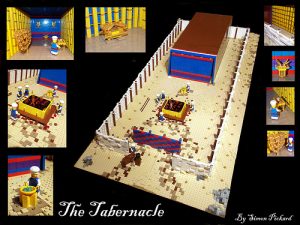
I am reflecting on this. And thinking about the idea of creativity and co-creation. And Lego.
I love Lego. I have always loved Lego. And it is interesting. How I play with Lego, and how my kids play with Lego? Very different.
The people who make Lego have a design in mind. They provide DETAILED instructions. When I purchase my Lego set, and I build Lego, I am indeed creating. I am co-creating with the makers of Lego, the set as it is DESIGNED.
Do I feel OBLIGATED to follow the directions? Or do I DESIRE to follow the directions? Wouldn’t it be MORE creative to take the set and just build what I want?
And I reflect on that. The designer gives me the materials. Has a way they see those pieces coming together. I CHOSE the design in the store of what I wanted to build. I could have chosen a DIFFERENT design. I have sovereignty. I have freedom. And when I get the set home? I am SUPER excited to build the set I have chosen. I am co-creating – like Bezalel – the master weaver – and I am a master builder – building the set as it was designed.
And when I am done? I will measure my success based on whether what I did MATCHES the picture on the box.
And. The box has OTHER ways the set can be put together usually, doesn’t it?
I don’t feel OBLIGATED to put the set together the way it was designed. I DESIRE to put the set together the way it was designed.
Do we JUDGE the creativity it takes to put together a Lego set? Is it MORE or LESS creative to put the set together the way it was designed? What is CREATIVITY? These are questions today’s portion has me thinking about.
What about you?
Here are my thoughts from the past two years:
Tyler’s Torah Thoughts for 24 Adar, 5783
So many interesting things in this joined portion.
The thing I reflect on today centers around the idea of obligation. When we feel OBLIGATED to be with someone. Or to do nice things for them. The opposite of obligation is DESIRE.
I want to be with friends who desire to be with me. That don’t feel like they are obligated to.
I think Hashem; and our higher selves (the Neshama within) don’t want to feel obligated.
When we feel obligated to ourselves, like we are a burden, I feel like that is when things go wrong.
We should DESIRE the best for ourselves. We do that so easily for others we care about. Yet it feels so difficult for us to do within us. Do we desire the best for us? Or do we believe we don’t deserve it? These are fundamental questions that need to be answered.
What are your thoughts?
Tyler’s Torah Thoughts for 29 Adar I, 5782
So, yesterday we left off with all the materials for the tabernacle made according to how Hashem commanded it. Today we are going to see what happens when they put it together.
Before jumping in, I had a reflection I wanted to share about our connection to Hashem. I’ve been processing a lot about our human friendships and relationships. When we are connected to people who feel obligated to be with us, how does it feel compared to people who want and desire to be with us? If a friend only connects when you initiate with them, how does it feel? And how does someone else feel if we don’t initiate?
The way we approach Hashem works the same, I think. I don’t think Hashem wants us to feel obligated to be with him. Certainly that’s better than NOT connecting with Hashem; but it misses the point. Hashem wants to feel wanted (I think). You can say He isn’t worthy of our desire or wanting; but if He isn’t worthy, then are we? What makes us worthy of desire or wanting from another human?
In the end are we connecting with Hashem because we want to? Or because we feel obligated to? I think that’s a critical question to look at.
Let’s dig in.
So; the Israelites went to erect the tabernacle. Everything had gone smooth so far. But when it came time to erect the beams, they were too heavy.
WHAAAAATTTTT? God, you brought us all this way, and you had us construct these pieces exactly how you told us to, and now we can’t lift them to build the Tabernacle you told us to build?
I can imagine being a little frustrated by that. Feeling set up for failure. The question is what we do in those moments…where do we go?
For the children of Israel they brought everything to Moses. Each piece they brought was listed in todays portion.
Moses takes one look at all the work. He acknowledges they did it correctly. His response? Moses blessed the people.
This is how the portion ends. We don’t get resolution today. It feels a little disappointing. But Moses blessed them.
Rabbi Samson Raphael Hirsch writes;
“There is always a danger that religious enthusiasm might lead a person beyond the scope of what his religion actually demands Moses was impressed that, in this case, the children of Israel had managed to act enthusiastically without deviating from what needed to be done.
“They had done it” – the entire nation, young and old, had enthusiastically devoted themselves to building the Tabernacle. And they had done it as God had commanded,” keeping strictly to the precise instructions. No artisan had attempted to bring his own ideas to bear on his work.
When Moses realized that they had effectively balanced religious passion with careful observance, he “blessed them”-to continue always in the same fashion.”
So they build the items for the tabernacle with desire and wanting and not out of obligation – they did it without adding their own flair to it. They just did it. That is worthy of Moses blessing.
Tomorrow we hopefully will see what they did “wrong” when trying to put everything together before when the beams were too heavy to lift!
What are your thoughts?


No responses yet