Tyler’s Torah Thoughts for 4 Adar 1, 5784
Parsha Terumah: (Exodus 25:1 – 27:19)
Third Portion: Exodus 25:31 – 26:14
Good morning! It is a continued time of spiritual celebration as we expand our consciousness beyond what we thought was possible!
It was pure bliss to start a new journey yesterday as the class on Opening Doors to Sacred Love began. We had an amazing combination digging into some of the Sefirot – the idea of Wisdom, Kindness, and Victory. We applied these principles to the shadow of Entropy (the idea that order seeks chaos because it seeks change), which produces freshness in our spiritual journey – and then results in something INCREDIBLY beautiful.
We will likely be repeating the class in April (around Passover), so be on the lookout for your opportunity to join us!
This all relates to our passage today, as we dig into the instructions for the Tabernacle – which can be symbolic of our hearts.
Let’s dig in:
31And you shall make a menorah of pure gold. The menorah shall be made of hammered work; its base and its stem, its goblets, its knobs, and its flowers shall [all] be [one piece] with it.
32And six branches coming out of its sides: three menorah branches from its one side and three menorah branches from its second side.
33Three decorated goblets on one branch, a knob and a flower, and three decorated goblets on one branch, a knob and a flower; so for the six branches that come out of the menorah.
34And on [the stem of] the menorah [shall be] four decorated goblets, its knobs and its flowers.
35And a knob under the two branches from it, and a knob under the two branches from it, and a knob under the two branches from it; so for the six branches that come out of the menorah.
36Their knobs and their branches shall [all] be [one piece] with it; all of it [shall be] one hammered mass of pure gold.
37And you shall make its lamps seven, and he shall kindle its lamps [so that they] shed light toward its face.
38And its tongs and its scoops [shall be] of pure gold.
39He shall make it of a talent of pure gold, with all these implements.
40Now see and make according to their pattern, which you are shown on the mountain.
So before we build the actual Tabernacle (the Mishkan), we have been given the instructions for the depth of our hearts.
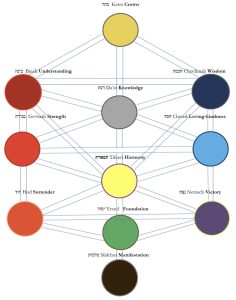
Yesterday the show table with challah on it – likely represented the Three upper Sefirot (the Jewish Energy Centers – kind of like Chakras for those who understand).
These “upper” Sefirot are (see the picture above);
-
- Chochmah (Wisdom)
- Bina (Understanding)
- Da’at (Knowledge)
In western society, Wisdom tends to be the “highest” level of internalization of a concept. But this is not the idea in Judaism. Wisdom and Understanding work together in Harmony to produce “Knowledge.” Knowledge is not like our current understanding. When we say someone “knows” something – its more an external knowledge. I can “know about” Kabbalah. But I don’t “know” Kabballah.
Knowledge – true knowledge is the highest form of these three concepts. This is why the bible says “Adam knew Chavah” (Eve was NOT her name in the Torah).
Knowledge is internal -which is why it is connected to sex.
So today, we look at the Menorah. For many – we have a visual of the Menorah – from Hanukkah, but this Menorah is NOT the Menorah of our hearts. The Menorah we are looking at today, is only 6 branches (and the Shamash) instead of 8.
Why is this important?
Because we have 7 more Sefirot to look at today. Here they are:
- Outer Left side:
- Chesed (kindness)
- Netzah (victory)
- Outer Right side:
- Gevurah (severity)
- Hod (splendor/surrender)
- Center three:
- Tiferet (beauty/harmony)
- Yesod (connection/foundation)
- Malkhut (humility/manifestation)
The ideas here are:
- The understanding of severity and wisdom of kindness come together in knowing harmony to produce beauty.
- The understanding of surrender and the wisdom of victory come together in knowing connection to produce a solid foundation
There are more, but this is a simple explanation of Kabbalah 101.
It’s beautiful. The work to freedom and liberation is squarely in our hearts.
What is our takeaway? How are we uncovering the depths of our soul?
This morning I read from Mark Nepo’s the Book of Awakening. This is what he wrote:
What Is Not Expressed
“What is not ex-pressed is de-pressed.”
It seems the more we express, that is, bring out what is in, the move alive we are. The more we give voice to our pain in living, the less build-up we have between our soul and our way in the world. However, the more we depress, the more we push down and keep in, the smaller we become. The more we stuff between our heart and our daily experience, the more we have to work through to feel life directly. Our unexpressed life can become a callus we carry around and manicure, but never remove. Experience can in effect lose its essential tenderness and poignancy, as we mistakenly conclude that life is losing its meaning. To a man unaware of the cataracts filming his eyes, the world seems dimmer, not his seeing. How often do we find the world less stimulating, unaware that our heart is diminished because of its encasement in all that remains unexpressed?
Let me give a personal example. I have, for many reasons, including issues of my own making, forever felt invisible in family or group settings. Initially, this stemmed from fearfully pleasing a self-centered mother at all cost. It led to years of unexpressed hurts and rejections that accrued into a callus that guarded the heart within my heart. I am and have always been a very open and emotionally accessible person, but at a certain depth, my core could not be touched. Though this started with Mother, it affected the level at which I could relate with anyone.
Eventually, this was not enough. I realized the world was not losing color, but that I was screening the deepest emotional colors out. That I state this so calmly and clearly in one sentence hardly reflects the difficult and slow, elusive way this awareness pained itself into my daily consciousness. Rather, it emerged in me gradually as I began to acknowledge and voice the feelings of invisibility I have carried all my life.
Whatever your own example, it seems our authenticity is tied to what is depressed and what is ex-pressed. Just as flowers need healthy root systems in order to blossom, feelings can only express their beauty when they are rooted cleanly within us, breaking ground in some manner, sprouting outside us. It is that delicate paradoxical inch of ground between surface and deep, between flower and root, between what is allowed out and what is allowed in, that continually determines whether we are living our lives or not.
This is the inner work. The depths of our hearts. The Torah lays this all out for us. And once we have these Sefirot, the three upper, and the 7 lower? Where do we go next?
1And the Mishkan you shall make out of ten curtains [consisting] of twisted fine linen, and blue, purple, and crimson wool. A cherubim design of the work of a master weaver you shall make them.
2The length of one curtain [shall be] twenty eight cubits, and the width of one curtain [shall be] four cubits; the same measure for all the curtains.
3Five of these curtains shall be joined to one another, and [the other] five curtains shall [also] be joined to one another.
4And you shall make loops of blue wool on the edge of one curtain [that is] at the edge of the [first] set, and so shall you do on the edge of the outermost curtain of the second set.
5You shall make fifty loops on [the edge of] one curtain, and you shall make fifty loops on the edge of the curtain in the second set; the loops shall correspond to one another.
6And you shall make fifty golden clasps, and you shall fasten the curtains to one another with the clasps; so shall the Mishkan become one.
7And [then] you shall make curtains of goat hair for a tent over the Mishkan; you shall make eleven curtains.
8The length of one curtain [shall be] thirty cubits, and the width of one curtain four cubits; the same measure for the eleven curtains.
9And you shall join the five curtains by themselves, and the [other] six curtains by themselves; and you shall fold the sixth curtain before the front of the tent.
10And you shall make fifty loops on the edge of one curtain, [which is] at the edge of the [first] set, and fifty loops on the edge of the [outermost] curtain of the second set.
11And you shall make fifty copper clasps; you shall bring the clasps into the loops, and you shall fasten the tent together so that it will become one.
12And the overhanging excess in the curtains of the tent half of the extra curtain shall hang over the rear of the Mishkan.
13And the cubit from here and the cubit from there of the excess in the length of the curtains of the tent shall hang over the sides of the Mishkan from here and from there to cover it.
14And you shall make a covering for the tent of ram skins dyed red and a covering of tachash skins above.
The Torah is building the human body around the heart. You see the curtains, the coverings – none of it is solid – like rock, granite, or stone. There is metal structure for sure. But the flow of the coverings is apparent. And that this portion ends with “skins” should be a good indicator of the symbolism and deep meaning of these passages; if we look deep enough.
What is our takeaway?
How will we uncover our hearts? How will we Ex-press our hearts instead of re-pressing them? Will we ex-press and speak our hearts desires and truths, living in fullness of the knowledge of who WE are? Or will we cover them up with stone, rock, and brick to live invisible lives?
This is the takeaway, in my opinion. But I am curious to your thoughts!
Here are my thoughts from the past two years:
Tyler’s Torah Thoughts for 30 Shevat, 5783
Tonight is the new moon, and the new month of Adar. Adar is a joyous month. Full of Mazal! Mazal means flow. So we are entering a moon cycle that is all about how things are flowing! Here’s a great article to read more;
https://www.chabad.org/…/Adar-The-Month-of-Mazal.htm
Thinking about the portion – and my writings a year ago, the concepts of the menorah and representing the sefirot, I am struck with the “flow” of how these all play together.
- Chesed (kindness)
- Gevurah (severity)
- Tiferet (beauty)
- Netzah (victory)
- Hod (splendor)
- Yesod (connection)
- Malkhut (humility)
May we set an intention for the moon cycle ahead to flow within us; to allow all of these sefirot to interconnect with one another and flow from us into the world.
Tyler’s Torah Thoughts for Shevat 30, 5782
Tonight at sundown begins the new month! This means it is a good time to reflect on our lives and the areas we want to focus on for the upcoming month.
For me, I’ve been chewing on human connection; and how important it is. Being mindful in each others presence and expanding our awareness beyond the borders of our own skin; and out into the spaces we find ourselves in. Too often I’m focused inward; in my head, in my heart. I need to do more grounding of myself and allowing my attention and focus to be external. It’s something I hope Adar I provides opportunities to grow and develop in!
Here’s todays portion;
Yesterday we focused on the ark, and the table. Today’s portion starts us off with the candelabrum. The image to have in mind is similar to the Hanukkah menorah. Except, in the temple, there were only 6 branches as opposed to 8 on the hanukah menorah. Also, the branches were more straight that they were curved. This was discovered of Nainonedes handwritten diagram and from Rashi’s commentary. Keep this in mind as we look at what the Torah says:
The candelabrum was to be made from a single metal block that was hammered. They were not intended to be made separately. Six branches should be coming out of its sides diagonally
Kabbalah talks about the seven branches (don’t forget the Shamash which is the center candle) represented the range of Devine emotional attributes (or Sefirot):
- Chesed (kindness)
- Gevurah (severity)
- Tiferet (beauty)
- Netzah (victory)
- Hod (splendor)
- Yesod (connection)
- Malkhut (humility)
The idea of the connection to the candelabrum is that it would be easy to see these seven sefirot as separate; and take the metaphor of the sefirot too literally. These sefirot, in actuality are all absorbed in God’s absolute oneness. The candelabrum was made of one piece of metal, and this contains the lesson that these sefirot are all connected and cannot be separated.
That’s critical to chew on. There is an interplay with these emotional attributes. It is interesting that I mentioned the idea of human connection above; I think my takeaway is that I cannot get hyper focused on this; I need to remember the other emotional qualities as i engage in the idea of human connection.
Next, the Torah talks about the coverings of the tabernacle. The roof of the Tabernacle was to be made from ten tapestries of fine linen, with animal designs woven into the fabric on both sides. I’m wondering if this is to represent what Kabbalah talks about the “animal soul.”
The directions include having five of the tapestries connected and stitched together and the other five the same. There were two big pieces for the roof of the tabernacle.
To these pieces, they added loops aligned on opposite edges of the two tapestry pieces. Then they fashioned gold clasps to the loops and connected the two pieces together to make the roof. The Torah says this after giving us the design; “so that the roof of the Tabernacle will become one.” I’m reflecting on this language to the idea of a Jewish marriage. That two become one; and the gold clasps connect the roof together. This is the covering for the house or the family.
I’m reflecting on the idea of these gold clasps as opposed to stitching the entire thing together. The gold clasps would have more give to them; and they would keep the pieces together; but too much pressure, gold is soft, and they’d get pulled apart. Why design it this way as opposed to just stitching the two pieces together? Just something I’m reflecting on.
Next, there was a covering to be made from goats hair to go over the roof. 11 sheets. Five sheets were stitched together, and six sheets were stitched together. And, like the roof, clasps were made; but they were copper and not gold.
This would hang over the roof, and the clasps would be in a different location, offsetting the gold clasps in the bottom roof. So now we have a roof of two layers.
The end of todays portion leaves us with two more layers for the roof. The third layer (covering the goat hair) was to be a layer of rams skin dyed red. And on top of that, was a covering of Tachash skins.
So the roof has four layers.
I’m really chewing on and reflecting on the four layers of covering.
What are your thoughts?


No responses yet