Tyler’s Torah Thoughts for 4 Tammuz, 5784
Parsha Bukkat – “Suprarational command”: (Numbers 19:1 – 22:1)
Fourth Portion: Numbers 20:14 – 20:21
So we have been in transition here. We went from dealing with our Cravings, Our Ego, and then our Courage. We have left the Desert of Paran, and are now in Kadesh – and we are now dealing with our grief. Miriam passes away in Kadesh.
Our journey so far:
- First camp: Cravings
- Second camp: Ego
- Third camp: Courage
- Sacrifice
- Fourth camp: Grief
And now it is time to journey again. Moses knew the way out of grief was through Edom.
And this is beautiful isn’t it? Remember back in Genesis? One of the “great ghostings” in the Torah? Jacob reconciled with Esau and said “hey you go to Mt Seir, we’ll meet you there.” Then never went.
Moses wanted to pass through but respected the land. Let’s dig in:
14Moses sent messengers from Kadesh to the king of Edom: “So says your brother, Israel, ‘You know of all the hardship that has befallen us.
15Our fathers went down to Egypt, and we sojourned in Egypt for a long time. And the Egyptians mistreated us and our forefathers.
16We cried out to the Lord and He heard our voice. He sent an angel, and he took us out of Egypt, and now we are in Kadesh, a city on the edge of your border.
17Please let us pass through your land; we will not pass through fields or vineyards, nor will we drink well water. We will walk along the king’s road, and we will turn neither to the right nor to the left until we have passed through your territory.'”
Moses tries to connect with Edom in their grief. Trying to find a flow. They are trying to move forward through grief.
Remember the takeaway from yesterday: “Grief blocks us from where we want to go. Moving through grief allows us to be free to flow.”
Today, moving through grief has a boundary. Our grief flows through the boundaries of others. Moses could have just said “hey – we are coming – just to warn you – it’s been a long few years – I am entitled to pass through. We are brothers, after all!” That is not Moses’ approach. It’s soft. Moses remains soft. Despite the hardness of that they experienced.
How will Edom respond?
18Edom replied to him, “You shall not pass through me, lest I go out towards you with the sword!”
Edom said “nope. You aren’t flowing through here!”
How does Israel respond? They’ve seen Hashem do great things. He’s won battles for them! Surely, They will play the “we are on God’s side card, right?” They will respond from ego, right?
Let’s see:
19The children of Israel said to him, “We will keep to the highway, and if we drink your water, either I or my cattle, we will pay its price. It is really nothing; I will pass through on foot.”
They responded from a place of humility – “we aren’t asking for much!”
20But he said, “You shall not pass through!” and Edom came out toward them with a vast force and with a strong hand.
21Edom refused to allow Israel to cross through his territory; so Israel turned away from him.
Strong no. And Israel – instead of fighting? Turned away. Flowed in a different direction.
I am reflecting on this. In our grief? We feel so out of control. So many things aren’t working the way we want them to. We feel blocked from going where we want to go.
“Grief blocks us from where we want to go. Moving through grief allows us to be free to flow.”
I was speaking with a friend last night about grief last night – though not directly. We were discussing how we have choices – becoming hard in order to survive – and a desire to be soft.
So often in our culture, we want people to “toughen up.” We laud strong and independent women (and men). While deep in our heart of hearts? We want softness and tenderness. We want to feel safe to be soft. We want to fell safe to flow.
Like Pharaoh – who was unable to grieve and be soft? Like Edom who seems in this place to be hard and not allow Israel to pass through? Are we hardening our hearts to block flow? Or are we open to allowing flow?
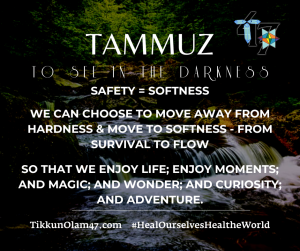
We ended the conversation with (what I think) most of us in our softness really want – to move AWAY from hardness and survival and move to flow – to flow into enjoying life; enjoying moments; and magic; and wonder; and curiosity; and adventure.
To do this? We require safety. Physical safety. Emotional safety. Spiritual safety. Intellectual safety.
Safety = Softness.
When we push people to be harder – we are acknowledging they aren’t safe to be soft. And – as the collective human soul experience on this earth? I am wondering if THIS isn’t the collective trauma we’ve all suffered?
This morning, I was reading Mark Nepo’s “Book of Awakening” – the passage was “the Ring of Safety.”
He starts with this quote from The Isa Upanishad:
“Who sees all beings in his
own Self
and his own Self in all
beings,
loses all fear.”
This is the magic. He goes on to talk about an experience with a yellowjacket.
“I was sitting on a bench in the sun…when a yellow jacket landed about four feet to my left. I watched its striped anterior pulse and protract, the sun making its black rinds blacker and its yellow rings almost orange.
It made me think of my mother and how if that yellow jacket were within yards of her, she would have rolled up the nearest magazine and with trepidation tried until she swat at it. Her fear of being stung made her kill many a small thing.”
And here is a key quote:
“She couldn’t tolerate the uncertainty that something living might hurt her, and in her deep fear of being hurt, she walled herself in, swatting everything away.”
He goes on later to say this:
“How often we imagine things are dangerous when they are only doing what comes naturally.”
And concluded with this:
“How often we murder parts of ourselves by not letting things advance or come close. How often we let fear and the swat rule our emotional lives. How often we kill or chase away everything that moves.”
This is big. Safety.
And let me be clear. We have enough experience to know there ARE people who are not safe to be around. We may have been stung by a “bee” (or a particular “bee”) too many times we’ve grown numb.
How can we allow ourselves to heal and flow – and respect the boundaries given to us – while at the same time remain soft for OTHERS to do their thing?
We have murdered parts of ourselves. Can we forgive ourselves for this? To go back to softness? To allow others in? To let them see those pieces of us that have been invalidated by our parents, lovers, friends?
And? More importantly? Can we take our own softness and create safe space for OTHERS to share those murdered parts of themselves without getting emotionally triggered? To let them flow through our lands – taking a drink of water in our peace and safety?
Maybe we are afraid we aren’t safe for them to pass through? I don’t know. These are just my thoughts.
And I want to go back.
To softness. To tenderness. Within. And for others. To be a land of peace.
To move AWAY from hardness and survival and move to softness and flow – to flow into enjoying life; enjoying moments; and magic; and wonder; and curiosity; and adventure.
What are we protecting where we won’t allow others “to pass through” our land? Even when we establish and appreciate the boundaries and guidelines:
“We will keep to the highway, and if we drink your water, either I or my cattle, we will pay its price. It is really nothing; I will pass through on foot.”
Negotiating the boundaries for someone to pass through your land in flow? That’s healthy. And maybe that’s a start? “You are free to flow through my heart – please keep to the highway. I don’t want a lot of your opinion or curiosity right now. Just stick to the main road.”
What are your thoughts?
Here are my thoughts from two years ago:
Tyler’s Torah Thoughts for 7 Tamuz, 5782
Good morning! I hope your Tammuz is keeping your focus sharp! It’s been a week of working to “see through the darkness.” May we be reminded of Hashem’s faithfulness in that process!
Let’s dig into the Torah!
Yesterday, we encountered Moses’ “failure” in the desert with the rock and providing water. Today, we have a short passage of Israel trying to pass through the land of Edom on their way to the promised land.
Remember that Edom is the land that Esau’s descendants grew up in. Israel are the people of Jacob. When we last connected the two brothers- Jacob had told Esau they would meet again. What Esau may not have realized is that it would be their descendants.
Messengers from Israel told Edom about their experiences in Egypt. They spoke about Hashem’s faithfulness. They gave Edom the full context and then made their request.
All Israel wanted was to pass through peacefully – they’d not pass through fields or vineyards, they will not drink water from the wells, but would purchase the water from Edom, they would stick to the king’s highway, and they’d muzzle their animals so they do not eat from their fields.
That’s a pretty benign request. Just let us go through.
I do find it interesting that to get from slavery to freedom, the path led Israel (the sons of Jacob) to need to confront his brother’s descendants. Going “home” involves confronting our past. That’s what I’m reflecting on today.
Edom mustered up their Gandalf voice; “you shall not pass!” And “if you try it, you will meet our sword!”
Israel tried to reassure and reason with Edom; “but we will keep to the Highway! If we or our cattle drink your water, we will pay whatever it costs! Nothing will harm you!
Edom said “nope. You shall not pass!” And let Israel with many men and “the strong hand of Esau.”
Wow. And what did Israel do? Did they fight? Did they trust Hashem?
No. And yes. No they did not fight. Yes they trusted Hashem. Since Edom refused to allow Israel to cross the border, Israel went away from Edom.
We can discuss “why?” Edom refused (some say it was a military decision because Edom was worried about Israel attacking them in the future). But I think the more important discussion is for us around boundaries.
In our relationships, people have boundaries. They don’t always make sense. As we journey from slavery to freedom, there are paths in front of us that SEEM to be the right direction towards freedom; maybe friendships, romantic relationships, time and relationship with our kids, etc.
However, we can’t control (we shouldn’t even try to control) another human being. If they have a boundary, we can try and push past it, or we can respect it. Some of the best friendships and relationships center around respecting one another’s boundaries. And that leads to true friendship and freedom.
Some of this is motive, right? Israel just wanted to pass through – assuming their motives are good, you’d be likely to let them do it. Seems like a win!
But if you believe Israel is your enemy, even simple requests that could work for your benefit seem evil and wrong.
How often do we assign motive to others, assume they are “against us” and then make decisions based on that.
Now. Stop. I know what you may be thinking. “But Tyler! People assume horrible motives about me! All. The. Time!”
And yes. That may be true. But that’s not something you can do a ton about. But the journey from slavery to freedom isn’t about worrying about someone else’s motives. We aren’t children of Esau in this story. We need to be Israel. To respect boundaries even when they don’t make sense and are placed because the assumptions about our own motives are called into question. Respecting others’ boundaries is on our path to true freedom and the promised land!
What are your thoughts?


No responses yet