Tyler’s Torah Thoughts for 6 Iyar, 5784 –Day 21 of Omer
Parsha ‘Emor – “Speak” (Leviticus 21:1 – 24:23)
Third Portion: Leviticus 22:17 – 22:33
Good morning!
Today is Day 21 of the Omer. Today’s theme is the “Dignity of Compassion.” From Chabad:
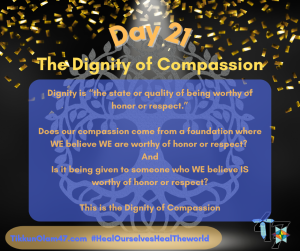 Examine the dignity of your compassion. For compassion to be complete (and enhance the other six aspects of compassion) it must recognize and appreciate individual sovereignty. It should boost self-esteem and cultivate human dignity. Both your own dignity and the dignity of the one benefiting from your compassion. Is my compassion expressed in a dignified manner? Do I manifest and emphasize majesty in my compassion? Does it elicit dignity in others? Do I recognize the fact that when I experience compassion as dignified it will reflect reciprocally in the one who receives compassion?
Exercise for the day: Rather than just giving them charity help them help themselves in a fashion that strengthens their dignity.
I am reflecting on the dignity of compassion and I can see how compassion given can trigger feelings of guilt and shame on the person we are providing compassion to. We need to center their experiences when providing compassion to others.
Then, looking within? How can we maintain our OWN dignity as we provide ourselves compassion?
And? What exactly is dignity? “the state or quality of being worthy of honor or respect.”
So in order to HAVE dignity? We need to believe WE are worthy of honor or respect while at the same time believe the person we are showing compassion to is worthy of honor and respect.
That. So much that. With this spirit, let’s dig into today’s Torah portion:
17And the Lord spoke to Moses, saying,
18Speak to Aaron and to his sons and to all the children of Israel and say to them: Any man whatsoever from the house of Israel or from the strangers among Israel who offers up his sacrifice for any of their vows or for any of their donations that they may offer up to the Lord as a burnt offering
19to be favorable for you, [it shall be] an unblemished, male, from cattle, from sheep, or from goats.
20Any [animal] that has a blemish, you shall not offer up, for it will not be favorable for you.
Basically, if we are going to make a sacrifice to be favorable for us? It needs to be unblemished. My takeaway? It comes back to our Omer theme. Is our sacrifice? Is our compassion? Coming from a place of dignity? Where we believe we are worthy of honor or respect? That is what a “pure” sacrifice would look like – I think.
21And if a man offers up a peace offering to the Lord for declaring a vow or as a donation from cattle or from the flock to be accepted, it shall be unblemished. It shall not have any defect in it.
22[An animal that has] blindness, or [a] broken [bone], or [a] split [eyelid or lip], or [one that has] warts, or dry lesions or weeping sores you shall not offer up [any of] these to the Lord, nor shall you place [any] of these as a fire offering upon the altar to the Lord.
Again – as a sacrifice, we are called to make unblemished sacrifices.
23As for an ox or sheep that has mismatching limbs or uncloven hooves you may make it into a donation, but as a vow, it will not be accepted.
Interesting. A donation is cool – it can have a blemish. But not as a vow.
24[Any animal whose testicles were] squashed, crushed, pulled out, or severed, you shall not offer up to the Lord, and in your land, you shall not do [it].
Again – we need to consider ourselves worthy – offering something that is not pure reflects on our value and dignity (I think).
25And from the hand of a gentile you shall not offer up as food for your God any of these [blemished animals], for their injury is upon them, there is a defect on them; they will not be accepted for you.
And this is interesting too. From the gentiles – no blemished animals.
26And the Lord spoke to Moses, saying:
27When an ox or a sheep or a goat is born, it shall remain under its mother for seven days, and from the eighth day onwards, it shall be accepted as a sacrifice for a fire offering to the Lord.
So I am reflecting on this part. Newborns were not acceptable to Hashem, even as animals. A week is when they would be an acceptable sacrifice.
28An ox or sheep you shall not slaughter it and its offspring in one day.
29And when you slaughter a thanksgiving offering to the Lord, you shall slaughter it so that it should be acceptable for you.
30It shall be eaten on that day; do not leave it over until morning. I am the Lord.
There is obviously an animal connection Hashem does not want to break between mother and child. And when something is sacrificed and when it is consumed.
31You shall keep My commandments and perform them. I am the Lord.
32You shall not desecrate My Holy Name. I shall be sanctified amidst the children of Israel. I am the Lord Who sanctifies you,
33Who took you out of the land of Egypt, to be a God to you. I am the Lord.
I’ll confess that last line sounds a little ego driven. “I freed you from slavery to be a God to you.” That is something I am digging into. I don’t have good answers for that.
I read my post from two years ago, and this is what I wrote:
“I am God who sanctifies you, who is taking you out of the land of Egypt to be your God. I am God.”
God makes us desirable. We can’t make ourselves desirable. We cannot make ourselves free. God makes us free.
God took us out of Egypt to be a God to us because he DESIRES us.
Interesting – this morning I have not been feeling desirable. I have been reflecting on a few areas of my life I have been neglecting. I have worked diligently on my emotional and spiritual fitness/health. I have worked on my physical health by losing weight. I have lost a lot of weight, and kept it off. And. I have not built up muscle strength. I have “tried” to work on my financial strength with not a ton of success.
Looking at the definition of “fitness?” The definition is “The quality of being suitable to fulfill a particular role or task.”
I have neglected my physical and financial strength. I am out of balance.
Time to rebuild my personal dignity – “the state or quality of being worthy of honor or respect.”
And stop neglecting my fitness – “The quality of being suitable to fulfill a particular role or task.”
I am curious to others’ thoughts on this
Here are my thoughts from two years ago:
Tyler’s Torah Thoughts for 9 Iyar, 5782
Today is the 24th day of the Omer.
So, I’ve been chewing a lot on the recent Torah portions and some questions that have come up.
I think some of the energy reading these passages is creating the feelings of being “unwanted” and “undesired” by Hashem. Someone recently pointed out that our past has created these feelings in us; so we don’t believe we are “worthy” of serving Hashem in the “highest” of ways.
I use quotes because those are things we tell ourselves that may not be true. We feel unworthy. We feel that we are blemished. We feel that we are not desired. Not wanted.
And as I reflect, it’s natural to feel this way engaging the Torah. Because in many ways, our unworthiness is translated by our brains as rejection and a lack of desire of God’s part to be with us. So we chase after our desires; because we want that, and getting what we want, we see ourselves as then worthy.
I see this with my kids. If they want something and I don’t give it to them, the emotional reaction tends to be big. I wonder if that’s because it communicates to them their value and worth. “Daddy must not love me because he isn’t giving me what I want.” Or with our romantic partners “They must not love me because they aren’t giving me what I want.”
How much do we tie our worth into having our desires met; and sensing someone else’s desire for us?
I think the idea of being “blemished” cuts to the heart of the issue inside of us. We believe we are blemished.
And as we dig into today’s portion, we are going to see this theme continue; God rejected the blemished animal as a sacrifice.
But we must resist the notion that we are the animal. We aren’t. Hashem provided us animals to sacrifice SO THAT we can navigate our blemishes. Hashem doesn’t ask us to be unblemished. He asks our sacrifices to be. And that is a significant difference.
If anything, these passages show just how much He desires us. He continually provides us ways to return to Him. And it communicates just how much He wants US to DESIRE HIM. Because if we didn’t desire Him, we wouldn’t go to this extent.
So let’s dig in;
The portion starts with speaking against offering a blemished animal as a sacrifice. The Torah lists out various animals and they should be brought without blemish. When we get to Oxes and Sheep, God does make a provision:
You may bring an ox or sheep that has disproportionate limbs or uncloven hooves as a pledge but not as a vow.
So we see there is a difference between a pledge and a vow. Vows require unblemished animals.
Next, God speaks to Moses about how to keep and slaughter the sacrifices.
- When an ox, sheep or goat is born, it should remain with its mother for 7 days. Then from the 8th day on, it will be accepted as a fire offering
- do not slaughter a mother ox or sheep and her child in one day
- When slaughtering a thanks giving sacrifice, it should be done while having in mind the sacrifice will be eaten on the same day it is sacrificed, and there will be no leftovers.
The portion then closes with the message; “pay attention.”
We should keep studying Hashem’s commandments and observing them because Hashem is God. We should not desecrate His name by violating the commandments intentionally.
Hashem is the God who sanctifies us. He separates us; makes us holy.
Let’s stop for a minute. Going back to the idea of being “blemished,” this line is critical. We are not made pure and holy because of what we do. Hashem makes us holy because he sanctifies us. Daily. Why else have this sacrificial system? Hashem provides a way for us. He desires us to be holy. He desires us to be set apart. That’s the message!
The last line of the portion also is significant:
“I am God who sanctifies you, who is taking you out of the land of Egypt to be your God. I am God.”
God makes us desirable. We can’t make ourselves desirable. We cannot make ourselves free. God makes us free.
And that is good news when we are dealing with our blemishes!
What are your thoughts?


No responses yet