Tyler’s Torah Thoughts for 3 Tammuz, 5784
Parsha Bukkat – “Suprarational command”: (Numbers 19:1 – 22:1)
Third Portion: Numbers 20:7 – 20:13
Good morning! I read something this morning along the lines of what we are studying in the Torah. The question becomes – “What is Humanity?” The passage read on Sunday (19:13) mentioned this:
“Whoever touches the corpse of a human soul…”
I have continued to reflect on this question – “Who are we?” We often reflect on the question “Who am I?” The question feels broader and deeper by asking “Who are we?” As Humanity? As a collective?
This morning I read this quote from the Book “Gene Keys” by Richard Rudd:
“It is through the two shadows of Greed and Immaturity that humanity must finally awaken to its nature as a single organism. Like a child, we must eventually grow out of our self-obsession and reach maturity….Just like a young child, humanity is an organism that is too self-obsessed to be aware of the consequences of its actions.”
How we tend to “other” people is the beginning of this self obsessions. We are human souls. That is our nature. There is no “my soul” – it is a “human soul.” And my body? Will eventually become a corpse. It won’t exist. What will continue? My human soul. THIS. This is who we are.
So how do we engage with ourselves as a collective organism?
How do I engage myself as a part of a collective organism?
These are the reflection questions I am contemplating this morning.
Let’s dig in. Remembering where we left off. Miriam died. The flow of water dried up. There was no flow. This flow could connect our souls. Miriam was the key to the flow of our souls connecting with one another. That dried up with her death.
We give a lot of judgement about men and women in the Torah. The Torah has been used to build a patriarchy. It’s been used to oppress. And. We see here – the value woman have. They are the flow. The flow of the soul. The people were definitely concerned and scared. Let’s see what happens:
7The Lord spoke to Moses, saying:
8″Take the staff and assemble the congregation, you and your brother Aaron, and speak to the rock in their presence so that it will give forth its water. You shall bring forth water for them from the rock and give the congregation and their livestock to drink.”
The words of Moses were going to speak to a rock – and the water would flow. The image in my head is tenderness. When the woman passes, and the man speaks tenderly to hardness? Water returns to flow. And. Let’s see what happens:
9Moses took the staff from before the Lord as He had commanded him.
10Moses and Aaron assembled the congregation in front of the rock, and he said to them, “Now listen, you rebels, can we draw water for you from this rock?”
Moses missed the tenderness. “You rebels.” Moses didn’t see the connection between Miriam’s death, the people’s fear, and the grief. Hashem did. Moses had anger.
To be fair, Moses was likely grieving the loss of his sister too. And. Moses took his anger further.
11Moses raised his hand and struck the rock with his staff twice, when an abundance of water gushed forth, and the congregation and their livestock drank.
Hashem wanted Moses to be tender with the rock. Grief hardens us. Moses struck the rock.
And. Water still flowed.
12The Lord said to Moses and Aaron, “Since you did not have faith in Me to sanctify Me in the eyes of the children of Israel, therefore you shall not bring this assembly to the Land which I have given them.
13These are the waters of dispute [Mei Meribah] where the children of Israel contended with the Lord, and He was sanctified through them.
The consequence was Moses did not get to go into the promised land. Grief blocks us from where we want to go.
And I think this is the takeaway.
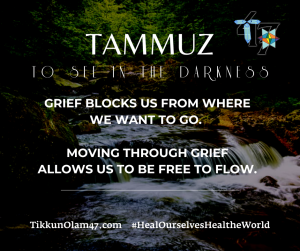
Grief blocks us from where we want to go. Moving through grief allows us to be free to flow.
What are YOUR thoughts?
Here are my thoughts from the past two years:
Tyler’s Torah Thoughts for 7 Tamuz, 5783
Happy Monday! First – I had an amazing weekend, capped off with my two youngest kids and I seeing THREE different rainbows on our drive home from the Fairy Festival in Harpursville, NY. ONE of the rainbows – we seemingly drove RIGHT INTO it. It was an amazing experience – one I have never had in my 51 years of life. Driving into the rainbow we encountered a deluge of rain. The message for us in the midst of Tamuz (and heading into AV) is that even rainbows can produce rain. And although rain can dampen a fun time – it is nurturing and healing and cleansing. And I see a lot of this in today’s “double portion.”
The two key themes for me today are Moses’ “failure” with the rock.
A year ago, I wrote this:
My takeaway is this; we cannot replace God with people. We may come across people who are very tapped into the spiritual and the sacred. But it is God who is in charge; who is pure. Not the people. If Moses fails, we will all likely fail at doing everything God asks of us. And there SHOULD BE some comfort knowing that even Moses failed to always follow God. And yet we don’t often remember his one sin, and it overshadowing everything else God used him for.
“Failure” (and I do use air quotes here) isn’t really “failure.” It serves a vital function on our spiritual journey to liberation and freedom. It serves a few functions:
- It reminds US that we are not Hashem on this earth. Although He is in us (our Neshama), we are bound by the rules of this earthly experience. We will make mistakes. We will choose to be selfish when generosity is called for. We will choose our ego, when love is the answer. We are human. That is our design
- It reminds us that OTHERS are not Hashem on this earth. We cannot replace Hashem within us by attaching our hearts to somebody. They are human too, and will fail. If Moses can make a “mistake” (and again, there is debate on Moses’ actions here) anyone can. We don’t worship Moses. We don’t worship our rabbi. We don’t worship our pastors (or leaders or coaches or anyone). We don’t worship our parents. We don’t worship our significant other. We don’t worship our children.
This year, as I read this, I am reflecting on the idea of what we DO Worship. If we worship Hashem – we can worship Hashem WITHIN us. We can worship Hashem WITHIN Moses. We can worship Hashem WITHIN our rabbi. Our pastor. That is an important shift for us to really reflect on.
To make this more personal – we CAN worship Hashem WITHIN our parents. The Torah tells us to “honor our parents.” How do we do this? By focusing on Hashem within them. Honoring THAT. Our parents may be living (or lived) lives that don’t reveal Hashem’s glory. But Hashem IS there. The same with our significant other. We HONOR our significant other – we don’t worship them. The same with our children.
Ok. And. Then. I connect this other thought with this idea we’ve been discussing. HOW? How do we navigate the DIFFERENCE between worshiping someone and HONORING them?
I think the answer is found in the second of our double portion.
Boundaries.
We Honor Ourselves and Worship Hashem within us by establishing boundaries for ourselves.
We Honor our Parents and Worship Hashem within them by respecting THEIR boundaries AND holding to our own.
We Honor our significant other (or friends, or people we care about) and Worship Hashem within them by respecting their boundaries and holding to our own as well.
I think THIS is the key of today’s portion. What are your thoughts?
Tyler’s Torah Thoughts for 6 Tamuz, 5782
Good morning! I hope you had a great three day (or four day) weekend!
Today we continue to see what happens after Miriam dies. The congregation had no water, so once again they complained to Moses and Aaron.
Moses and Aaron go to the tent of meeting, and God appears. Let’s dig in today as to what he has to say:
God tells Moses to take the staff and Aaron, and assemble the congregation. He tells Moses to speak to the rock that as in Miriam’s well that produced water, and it will produce water.
So. It’s interesting here that God doesn’t seem angry. I’m curious as to why?
My reflection was the grumbling was over a need, and not a want. The people needed water. God was going to encourage them. Maybe?
Or maybe God was teaching this lesson to Moses? Or maybe God was using Moses here to teach us?
So. Moses and Aaron gather the people. They were standing in front of the rock. There are two ideas about what comes next. One, is the people mocked Moses and Aaron because they couldn’t figure out which rock, and the other is Moses knew what he was about to do.
Because he said “Listen. You rebels! How could we draw water for you from this rock?”
Lots is written about this:
Maimonides writes:
“Moses committed two sins. First, he lost his temper, saying, Listen, you rebels!” Second, he caused the people to think mistakenly that God was angry with them for requesting water
Rabbi Hananel b. hushi’el writes:
Moses and Aaron’s sin was saying, “Could we draw water for you from this rock,” when they should have said, “God will get water out of the rock.” Perhaps the people would now think Moses and Aaron had extracted water from the rock through their own powers.
Rabbi Abraham Isaac Kook writes:
All religious anger, all intolerance for the spiritual shortcomings of others, is rooted in the angry outburst of Moses. When he should have sought reconciliation, he shouted, “Listen, you rebels!” There may be such a thing as righteous indignation, but in practice our highest goals will only be achieved through mutual respect.
Let’s go back to the story:
Some commentary has Moses and Aaron speaking to the rock and it didn’t produce any water since it was the wrong rock. Moses remembered back to Rephadim and hitting the rock, so he hit the rock. It happened to be the right rock but only a little water came out, since God told him to speak to the rock and then he hit it. So Moses hit the rock a second time and a lot of water came out and the congregation drank.
Other views on this passage just jump to Moses hitting the rock with his staff twice.
Either way, we know they did NOT do as God commanded. Whether it was anger, or Moses intentionally disobeyed because he was sacrificing himself for the people (since the people continued to rebel against God and Moses believed his sacrifice would benefit everyone) God had to respond.
God himself said “since you did not believe in Me to sanctify Me in the presence of the children of Israel, you will NOT bring this congregation into the land which I have given them.
However, Moses and Aaron not entering the land was the way God was sanctified in front of the people. Since they knew Moses was only human like them!
Some interesting thoughts here. My takeaway is this; we cannot replace God with people. We may come across people who are very tapped into the spiritual and the sacred. But it is God who is in charge; who is pure. Not the people. If Moses fails, we will all likely fail at doing everything God asks of us. And there SHOULD BE some comfort knowing that even Moses failed to always follow God. And yet we don’t often remember his one sin, and it overshadowing everything else God used him for.
Do we focus on our one mistake? Or do we look at the full picture of our growth and development?
Those are my thoughts today. What about you?


No responses yet