 Tyler’s Torah thoughts for 19 Iyar, 5783. 34th Day of the Omer.
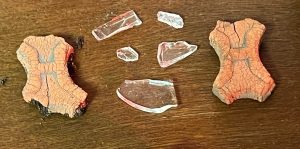
I hope people were able to walk through the day yesterday focused on our own humility. There were some amazing things that happened to me today, and without much context, wanted to share a picture of a few things I found on my walk yesterday. The two H things were found a different parts of my walk. I will share I think they symbolize the reminder of yesterday’s Omer theme: Humility of Humility. The broken glass pieces I picked up and kept because I heard a story yesterday about Seth Rogan talking about his marijuana use. He likened it to wearing shoes and glasses.
We lived in a world where there was no broken glass for a long time. We really didn’t need to wear shoes. The world we live in today? Lot’s of broken glass. If we don’t wear shoes (like I did my freshman year at UCSB) we end up with shattered glass stuck inside our foot. Instead of suffering – we wear shoes when we go outside and where things may not be safe. At home? Maybe we don’t wear shoes. Maybe we wear slippers. Because in the house, we know it’s safe. There is no broken glass. Maybe there are legos (which hurt more than stepping on broken glass).
Metaphorically, emotionally, we live in a world much different than when we didn’t have glass. Our lives are surrounded by data coming at us at such a high speed, it is tough to just slow down and take care of ourselves emotionally. I was doing a guided meditation this morning that talked about brain research – where they are studying the interactions BETWEEN brains. It was fascinating.
The research showed that when shown trauma, and videos of people’s trauma, our brains pull in that trauma and take it as our own. We get triggered in the same fight or flight mode when we engage with someone’s trauma. That’s empathy. The issue is how we personalize this empathy and take it on as our own. ESPECIALLY when WE feel powerless to do anything to relieve the trauma and suffering.
In this research, they took a random group of subjects and taught them a meditation practice that was all about active compassion. How do we see or feel that trauma, and turn it around into active compassion? The brain responded MUCH differently. Sitting quietly, and having someone we know who is suffering in our minds and just quietly saying “may you have ease” or “may you be free from suffering” can help with our OWN brain’s response and feel more regulated than just being a sponge.
And. If we are in a place to alleviate someone’s suffering, we can’t just regulate our own brains either. There is a balance. But our actions – our active compassion needs balance. Thoughts and prayers are good – they can relieve our own suffering and trauma triggered responses – but if we have power to do more – we need to do more.
Next, let’s look at the Omer theme.
Today’s theme is “Yesod of Hod” or “Bonding of Hod.”
From Chabad:
Humility should not be a lonely experience. It ought to result in deep bonding and commitment. There is no stronger bond than one that comes out of humility. Does my humility separate me from others or bring us closer? Does my humility produce results? Long term results? Does it create an everlasting foundation upon which I and others can rely and build.
Exercise for the day: Use your humility to build something lasting.
It is interesting how this theme of humility should not be done in isolation. We should be sharing our humility with others. I think the meditation discussion above certainly falls in line with this thinking. Curious to your thoughts.
Finally, let’s look at the Torah portion. Today – we have 4 different portions combined across two parshas! Wow! As we enter into the final few days of reading the book of Leviticus (which we will conclude this Shabbat) we cross from Parsha Be-Har to Parsha Be-Hukkotai. From “on the mountain” to “my laws.”
It is interesting how this coincides with our process of the Omer. Leviticus seems much more deep when we keep it connected with the themes of the Omer, TBH. It’s not just a set of rules to follow. Instead, it seems like a more loving discussion and teaching on how to love ourselves and others. We cannot just love from a place of freedom. There need to be boundaries. Boundaries ARE healthy. Respecting boundaries ARE important. In our relationship with each other and with ourselves, I wonder if “Be-Hukkotai” may be better translated to “my boundaries.” As we approach Shavuot, Hashem is giving us the Torah. We came out of slavery in Egypt – into a place of freedom that felt AMAZING – do what we want! And, that led us into the wilderness. Hashem doesn’t leave us in the wilderness – he gives us his boundaries. Boundaries for a relationship with HIM. We aren’t FORCED to be in relationship with Him. It’s a choice. But if we want a deep relationship with Him, there needs to be respect of those boundaries.
What are your thoughts?
My commentary from a year ago:
Tyler’s Torah Thoughts for 19 Iyar, 5782
Today is the 34th day of the Omer!
Today’s portion is very short. It deals with Jews who are owned as slaves by other Jews.
The Torah starts with saying if your fellow among you is needy and he is sold to you as a slave, do not make him do demeaning labor – he should be treated like an employee or a hired resident.
So. A few things here. The Torah does talk about slavery; and it would be easy to equate it to the slavery in America. However, this passage right here is why the Torah is different and actually speaks against our history here in America. Slavery wasn’t about the dehumanization of Hashem’s creation. It was a way to have those who had need to be restored.
Rabbi Mordecai ha-Kohen wrote this; “The human master is charged with the task of helping the slave mend his ways and return to his roots, to the dignified status of his ancestors.”
This is an important point. Dignity was built into the Torah understanding of slavery.
Next, the Torah talks about how long they should work; “He should work with you for six years or until the jubilee year (which ever comes first). He should leave along with his children. He should return to his family and resume the dignified status of his ancestors.”
So once again; it’s about freedom and dignity.
God says the reason for all of this is because “The Jewish people are My servants, whom I brought out of the land of Egypt. They should not be sold as slaves.” In a sense, Rashi points out; God says “their contract with me came first.”
Ok. That’s the good part. Now. Here’s the troubling part. And we have to acknowledge it is a little troubling:
The Torah says Jews can acquire male or female slaves from the nations that are around your land and work these slaves with Harsh labor. The Torah says these will be a permanent inheritance.
So let’s talk about this. At the time, the nations around the Jews were all the enemies of the Jews. They weren’t to go beyond – to a different land far away, and bring back slaves.
And the rules of slavery were still the same; it was a way to collect debts. So it was only if a non-Jew owed money and couldn’t pay.
This isn’t to excuse the practice. But it is to provide context. People weren’t born into slavery. And other passages in the Torah talk about treating the non-Jewish slaves well. So these are all important.
I’m curious as to your thoughts; even if you fundamentally disagree!
Tyler’s Torah Thoughts for 20 Iyar, 5782
35th day of the Omer.
Shabbat Shalom!
Today we finish up Parsha be-har.
Today we dig into more about financial problems.
The portion starts that by saying if a non-Jew who lives around you becomes rich by being associated with you, and a fellow Jew becomes needy by being associated with him (the non Jew) and the Hew is sold to a non-Jew who lives among you, or into a position where they are required to maintain idols, or is sold to an idol worshipper, then as soon as he is sold, he should be redeemed. A fellow Jew should redeem him. Someone; an uncle, a cousin, close relative, or he should redeem himself.
Let’s stop for a moment. The idea here might be centered around acquiring wealth and how the wealth should have been intended for the Jew, but because the non-Jew is a part of the community, they benefitted instead of the Jew. That is not something Hashem seems to take lightly. He provides for His people.
The next part is about fairness. That when redeeming the Jew from the non-Jew, we should calculate the costs based on the jubilee year.
The We see that if the non-Jew is forcing the Jew into harsh labor, it is on us to stop him.
And then we see that if he is not redeemed, he and his Children will go free in the jubilee year.
Hashem gives a warning to Jews who are sold into slavery to non Jews – do not make idols for yourself as the non Jew does. Keep the sabbaths and fear God; who promises to reward you.
Something I chew on here; Joseph is the model isn’t he? He lived this out and trusted Hashem.
Also, as we’ve been discussing the journey from slavery to liberation and freedom, we see here that it won’t always be a straight line. Sometimes we will end up back in slavery. But it is only for a (relatively) short time; no more than 49 years; not like the 400 years of slavery in Egypt. But the process is always towards freedom!
What are your thoughts?
As always todays Haftorah thoughts are in the comments below
Todays Haftorah is from Jeremiah 32:6-27. Chabad tends to only go to 22, so the last five verses aren’t read by everyone.
The setup for the Haftorah is the prophet Jeremiah is speaking in King Zedekiah’s royal compound. He had been confined to the compound because he predicted the downfall of Jerusalem into the hands of the Babylonians.
In order to bring hope; Jeremiah purchase the field of his cousin, letting people around him know there was restoration coming.
The portion opens with God telling Jeremiah to purchase it.
We get an interesting perspective of the legal process of purchasing land at that time; with a lot of details. But when it is all said and done, Jeremiah says to someone – God has told us to put the deeds into an earthenware vessel so they should be preserved for a long time.
Jeremiah knew the land would be redeemed; but he also knew it was a long way off.
He says this is not an exercise in futility- but God has promised there will come a time where land will be bought and sold again.
Sounds good so far, right? But then we get a small insight in to Jeremiah.
He goes right to God and prays; “if only I knew why you asked me to do this…”
He goes on to share his heart of doubt AND his trust of Hashem.
There is a really important lesson for us here. When God asks us to do something, we can ask why? But like Jeremiah, we should do what he asks first. Then ask why?
This is a great Haftorah lesson for us! What are your thoughts?
Tyler’s Torah Thoughts for 21 Iyar, 5782
36th day of the Omer.
We are now into the fifth week of the Omer – and the theme for the week is “bonding.” Hopefully this is a bonding time with Hashem and with each other.
Let’s dig into a new Parsha!
This week’s Parsha is Be-Hukkotai which means “my laws.”
From the Chumash I am reading, the quote for the week is this; “The world runs on cause and effect. Positive actions lead to positive outcomes; negative actions bring about negative outcomes. God does not usually break these laws because they were set up for your benefit.”
Something to reflect on as we dig in.
It’s a short passage today. So short I’m going to post the text here:
If you pursue (the study of) My laws (in order to) guard My commands and observe them, then I will give you rain at (a convenient) time, the land will yield its produce, and, (in the future, even) the (non-fruit-bearing) trees of the field will produce fruit. You will be (busy) with threshing until the grape harvest, and the grape harvest will keep you (busy) until the sowing season. You will be satisfied with (even a small amount of) your bread, and you will live safely in your land.
This is basically an encouragement to us – as we seek to connect and bond with Hashem and each other, we need to focus on doing the things Hashem has called us to do. Then He will bless us with provision. And. We. Will. Be. Safe.
My thought is; the theme this week is bonding. The opposite of this (seems to me) to be neglect. If we neglect Hashem and his mitzvahs, we won’t feel connected or bonded.
If we feel neglect in our human relationships, we also feel this lack of bonding and connection. How we navigate these feelings of neglect is crucial in how we bond with others.
Thoughts?
Tyler’s Torah Thoughts for 22 Iyar, 5782
Today is the 37th day of the Omer
Todays passage is once again short, so I’m going to put it here in its entirety:
“I will grant peace in the land, and you will go to sleep with nothing frightening (you). I will eliminate wild animals from the land, and (foreign) sword(s) will not (even) pass through your land (in peace, never mind in war).
You will chase away your enemies, and (as they are running away) they will fall (dead) by the(ir own) sword(s) before you (kill them). Five of you(r weakest men) will be able to chase away a hundred, and a hundred of you will be able to chase away ten thousand. (As they are running away) they will fall (dead) by their own sword(s) before you (despite your tiny army).
I will turn (away from all My affairs) to (reward) you, and I will make you fruitful and (into men of) stature. I will set up My covenant with you (anew).” (End portion)
So this portion is connected with yesterday’s as it is the promise of what will happen if we pursue the Torah, guarding the mitzvahs and observing them.
Hashem will not only protect us and provide us within the land; He will protect us from outsiders. As we navigate anti-Semitism in our country; we should take comfort that Hashem does not neglect us, if we honor the Torah and His mitzvahs.
There is peace here as we engage the Torah!
What are your thoughts?


No responses yet