Tyler’s Torah Thoughts for 11 Iyar, 5783. 26th Day of the Omer
Today is the 26th Day of the Omer –
The theme of the day is “Hod of Netzach” or “Humility of Endurance.” Chabad talks a lot today about Yielding:
From Chabad:
Yielding – which is a result of humility – is an essential element of enduring. Standing fast can sometimes be a formula for destruction. The oak, lacking the ability to bend in the hurricane, is uprooted. The reed, which yields to the wind, survives without a problem. Do I know when to yield, out of strength not fear? Why am I often afraid to yield?
Endurance is fueled by inner strength. Hod of netzach is the humble recognition and acknowledgement that the capacity to endure and prevail comes from the soul that G‑d gave each person. This humility does not compromise the drive of endurance; on the contrary, it intensifies it, because human endurance can go only so far and endure only so much, whereas endurance that comes from the Divine soul is limitless.
Do I attribute my success solely to my own strength and determination? Am I convinced that I am all powerful due to my level of endurance? Where do I get the strength at times when everything seems so bleak?
Exercise for the day: When you awake, acknowledge G‑d for giving you a soul with the extraordinary power and versatility to endure despite trying challenges. This will allow you to draw energy and strength for the entire day.
For me? The key line is “Standing fast can sometimes be a formula for destruction.” Where are we standing fast that we need to yield to?
I learned about trees this morning. I have been growing an avocado tree for the past 17 months. It started as a pit. Trees that are staked do not grow strong. They grow tall for sure – but they have skinnier trunks. They don’t have to face the wind. They don’t have to yield.
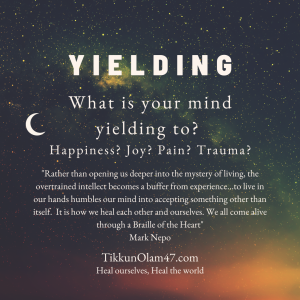
The wind is nothing something to avoid – it is something to yield to and grow stronger in. What are we yielding to?
In my guided meditation this morning (thank you 10% happier app), we focused on joy. The idea of reflecting on someone else’s joy and good fortune and then imagining how that would feel for ourselves. This was difficult at first. I questioned other’s joy – was I really seeing their joy? Or were they masking their pain by smiling and living joyful lives? And do I do this?
What i realized was that I tend to be a cynic. I remain steadfast as a cynic. I always look for the “yeah but…”
Then I began to just yield to joy. Allow joy to live within me. And then I turned within to look at the things in my life where there is joy. I made a list. And I realized – I can yield in my heart to those things that bring a smile to my face, or I can yield to the pain points and trauma that exist. I can focus on how far I need to go on my journey to get to where I want, or I can yield to the progress I have made in the past 51 years of my life.
That is a choice. That is freedom. That is liberation. And. Let me be clear. I need to sometimes yield to the pain. The trauma. Because it is there. Allowing myself to ugly cry because of the pain and trauma? That is healthy too. Because even in yielding to joy, “standing fast can sometimes lead to destruction.” If a moment calls for joy, yield to joy. If a moment calls for sadness, yield to sadness. If a moment just is – and there is no weight – make a choice.
I think this connects to today’s Torah portion because of these feelings of “worthiness.” If we focus and yield to our trauma and past mistakes? We can live in a place and root ourselves in unworthiness. If we can yield to joy and growth? We can move in the direction (in my opinion) Hashem wants us to grow.
This is the message for today. What are we yielding to?
What are your thoughts?
I wrote this a year ago:
Tyler’s Torah Thoughts for 9 Iyar, 5782
Today is the 24th day of the Omer.
So, I’ve been chewing a lot on the recent Torah portions and some questions that have come up.
I think some of the energy reading these passages is creating the feelings of being “unwanted” and “undesired” by Hashem. Someone recently pointed out that our past has created these feelings in us; so we don’t believe we are “worthy” of serving Hashem in the “highest” of ways.
I use quotes because those are things we tell ourselves that may not be true. We feel unworthy. We feel that we are blemished. We feel that we are not desired. Not wanted.
And as I reflect, it’s natural to feel this way engaging the Torah. Because in many ways, our unworthiness is translated by our brains as rejection and a lack of desire of God’s part to be with us. So we chase after our desires; because we want that, and getting what we want, we see ourselves as then worthy.
I see this with my kids. If they want something and I don’t give it to them, the emotional reaction tends to be big. I wonder if that’s because it communicates to them their value and worth. “Daddy must not love me because he isn’t giving me what I want.” Or with our romantic partners “They must not love me because they aren’t giving me what I want.”
How much do we tie our worth into having our desires met; and sensing someone else’s desire for us?
I think the idea of being “blemished” cuts to the heart of the issue inside of us. We believe we are blemished.
And as we dig into today’s portion, we are going to see this theme continue; God rejected the blemished animal as a sacrifice.
But we must resist the notion that we are the animal. We aren’t. Hashem provided us animals to sacrifice SO THAT we can navigate our blemishes. Hashem doesn’t ask us to be unblemished. He asks our sacrifices to be. And that is a significant difference.
If anything, these passages show just how much He desires us. He continually provides us ways to return to Him. And it communicates just how much He wants US to DESIRE HIM. Because if we didn’t desire Him, we wouldn’t go to this extent.
So let’s dig in;
The portion starts with speaking against offering a blemished animal as a sacrifice. The Torah lists out various animals and they should be brought without blemish. When we get to Oxes and Sheep, God does make a provision:
You may bring an ox or sheep that has disproportionate limbs or uncloven hooves as a pledge but not as a vow.
So we see there is a difference between a pledge and a vow. Vows require unblemished animals.
Next, God speaks to Moses about how to keep and slaughter the sacrifices.
- When an ox, sheep or goat is born, it should remain with its mother for 7 days. Then from the 8th day on, it will be accepted as a fire offering
- do not slaughter a mother ox or sheep and her child in one day
- When slaughtering a thanks giving sacrifice, it should be done while having in mind the sacrifice will be eaten on the same day it is sacrificed, and there will be no leftovers.
The portion then closes with the message; “pay attention.”
We should keep studying Hashem’s commandments and observing them because Hashem is God. We should not desecrate His name by violating the commandments intentionally.
Hashem is the God who sanctifies us. He separates us; makes us holy.
Let’s stop for a minute. Going back to the idea of being “blemished,” this line is critical. We are not made pure and holy because of what we do. Hashem makes us holy because he sanctifies us. Daily. Why else have this sacrificial system? Hashem provides a way for us. He desires us to be holy. He desires us to be set apart. That’s the message!
The last line of the portion also is significant:
“I am God who sanctifies you, who is taking you out of the land of Egypt to be your God. I am God.”
God makes us desirable. We can’t make ourselves desirable. We cannot make ourselves free. God makes us free.
And that is good news when we are dealing with our blemishes!
What are your thoughts?


No responses yet