Tyler’s Torah Thoughts for 18 Nisan, 5784 – Fourth Day of Passover – Day 3 of Omer
Parsha ‘Aharei Mot – “After the death”: (Leviticus 16:1 – 18:30)
Sixth Portion: Leviticus 18:6 – 18:21
Passover Torah Portions: Exodus 22:24 – 23:19, Numbers 28:19-25
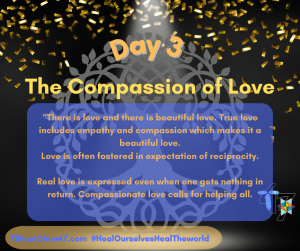 Good morning! Today we are on Day 3 of the Omer. The theme today is “Compassion of Love”
From Chabad:
“There is love and there is beautiful love. True love includes empathy and compassion which makes it a beautiful love. Love is often fostered in expectation of reciprocity. Real love is expressed even when one gets nothing in return; even when the other doesn’t deserve love. Tiferet is giving also to those that have hurt you. It acknowledges the discipline of gevurah and says that, nevertheless, compassionate love calls for helping all.
Exercise for the day: Offer a helping hand to a stranger.”
This is a practical way for us to love on this fourth day of Passover. As we leave our Egypt and look towards liberation and freedom – this is where we can make practical steps in our lives.
Do we only love those who reciprocate? Or do we offer compassion and empathy to all?
This is not to say we should be doormats. We should have boundaries for ourselves to love ourselves, EVEN WHEN WE DONT BELIEVE WE DESERVE IT!
That’s where this begins. Offering love to ourselves when we don’t believe we deserve it.
If we can’t do this for ourselves, we won’t truly be able to do it for others.
Let’s dig into today’s portion. Today we begin to explore forbidden relations.
Let’s go!
6No man shall come near to any of his close relatives, to uncover [their] nakedness. I am the Lord.
7You shall not uncover the nakedness of your father or the nakedness of your mother; she is your mother; you shall not uncover her nakedness.
So pretty straightforward. No getting naked with your mom or dad.
8You shall not uncover the nakedness of your father’s wife; it is your father’s nakedness.
This is interesting, isn’t it? The Torah is alluding to the idea that your mom and your father’s wife may be two different people. That is quite fascinating to me.
9The nakedness of your sister, whether your father’s daughter or your mother’s daughter, whether born to one who may remain in the home or born to one who must be sent outside you shall not uncover their nakedness.
Again, the Torah seems to allude to the father and mother not being together here.
10The nakedness of your son’s daughter or your daughter’s daughter you shall not uncover their nakedness, for they are your own nakedness.
So no sleeping with the grandkids.
11The nakedness of the daughter of your father’s wife, born to your father she is your sister: you shall not uncover her nakedness.
Even your half sister.
12You shall not uncover the nakedness of your father’s sister; she is the close relative of your father.
13You shall not uncover the nakedness of your mother’s sister, for she is the close relative of your mother.
14You shall not uncover the nakedness of your father’s brother you shall not come near his wife; she is your aunt.
Aunts and Uncles. Nope.
15You shall not uncover the nakedness of your daughter in law; she is your son’s wife you shall not uncover her nakedness.
16You shall not uncover the nakedness of your brother’s wife: it is your brother’s nakedness.
And neither your daughter in law, or your sister in law.
17You shall not uncover the nakedness of a woman and her daughter; you shall not take [in marriage] her son’s daughter or her daughter’s daughter, to uncover her nakedness they are close relatives, it is evil counsel.
So if you sleep with a woman, don’t sleep with her daughter, or her grandchildren. They are close relatives.
18And you shall not take a woman with her sister [in marriage] as rivals, to uncover the nakedness of one upon the other, in her lifetime.
This Is interesting. It calls out what Jacob did.
19And to a woman during the uncleanness of her separation, you shall not come near to uncover her nakedness.
So this is also fascinating. The Torah puts a woman on her period in the middle of all of this.
20You shall not lie carnally with your neighbor’s wife, to become defiled by her.
This is adultery.
21And you shall not give any of your offspring to pass through for Molech. And you shall not profane the Name of your God. I am the Lord.
And we aren’t supposed to sacrifice our children – to give them for Molech.
What does all of this mean?
I think the takeaway for us is the physical intimacy that comes with sex. There is something energetic that takes place. And? I think there is a connection to our souls journey – with our immediate family.
Who we give ourselves to in nakedness – both physically, and emotionally (and spiritually) matters. This is the takeaway today.
What are your thoughts?
Here is my thoughts from two years ago:
Tyler’s Torah Thoughts for 14 Nisan, 5782
It’s time for us to have a tough conversation. Keeping in mind all of what we talked about yesterday – the reason for these passages that God has given us. We have been talking about ritual impurity. Yesterday we discussed the difference between Hashem’s rational mitzvahs (ones that are logical to us) and suprarational mitzvahs (ones we don’t understand).
Hashem explained why we should do this;
- He was concerned we’d bring the customs from Egypt where we were slaves into our new lives.
- He was concerned that with our freedom and liberation, we’d take on the practices of the people living in the promised land.
He wants us to be a unique and separate people. He doesn’t want us to assimilate; either from where we’ve been to where we are going. I think this is important context for getting into the passages about “forbidden” relations. Again, the word forbidden is in quotes because nothing we’ve read so far uses that term. So let’s dig in.
- No man or woman may come near (read; have sex with) any of their close relatives, to uncover their nakedness and cohabit with them.
As a reminder, this verse closes with “I am God who is faithful to pay reward.” Which is an interesting close.
- You must not uncover the nakedness of your father’s wife, or the nakedness of your mother (if she is not your fathers wife). Since she is your mother you must not uncover her nakedness.
- You must not uncover the nakedness of your father’s wife, even after he dies.
- You must not uncover your sisters nakedness, whether she is your father’s daughter or your mother’s daughter.
- You must not uncover the nakedness of the daughter of your son or daughter, for they are like your own nakedness.
- You must not uncover the nakedness of your father’s Jewish wife’s daughter, born to your father because she is your sister
- You must not uncover the nakedness of your father’s sister because she is the close relative of your father
- You must not uncover the nakedness of your mother’s sister because she is a close relative of your mother.
- You must not uncover the nakedness of your father’s brother, namely you must not come near his wife because she is your aunt.
- You must not uncover the nakedness of your daughter in law. She is your son’s wife.
- You must not uncover the nakedness of your brother’s wife for she is your brother’s nakedness.
Ok. So far, I’m not sure any of the above are too radical. My takeaway so far is the establishment of the importance of family and how being connected by blood is something sacred – and not to be connected with sexual intimacy.
I’m also chewing on how given the context, these must have been things happening in Egypt (at the time) or in the promised land (or both).
- You must not uncover the nakedness of a woman to whom you are married and her daughter. You must not take your son’s daughter or her daughter’s daughter in marriage to uncover her nakedness. It is the advice of the evil inclination since they are close relatives.
So again, probably not controversial; but this is interesting, because Hashem gives us a reason- it seems like maybe people thought they could get around the above prohibitions by marrying some of the people above, and therefore be able to uncover their nakedness. Hashem is saying that thought (a workaround to His mitzvahs) is from the evil inclination.
- You must not take a woman in marriage in addition to her sister, to make them rivals by uncovering one’s nakedness in addition to the other’s. Even if you divorce one sister, you may not marry the other one in her lifetime.
Whoa. Hold up. Stop right here. We have a controversy (in my opinion).
Hashem basically calls out one of our forefathers here. Jacob married Rachel and Leah. This seems to violate this mitzvah.
My takeaway; humanity is all about growth and development. Who we are in each moment is built off of who we were in each previous moment; however, we aren’t bound by our past. Jacob (at the time) seemingly did nothing wrong; and that would be true. AND AT THE SAME TIME looking back, Hashem is saying – it wasn’t the best.
So when we read these mitzvahs I think it’s s good thing to keep in mind that our forefathers broke these mitzvahs before they were written. The question is what do we do with them now that we are aware? Keeping in mind the purpose of the mitzvahs is to get closer to God and these specific mitzvahs were to prevent assimilation to the ways we lived while in slavery, and the ways we will live in freedom.
- You must not come near a woman during the ritual impurity of her menstruation, to uncover her nakedness.
Another takeaway. We’ve already read about this happening earlier in the Torah. And the consequences around it. It wasn’t punishable by death. It was about ritual impurity. We need to keep this in mind. I’m not saying we should engage with women during their menstruation- I’m just saying there are reasons for this.
Also; Rabbi Samson Raphael Hirsch writes this; “Through Issuing Devine commands relating to marital life, God raises human intimacy from an animalistic, sensual experience to the sphere of holiness and purity.” I think that is something interesting to chew on.
- You must not lie carnally with your fellowman’s wife, to make yourself impure with her.
Something I reflect on here. Adultery is mentioned in the 10 commandments and here as well. Yet, many religious people I know tend to gloss over this; especially as we close the parsha tomorrow and talk about some even more difficult things. Why? If all of these behaviors are mentioned as problematic; why are only certain things focused on?
Just something to keep in the back of your mind.
- You must not give any of your offspring to pagan priests to pass through between two bonfires, in worship of the pagan deity Molech. You must not profane the name of your God. I am God.
Um. This seems way out in left field. Everything so far was about sex. This is about sacrificing children.
It’s an interesting way to close the portion today.
Something my brain is navigating as I read these. I want to put these “in order” of severity; like the things at the beginning (sex with your own children or parents) seems pretty bad compared to adultery and sacrificing children. But then I’m the middle of all of that are some things that seem more mild – sex during menstruation? Marrying your sister in law after divorcing your wife?
I think we need to be cautious in assigning value to the order in which these appear. My guess is; all of these are seen the same by Hashem. We will likely find out when we consider the consequences tomorrow. If the consequences for all of these are the same; ie having sex with your wife during menstruation is the same as committing adultery, that’s important to consider from a Torah perspective.
How much are our views around sex really grounded in scripture (I ask that for my Christian friends), and how much are our views grounded in the society around us? It seems like all of us; Jew and Gentile alike, tend to pick and choose the severity of these mitzvahs being violated based on our own personal choices. We are projecting ourselves onto the Torah. And I’d argue that’s a concern.
What are your thoughts? Does anything jump out at you?


No responses yet