Tyler’s Torah Thoughts for 19 Tammuz, 5784
Parsha Pinchas: (Numbers 25:10 – 30:1)
Fifth Portion: Numbers 28:1 – 28:15
Good morning! We are continuing our mourning period as we are learning to see in the darkness! If things are a struggle for you? You are not alone! The news is – things will continue to get darker and darker through the 9th of Av (Sundown on August 12 – 8/12/24 if you are into numerology). And? Quickly after that? We have an amazing day – the 15th of Av – basically “Jewish Valentines Day.” So at sundown on August 18th (18 is the number of life in Hebrew) we will enter into a bright bright time!
So it’s time to buckle up, prepare ourselves to embrace the darkness and sadness, and remember joy will come. We just need to trust we have what we need to see in this darkness!
We just finished reflecting on the transition of leadership from Moses to Joshua. Moses “bestowed” some of his “majesty” on Joshua.
During this darker period for us, we can remember – we have this same majesty – within us. We only need be turned inward to see within us where that majesty is. If we forget, we have external things to remind us – Hashem’s creation. I read this in Mark Nepo’s “Book of Awakening” this morning:
The Human Soul is to God as
The flower to
The sun; it opens at its approach,
And shuts
When it withdraws
-Benjamin Whichcote
God, like the sun, emanates on all: on the hill exposed in the open, on the plant growing in the window….
The same source of spirit emanates on our different lives, regardless of circumstance. Thus our experience and perception of God in the world may be limited and different, may even change, but that doesn’t define or limit the source.
And though the sun appears to disappear every day, it is the Earth that turns away, causing night. Likewise, when it appears the God is nowhere to be found, it is we, in the turmoil of our lives, who turn away or are turned away and back, again and again.
….we can move back into the light
I love this passage as it reflects the constancy of the source. Light. There is always light. We just need to turn to it. If it is dark, we must find the light – that emanates within.
We keep looking externally for this majesty. We can look in the mirror and see the majesty within. This is the light we need to turn to in the darkness and mourning and sadness of the next three weeks.
Here we go:
28:1The Lord spoke to: Moses, saying:
2Command the children of Israel and say to them: My offering, My food for My fire offerings, a spirit of satisfaction for Me, you shall take care to offer to Me at its appointed time.
3And you shall say to them: This is the fire offering which you shall offer to the Lord: two unblemished lambs in their first year each day as a continual burnt offering.
4The one lamb you shall offer up in the morning, and the other lamb you shall offer up in the afternoon.
5And one tenth of an ephah of fine flour for a meal offering, mixed with a quarter of a hin of crushed [olive] oil.
6A continual burnt offering, as the one offered up at Mount Sinai, for a spirit of satisfaction, a fire offering to the Lord.
7Its libation shall be one quarter of a hin for each lamb, to be poured on the holy [altar] as a libation of strong wine to the Lord.
8And the second lamb you shall offer up in the afternoon. You shall offer it up with the same meal offering and libation as the morning [sacrifice], a fire offering with a spirit of satisfaction to the Lord.
This is the offering to source. To the creator. To the one who bestowed majesty on us and in us. There is meant to be daily connection with our source. With our light. With our fire. Twice a day we are asked to tend to this offering. This gratitude. The gratitude is meant to be continual – and – we need to be conscious of it twice a day.
This also teaches us another lesson. It isn’t always the sun – the source that is the issue. It is within.
I have been trying to grow a sunflower indoors. It’s a tough task as Sunflowers need light. They need space. They need roots. I have been trying for over a year to attempt to grow a sunflower. And I am finally close to it.
What happened was – the seeds would start to sprout. I would get excited. But then? They would wither and die. I couldn’t figure it out. And one time as I went to throw the soil away, I noticed something. The roots. They were tightly wound all together. There were 8-9 sprouts, but the soil was completely tangled with roots.
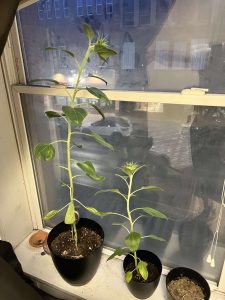
I had a hypothesis – maybe the issue was the soil was too cluttered. So this last time? I started the same way – but when the 8 sprouts popped up? I replanted them. 4 and 4. And one pot? The same thing happened. The other? Three started to thrive, one did not. The other three started to wilt. I went to repot the three of them in three separate pots. When I did this? Two plants broke their stem. One did not. I went to nurse the stems – I used a toothpick and some twist ties to strengthen them. And? One survived. I now have two sunflowers thriving in my window. And? They are ready to sprout.
It’s a beautiful lesson – how the roots of others can impact us. Sometimes we need to sacrifice (I went from 8 seedlings to 3 plants to 2 viable plants) in order to sustain.
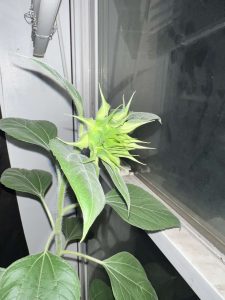
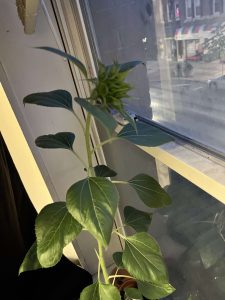
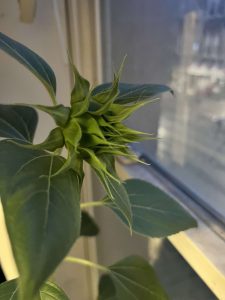
And? If this feels like too much? The Torah has our back:
9And on the Sabbath day, two unblemished lambs in the first year, and two tenths of an ephah of fine flour as a meal offering, mixed with oil, and its libation.
10[This is] the burnt offering of each Sabbath on its Sabbath, in addition to the continual burnt offering and its libation.
11And on the beginning of your months, you shall offer up a burnt offering to the Lord: two young bulls, one ram, and seven lambs in the first year, [all] unblemished.
12Three tenths of an ephah of fine flour as a meal offering, mixed with oil for each bull, and two tenths of an ephah of fine flour as a meal offering, mixed with oil for each ram.
13And one tenth of an ephah of fine flour mixed with oil as a meal offering for each lamb. A burnt offering with a spirit of satisfaction, a fire offering to the Lord.
14And their libations: a half of a hin for each bull, a third of a hin for each ram, and a quarter of a hin for each lamb wine; this is the burnt offering of each new month in its month, throughout the months of the year.
15And one young male goat for a sin offering to the Lord; it shall be offered up in addition to the continual burnt offering and its libation.
We are called to rest. It’s a different sacrifice to rest. To let go. Release. Trust. It’s not our work that helps us succeed. We just play to the universe, and allow things to unfold.
Look to the sunflower. Look to the light. Look within for the light, the fire and the majesty. Look within for the healthy roots and the space needed to grow.
Plants need light. And – they need darkness. The roots need the darkness to grow strong. The plant and flower needs the light to blossom.
This is the lesson for today from the Torah!
What are your thoughts?
Here are my thoughts from the past two years:
Tyler’s Torah Thoughts for 17 Tamuz, 5783
Today marks the beginning of a solemn period in Judaism. The “three weeks” to commemorate the destruction of the temples.
A lot of challenging things have happened during this period of time. You can read more here:
The idea here is we should set aside joy and really own our sadness and grief. For the next three weeks, we need to be in the hard stuff.
Today In particular; five things have happened on this particular day:
- Moses broke the tablets when he saw the Jewish people worshipping the Golden Calf.
- During the Babylonian siege of Jerusalem, the Jews were forced to cease offering the daily sacrifices due to the lack of sheep.
- Apostomos burned the holy Torah.
- An idol was placed in the Holy Temple.
- The walls of Jerusalem were breached by the Romans, in 69 CE, after a lengthy siege. (Three weeks later, after the Jews put up a valiant struggle, the Romans destroyed the second Holy Temple on the 9th of Av.)
It is a fast day; many Jews today will not eat until sundown.
This is the beginning of the period of culmination of the shadow – the part of us not reflecting light. It’s a lot easier to reflect light when we focus solely on our whole being.
We will descend more into darkness until we arrive on the 9th of Av; the most solemn day on the Jewish calendar.
After that? We turn towards the light to when we get to the 15th of Av; Tu B’Av which is the Jewish version of Valentine’s Day. It’s a day of Love. It’s a day of rebirth.
This is a good reminder for us that the energies around us fluctuate like waves. So if you are struggling today? Or over the next few weeks? It could be connected to this!
And yet, in this darkness there is still light. The Torah itself will shine for us! So let’s dig in!
Todays key passage (in my opinion) is “my food on my altars; a pleasant aroma for me.”
You can see below what I wrote about this a year ago. But for today? We are reminded that even though our hearts may be heavy. Even though we may be struggling, we can still light our way with the Torah.
And although the temple is destroyed for now; we offer the sacrifices of our prayers. And in these prayers, the sacrifices of wrapping tefillin? They remain a pleasant aroma for Hashem.
So in our struggles, remaining in love with ourselves (and the Neshama within us) is key to navigating the next three weeks!
Blessings to us as we navigate this all together!
These are my thoughts? How about you!
Here are my Torah thoughts from a year ago:
Tyler’s Torah Thoughts for 22 Tamuz, 5782
Good morning!
Todays portion starts with God telling Moses to talk to the children of Israel and offer up sacrifices at the appointed times. God calls them “My food on My fires; a pleasant aroma for me.”
Rabbi Schneerson has some interesting thoughts on this:
God describes the daily sacrifices as “My food,” a metaphor that suggests that the sacrifices actually “sustain” the Almighty, so to speak.
Since the prayers were instituted as a direct compensation for the sacrifices (Babylonian Talmud, Berakhot 26b), it follows that every one of our daily prayers is of tremendous significance to God, to the extent that He describes them as His very “sustenance” (Rabbi Shneur Zalman of Lyady)
Through the sacrifices, the Shekhinah (Divine Presence) entered the Holy Temple, from which it spread throughout the entire world. It follows, then, that each different type of sacrifice was responsible for a different aspect of Godly revelation, and this was expressed by the nature of the sacrifice and the mode in which it was offered.
The sacrifices which are discussed here in the current passage could be broadly divided into two categories:
-
- (a) Continual Offerings- the two offerings which are offered on a daily basis, each morning and afternoon (v. 3-8); and,
- (b) Occasional Offerings–brought on a special occasion, such as the Sabbath, New Month or the Festivals (v. 8f.).
The fact that the occasional offerings were bound by a specific time suggests that the spiritual revelation which they brought also possessed a certain limitation. The continual offerings, however, were offered every single day, suggesting that they brought a totally unlimited form of spiritual revelation that could not be “contained” by any particular time or moment. (End quote)
It is interesting that there are energies that exist daily for us to tap into AND there may be special energies at appointed times. This is a great framework for the sacrifices we are learning today!
First we learn about the continual offering – offered up daily – like when they were at Mount Sinai. One in the morning, one in the evening.
Next, we learn about the additional sabbath offering. This is not a replacement sacrifice according to Torah. It’s an additional sacrifice on the sabbath.
One struggle/question I have is around the idea of the Sabbath and work. Wouldn’t it have been “work” to sacrifice on the sabbath? Aren’t we supposed to rest?
The answer is “yes” we are supposed to rest. and, we are reminded that it is about Hashem. The sabbath isn’t necessarily to just kick back; it’s to focus on what matters to Him!
The next sacrifice is the new moon sacrifice – at the beginning of every month there was a sacrifice to be made. This was not a replacement sacrifice for the daily ones; it was in addition to.
What are your thoughts on sacrifices? We should be sacrificing daily for Hashem! What in our lives are we doing to ensure that we are our putting ourselves aside for Hashem and leaving our selves behind; even for a minute or two each day?
Thoughts?


No responses yet