Tyler’s Torah Thoughts for 20 Tammuz, 5784
Parsha Pinchas: (Numbers 25:10 – 30:1)
Sixth Portion: Numbers 28:16 – 29:11
Good morning! As we prepare for the first sabbath during the three weeks of mourning, we are called not only to SUSPEND our mourning tonight – but INCREASE our joy! In fact, there is a belief we should do something EXTRA joyful tonight so we are reminded we are NOT in mourning! So do something extra special tonight for yourself!
I think this concept in Judaism is fairly unique. We remember and lean into our trauma instead of running away from them. I wrote this last year:
Most of us want to run away from our traumas. Ignore them. But as Jews, yearly we are called to REMEMBER our trauma. To remember the sacrifices. To remember the exodus of freedom.
And we can’t understand freedom until we understand slavery. And we can’t truly understand slavery until we understand the collective trauma it had on a people. And we can’t understand freedom until we understand the collective liberation of a people.
Things may be getting more and more dark – and at the same time – that allows us to see more and more sources of light. When we live in a city, light pollution does not allow us to see the pinpoints of stars in space. Out on the country side? We see CLEARLY.
Be reminded of this as we dig into today’s portion:
16In the first month, on the fourteenth day of the month, [you shall offer up] a Passover offering to the Lord.
17On the fifteenth day of this month, a festival [begins]; you shall eat unleavened bread for seven days.
18On the first day is a holy convocation; you shall not perform any mundane work.
19You shall offer up a fire offering, a burnt offering to the Lord: two young bulls, one ram, and seven lambs in the first year they shall be unblemished for you.
20Their meal offerings [shall be] fine flour mixed with oil; three tenths for each bull and two tenths for the ram you shall offer up.
21And you shall offer up one tenth for each lamb, for all seven lambs.
22And one young male goat for a sin offering to atone for you.
23You shall offer these up besides the morning burnt offering which is offered as a continual burnt offering.
24Like these, you shall offer up daily for seven days, food of the fire offering, a spirit of satisfaction to the Lord; you shall offer up this in addition to the continual burnt offering and its libation.
25The seventh day shall be a holy convocation for you; you shall not perform any mundane work.
 So yesterday we went into the temple sacrifices – the daily sacrifice, the sabbath sacrifice, and the sacrifice at the beginning of each month. Today? We start with the first of the three major holy days and sacrifices. Passover. The one that started it all.
It believed the “Three Weeks” is connected to this passage, because the first Shabbat of the three weeks almost always includes this parsha. We read about the three times we were to bring sacrifices to the temple, in the period of time we spend three weeks between remembering the Golden Calf to the destruction of the first two temples.
Passover reminds us – we were slaves. Now we are free. We made a choice. We chose to leave slavery to go sacrifice In the desert. Remember when I wrote about the challenge of this choice? Slavery or sacrifice? We chose sacrifice.
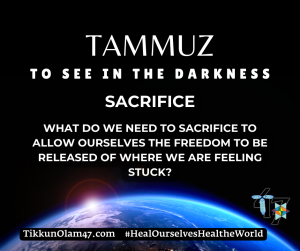
What do you we need to Sacrifice in this period of time to allow ourselves the freedom to no longer be stuck?
This is the first lesson of the portion.
26On the day of the first fruits, when you offer up a new meal offering to the Lord, on your festival of Weeks; it shall be a holy convocation for you, and you shall not perform any mundane work.
27You shall offer up a burnt offering with a spirit of satisfaction to the Lord: two young bulls, one ram, and seven lambs in the first year.
28Their meal offerings [shall be] fine flour mixed with oil; three tenths for each bull and two tenths for the ram.
29One tenth for each lamb, for all seven lambs.
30One young male goat to atone for you.
31You shall offer this up besides the continual burnt offering and its meal offering they shall be unblemished for you, as well as their libations.
Next we read about the sacrifice of Shavuot. The message here? Once we sacrifice what we are holding onto for our freedom? We must sacrifice what we are provided in our freedom – back to Hashem. When we hold onto our productivity? We come from a lack mentality. We must give back. If we grasp our fruit (wealth and prosperity) we are not trusting Hashem to provide.
29:1And in the seventh month, on the first day, there shall be a holy convocation for you; you shall not perform any mundane work. It shall be a day of shofar sounding for you.
2You shall offer up a burnt offering for a spirit of satisfaction to the Lord: one young bull, one ram, and seven lambs in the first year, [all] unblemished.
3And their meal offering [shall be] fine flour mixed with oil, three tenths for the bull and two tenths for the ram.
4And one tenth for each lamb, for the seven lambs.
5And one young male goat as a sin offering, to atone for you.
6[This is] besides the burnt offering of the new month and its meal offering, and the continual burnt offering and its meal offering, and their libations as prescribed for them, as a spirit of satisfaction, a fire offering to the Lord.
7And on the tenth day of this seventh month, there shall be a holy convocation for you, and you shall afflict your souls. You shall not perform any work.
8You shall offer up a burnt offering to the Lord, [for] a spirit of satisfaction: one young bull, one ram, and seven lambs in the first year; they shall [all] be unblemished.
9And their meal offering [shall be] fine flour mixed with oil, three tenths for the bull and two tenths for the ram.
10One tenth for each lamb, for the seven lambs.
11A young male goat for a sin offering, besides the atonement sin offering and the continual burnt offering, its meal offering and their libations.
This is the sacrifice of Rosh Hashanah and Yom Kippur. Once a year, we are called to sacrifice for the King. Purely to reinforce who is sovereign within us. Are we in charge, or do we submit to the Royalty Hashem has put within us? Our Neshama? Do we live according to our animal soul? Or do we live according to our Godly soul? This is the final sacrifice we learn about.
When we are in mourning – the last thing we want to do? Sacrifice. And yet we are called to do this.
These are my thoughts. What are yours?
Here are my thoughts from the past two years:
Tyler’s Torah Thoughts for 18 Tamuz, 5783
Today’s portion is really interesting for me. One of the things that really stands out is how sacrifice is connected to our brain. Why are these sacrificial passages so enmeshed into the Torah. And why do they matter given no one really does them anymore?
I’m reflecting on this question. And I keep coming back to our brain. Trauma. Healing.
Imagine the collective trauma of the Israelites going through this? The trauma of being an enslaved people. We read these stories in the Torah, this history, and we lose sight of context.
How traumatic would it have been being in this life? To have come from slavery, to walk through the sea parted, and be wandering in the wilderness? To see the earth swallow up those who confronted Moses? Trauma. Trauma. Trauma.
And we have the sacrifice. To remember.
Most of us want to run away from our traumas. Ignore them. But as Jews, yearly we are called to REMEMBER our trauma. To remember the sacrifices. To remember the exodus of freedom.
And we can’t understand freedom until we understand slavery. And we can’t truly understand slavery until we understand the collective trauma it had on a people. And we can’t understand freedom until we understand the collective liberation of a people. And. It’s not that simple is it?
We read stories and watch movies (Shawshank redemption comes to mind as just one example) that show us how living in captivity, in oppression, in slavery impacts you once you gain your freedom. Making it “on the outside” isn’t just a simple thing, is it?
And here we get prescriptive in the Torah. We reflect on the slavery in Egypt. We are called to live it. Remember it.
From my own life, the journey I went on for about 24 hours – the first of the “Three Weeks” has been poetic.
I mentioned yesterday my power was off. I came home on Wednesday night to no power. Darkness. Within 24 hours, the power was restored. This morning, I see the power and light in my apartment much differently. There is a MUCH greater appreciation this morning than I had two mornings ago before the power went out. My warm cup of coffee tastes that much better.
This is a good reminder for all of us. These “three weeks” aren’t meant to do anything other than help us remember. To be grateful. We may not have yet gotten to where we want to be. We may not have yet entered the “promised land.” But we control our consciousness. Is our consciousness trying to live in the future? In the promised land? Or is our consciousness stuck in the past? Stuck in a past that is no longer reality today?
Or are we in the moment? Remembering our past. Reliving our past. To remember in THIS moment what we experienced. What we’ve learned.
In order to.. better live out THIS moment. The way we are called to. Without judgment. But with curiosity. To receive the moment that has arrived (including when we come home from a long day to no power) and trust that moment to live it. With our rearview mirror steadying our journey from the past. And.
With a window to multiple futures that are all possible and real in front of us.
I am working on not being to tied to a future. To a road leading me to my future. My future is in front of me. There will be a labyrinth to walk to get there.
I need to remember the past. the lessons. My current sacrifice? When a moment arrives and it feels painful? That’s a reminder. I may be getting behind the timeline and caught in the hurricane. Or too far ahead in the timeline – caught in the hurricane.
I can choose to live in the eye of the hurricane. Always. The storms will come around us. We live in a perpetual hurricane. We can choose to accept the peace of the eye of the hurricane. We can choose to trust we can keep up with the eye of the hurricane – we aren’t limited to being stuck in one place as the hurricane moves.
We can. Instead. Trust the hurricane – it’s showing us where to go. In each moment. We need to always get to the eye. The peace. The comfort. In the storm around us.
Most of us can’t afford to purchase a hurricane proof plane to fly through the storm. But those who can? They are momentarily sheltered from the storm in their plane. Because that plane can also break down. The only thing that won’t break down?
Us.
This being said, I want to close my thoughts today with those of us who can’t find safety and peace in the middle of the hurricane. Those of us who cannot see the eye.
I have spent MANY MANY MANY of my moments right there. Unable to see the peace of the eye. I don’t have great answers for us. All I know in those moments, the universe (Hashem) showed up for me – and in the darkness? I saw a glimmer of light.
If you need that? Reach out to me. Seriously. I do my best to be in tune where people are – but sometimes, on my journey, I have needed to learn to ask for help to find the eye. To find the peace within the hurricane. That’s part of the journey, isn’t it? We read about the daughters who came to Moses a few days ago and asked for their inheritance. Their sacrifice was asking. Speaking out. In power.
Ask if you need it. We are not alone. Even when we are lonely.
These are my thoughts. What about you? What are yours?
Tyler’s Torah Thoughts for 23 Tamuz, 5782
Good morning!
Today we continue our journey of the sacrificial offerings. Yesterday we looked at the continual daily (twice a day) offering, the sabbath offering and the new moon offering. All of these offerings signified important events and reminders for us.
We start today’s portion with Passover. As we consider the journey from slavery to freedom, the Passover remains the hub of the story. It is the story of the Jews leaving Egypt.
The next holiday is the Festival of Weeks: the “Day of the First Fruits” – this is Shavuot. And it marks 49/50 days from leaving Egypt.
The 50 days between Passover and Shavuot are interesting to consider. And it is also interesting that right before the Jews enter the promised land, God is reviewing all of this with Moses – for the people.
Remember. Remember. Remember. This is why we sacrifice. To remember.
Between Shavuot and the next sacrificial holy day is a long period of time (which we are currently living today). The next holy day is Rosh Hashahna.
I’m reflecting on how, in our journey after slavery, into the wilderness; where we can celebrate the first fruits of freedom, the journey isn’t over.
It’s still beginning. We get to Rosh Hashanah and there is a focus on repentance. Just because we are free, doesn’t mean we won’t stumble. But the opportunity to repent is always there!
Then today’s portion ends with Yom Kippur. The day our sins are atoned.
There is a process for freedom laid out here. And it’s building to something. We exit Yom Kippur with a clean slate; ready to enter the promised land of freedom.
We aren’t there quite yet. And we know on this earth, even once we “arrive” – we will start all over again. A yearly reminder of the journey from slavery to freedom.
I’m excited for Shabbat tonight and tomorrow; we will focus on the last group of sacrifices – and they will be centered around my favorite Jewish holy day. Sukkot!
What are your thoughts?


No responses yet