Tyler’s Torah Thoughts for 20 Sivan, 5784
Parsha Shelach-Lekha – “Send For Yourself”: (Numbers 13:1 – 15:41)
Fourth Portion: Numbers 14:26 – 15:8
Good morning! It has been an interesting journey at this camp, hasn’t it? We went from navigating our cravings at the first camp, to navigating our ego at the second. Now we come face to face with courage. Shame is one of the areas we need to bring courage to. We left off yesterday with Hashem asking Moses for council. Moses gives Hashem some great council. Hashem forgives the people for complaining. He gives them consequences – they will see the land. Now, Hashem turns to those who CAUSED the complaints:
26The Lord spoke to Moses and Aaron, saying,
27″How much longer will this evil congregation who are causing to complain against Me [exist]? The complaints of the children of Israel which they caused them to complain against Me, I have heard.
Hashem is looking to the 10 spies who gave their report and the complaints it generated.
I am reflecting on this. Are we sparking others to complain like the 10 spies? Or are we like Caleb and Joshua? How does Hashem deal with the spies?
28Say to them, ‘As I live,’ says the Lord, ‘if not as you have spoken in My ears, so will I do to you.
29In this desert, your corpses shall fall; your entire number, all those from the age of twenty and up, who were counted, because you complained against Me.
30You shall [not] come into the Land concerning which I raised My hand that you would settle in it, except Caleb the son of Jephunneh and Joshua the son of Nun.
31As for your infants, of whom you said that they will be as spoils, I will bring them [there], and they will come to know the Land which You despised.
32But as for you, your corpses shall fall in this desert.
33Your children shall wander in the desert for forty years and bear your defection until the last of your corpses has fallen in the desert.
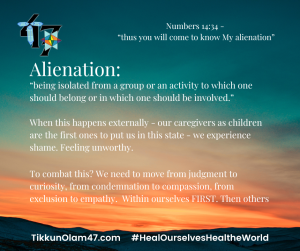
34According to the number of days which you toured the Land forty days, a day for each year, you will [thus] bear your iniquities for forty years; thus you will come to know My alienation.
35I, the Lord, have spoken if I will not do this to the entire evil congregation who have assembled against me; in this desert they will end, and there they will die.
36As for the men whom Moses had sent to scout the Land, who returned and caused the entire congregation to complain against him by spreading [a slanderous] report about the Land”
37the men who spread an evil report about the Land died in the plague, before the Lord.
38But Joshua the son of Nun and Caleb the son of Jephunneh remained alive of the men who went to tour the Land.
So first we see – the purpose of the consequence here is to “know” Hashem’s alienation.
This is an interesting concept. Hashem was alienated by the complaints.
What is “alienation?” I looked it up: “the state or experience of being isolated from a group or an activity to which one should belong or in which one should be involved.”
I am sitting with this. Hashem was in a state of isolation when He should be connected with the children.
As a parent? I have experienced alienation. In my career? I have experienced alienation. I think we all have.
I want to go back to dignity, fitness, and now bring in alienation.
What is dignity? “the state or quality of being worthy of honor or respect.”
What is fitness? “The quality of being suitable to fulfill a particular role or task.”
Alienation? “the state or experience of being isolated from a group or an activity to which one should belong or in which one should be involved.”
This is connected to shame. From Brene Brown:
“Shame is the intensely painful feeling or experience of believing that we are flawed and therefore unworthy of love, belonging, and connection.”
We are seeing the IMPACT of alienation. We inherently have dignity and fitness for a role. When we are born? We are worthy of honor and respect. We are suitable to fulfill the role of being a baby. We are human.
However, somewhere along the way? We experience alienation. Isolation from a group which we should belong or be involved.
Hashem wanted to just destroy the entire group. He got angry. Anger is Hashem’s response to alienation. As a child, I have watched my kids experience alienation. I have watched my kids alienate one another. I have alienated my children. That is all connected to shame.
And we don’t talk about it.
We don’t talk about alienation. I look at the options in front of me. This is where the questions I have asked in years past come to light. Do I act in a way that alienates because of my shame? Or do I connect myself with Hashem, and that drives me to act in a way that reminds others of their dignity and worth. This is our choice – and it’s not binary – it’s a continuum.
On one end we can act in a way the alienates others:
- Judgment
- Condemnation
- Exclusion
On the other? We can act in a way that connects others to their dignity. To remind them of their worth. Communicate in a way they believe they are wanted and needed in this world:
- Curiosity
- Compassion
- Empathy
The move is from judgment to curiosity, from condemnation to compassion, from exclusion to empathy.
And this starts within. Do we talk to OURSELVES with judgment, condemnation, and exclusion? Do we alienate OURSELVES from OURSELVES? Or do we connect?
Let’s sit with that.
Being impacted by alienation is one thing. Alienating others is another.
Let’s keep going.
39Moses related all these words to the children of Israel, and the people mourned greatly.
40They arose early in the morning and ascended to the mountain top, saying, “We are ready to go up to the place of which the Lord spoke, for we have sinned. “
41Moses said, “Why do you transgress the word of the Lord? It will not succeed.
42Do not go up, for the Lord is not among you, [so that] you will not be beaten by your enemies.
43For the Amalekites and the Canaanites are there before you, and you will fall by the sword. For you have turned away from the Lord, and the Lord will not be with you.
44They defiantly ascended to the mountain top, but the Ark of the Covenant of the Lord and Moses did not move from the camp.
45The Amalekites and the Canaanites who lived on the mountain came down and smote them and crushed them [pursuing them] until Hormah.
The spies and others, in their grief, do not accept the consequences of their actions. They try to enter the land on their own, without Hashem’s direction. They suffer a significant loss.
Alienation can cause us deep grief. Courage continues to be the move. To accept the consequences as they are – and not fight them. Because of a lack of courage, their shame moved them away from Paran – they were pursued to Hormah
15:1The Lord spoke to Moses saying:
2Speak to the children of Israel and say to them: When you arrive in the Land of your dwelling place, which I am giving you,
3and you make a fire offering to the Lord, a burnt offering or a sacrifice [namely a peace offering], for an expressed vow or for a voluntary offering or on your festivals, to provide a pleasing fragrance for the Lord, from the cattle or from the sheep.
4The one who brings his offering to the Lord shall present a meal offering containing one tenth fine flour mixed with a quarter of a hin of oil.
5And a quarter of a hin of wine for a libation, you shall prepare with the burnt offering or for the sacrifice, for each lamb.
6Or for a ram, you shall present a meal offering containing two tenths fine flour mixed with a third of a hin of oil.
7And a third of a hin of wine for a libation; you shall offer up, a pleasing fragrance to the Lord.
8If you prepare a young bull as a burnt offering or sacrifice by expressing a vow, or for a peace offering for the Lord,
This is an interesting transition, isn’t it? We left the courage camp. We actually FLEED the courage camp. And are now at a new camp. And we jump right into sacrifice.
Cravings.
Ego.
Courage.
Sacrifice.
These have been the themes of the journey it would seem after getting the Torah.
Dignity. Fitness. Alienation.
Moving from judgment to curiosity, from condemnation to compassion, from exclusion to empathy.
This seems to be our focus today. What are your thoughts?
Here are my thoughts from the past two years;
Tyler’s Torah Thoughts for 25 Sivan, 5783
Provoking others. Today’s theme from the portion (that I am picking up) is really a consideration is how is our journey provoking others?
We can convince ourselves we “don’t care what other people think.” But the truth is our bodies feel it. When someone talks badly behind our backs – we can cognitively disassociate with it – and convince ourselves it doesn’t matter. But if we get out of our head in the moment, and feel our bodies – and feel our hearts? We care. The only way we can convince ourselves we don’t care is to tell our bodies – “you are not us.” We have to separate ourselves from our emotions and feelings.
And let me be clear. That is a coping strategy – ESPECIALLY when it comes to trauma.
But if the question is – how are we provoking others? My opinion is – we need to start by asking ourselves – how are we provoking ourselves?
I wrote this last year regarding today’s portion:
What I glean from the question is that provoking our fellow humans to either trust God or mistrust Him is something He cares about. So an additional reflective question for us might be; “how are we provoking others to view God? Are we provoking curiosity? Empathy? Judgment? Compassion? Freedom?”
I take this within and ask myself – do I reflect within and provoke for myself:
- Curiosity?
- Empathy?
- Judgment?
- Compassion?
- Freedom?
- Condemnation?
- Exclusion?
The answer to this question within will directly impact how we engage with others. If I am judging and condemning myself? I am likely going to do that with others. And – it may result in judging others favorably – because I see them as “better” and “more worthy” than I see myself. But that is still judgment.
Again – if we are going to heal the world, the work starts within us.
What do you think?
Tyler’s Torah Thoughts for 23 Sivan, 5782
Good morning!
I have some reflective questions for you before jumping into the Torah:
- Ask yourself “how are you doing?” And just sit and listen. Journal if you feel compelled.
- What does your body need? Think about your senses- what you can see, what you can touch, what you can hear, what you can smell. Ask your body, “what do you need?”
These two questions this morning have been incredibly helpful in my meditation and journaling. My body is screaming at me because of some of the processing we’ve been doing together (my brain and my body are deconstructed at the moment). I’m now more fully aware of what I need. And that’s empowering!
Ok. Lets dig into the Torah!
God has heard Moses and is having the Israelites turned around and go back into the desert.
And we get a new piece of the puzzle.
God asks Moses and Aaron a rhetorical question; “How much longer will I hear this evil congregation of spies who are provoking the Jewish people against me? I have heard the complaints of the children of Israel whom they provoke against Me!”
So God is aware of the IMPACT of what the spies are saying on the relationship He has with his people. In the end, the spies demonstrate a lack of trust in God.
It is interesting to me that the Torah records God asking Moses and Aaron a rhetorical question. Why? Why would he do that? Maybe it’s for us?
What I glean from the question is that provoking our fellow humans to either trust God or mistrust Him is something He cares about. So an additional reflective question for us might be; “how are we provoking others to view God? Are we provoking curiosity? Empathy? Judgment? Compassion? Freedom?”
God then tells Moses He will give the spies what they asked for when they said “if only we had died in the desert.” He tells Moses that their children (whom they said would be captured) will see the freedom of the promised land. The kids will bear the brunt of the sin of the spies and the people corresponding to the days they spied the promised land. 40 years. 1 year for each day.
And then we learn the 10 spies who gave the report and didn’t trust God died right away from the plague. Only Joshua and Caleb survived.
Now. You’d think this was enough for the children of Israel to get it. Nope. People heard all of what Moses told them about what God said. And the next morning they went up the mountain to go to the promised land on their own. They left the camp, and the ark and the tent of meeting and went up to the mountain to try to enter the land. And the Amelekites and Canaanites who lived on the mountain came down and thrashed them and thwarted them. They were destroyed.
Again; we can’t take matters into our own hands; but we need to trust the process God is taking us through.
Today’s portion then closes with God telling Moses to tell the children of Israel what sacrifices He wants from them.
The placing of this is interesting. It basically reassures the people that they WILL enter the land despite all of the judgment and what just transpired. The declaration that the current generation of adults will die, and the spies dying immediately, turning around from the promised land, etc.
The sacrifices were just that – sacrificial. AND. They were encouraging.
What are your thoughts?


No responses yet