Tyler’s Torah Thoughts for 3 Iyar, 5784 –Day 18 of Omer
Parsha Kedoshim – “Holy” (Leviticus 19:1 – 20:27)
Seventh Portion: Leviticus 20:23 – 20:27
Shabbat Shalom! Today we finish out a tough parsha. And focus on the 18th day of the Omer. Today’s theme? The determination of compassion”
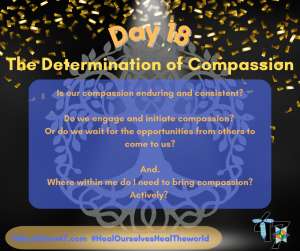 From Chabad:
Is my compassion enduring and consistent? Is it reliable or whimsical? Does it prevail among other forces in my life? Do I have the capacity to be compassionate even when I’m busy with other activities or only when it’s comfortable for me? Am I ready to stand up and fight for another?
Exercise for the day: In middle of the busy day take a moment and call someone that needs a compassionate word. Defend someone who is in need of sympathy even if it’s not a popular position.
I love this. The idea of being determined with our compassion – instead of being passive is important. Do we engage and initiate? Or do we wait for the opportunities to come to us? If we feel into our hearts, who needs our compassion? Can we be determined to provide that, even if they aren’t initiating it?
And. Where within me do I need to bring compassion? Actively?
Let’s close out today’s portion:
23You shall not follow the practices of the nation that I am sending away from before you, for they committed all these [sins], and I was disgusted with them.
24So I said to you, You shall possess their land, and I shall give it to you to possess it a land flowing with milk and honey. I am the Lord your God, Who has distinguished you from the peoples.
I wrote this two years ago, and given the conflicts in the middle east, we need to really understand colonization isn’t a one way street. As Jews, the Torah talks about this. The promised land of Israel WAS inhabited before we got there.
This is what I wrote:
We have to own the fact, that we drove people from their homes in order to live in the land Hashem promised us. And we have to own, from various perspectives, that’s going to be seen as imperial. Yes, we can see Hashem’s authority in doing this; but for those who don’t recognize His authority, the idea of people being driven out of their homes so that the Jews could possess it? Highly problematic. Even if the Jews were slaves before.
And we have recent history to guide us on this. After the holocaust, the Jews were given Israel. And people who were living there lost their homes; they were given the option to stay, but still the homes they grew up in would fundamentally be changed forever.
In this time of compassion; we need to turn our eyes to this idea. That those who were living in the land before the Jews possessed it – both in the Torah and today- had their lives disrupted. We can be compassionate towards them. And. At the same time, have compassion for ourselves. We have the capacity for both.
The same is true for us in America. It is interesting that so many Americans are focused on the idea of Israel and Palestine being in a conflict in the middle east, without recognizing our own colonization of OUR land from those who were Native here. I am curious why people in our country fight so hard for justice in the middle east in the Palestinian/Israeli conflict when they ignore the injustice here at home.
I get that people are dying in the middle east and that heightens the issue on all sides. And. We still need to reconcile our own history.
Let’s keep going:
25And you shall distinguish between clean animals and unclean ones, and between unclean birds and clean ones; thus you shall not make yourselves disgusting through [unclean] animals and birds and any [creature] which crawls on the earth, that I have distinguished for you to render unclean.
26And you shall be holy to Me, for I, the Lord, am holy, and I have distinguished you from the peoples, to be Mine.
The entire purpose of this – being set apart for Hashem. He wants our attention. He wants our commitment. How can we commit to another? To ourselves? Without learning about commitment from the universe? From love?
27And a man or a woman who has [the sorcery of] Ov or Yid’oni, shall surely be put to death; they shall pelt them with stones; their blood is upon themselves.
And here we are back to the Ov and Yid’oni – another reference to this.
See yesterday’s portion, and the thoughts below on this.
And let me know your thoughts!
Here are my thoughts from two years ago:
Tyler’s Torah Thoughts for 6 Iyar, 5782:
Shabbat Shalom! Today is the 21st day of the Omer, three weeks. It’s the last day of the theme of “compassion” for the Omer. At sundown, the theme transitions to “determination.” As we go about our day today, let’s focus on compassion- and not just for others. One of the hardest skills is to have compassion for ourselves. Give yourself some compassion today in how you are internally communicating. What stories are you telling yourself about yourself? Today, make an intention to tell yourself loving and kind things! As I posted earlier; tell your self:
- I believe in you!
- I trust in you!
- I know you can handle life’s situations!
- You are listened to!
- You are cared for!
- You are very, very important to me!
Tell yourself these things – even if you don’t yet believe them to be true!
And if you are struggling to believe these things, talk to me! Send me a DM! I’m glad to help!
Ok! Let’s dig into the final portion of this week’s Parshah!
This week as been tough reading the Torah. A lot of ideas and concepts that challenge our feelings about our current reality and culture. But the portion ends with a reminder of why we are being given these mitzvahs:
“You should not follow the practices of the nation that I am driving out before you, for they committed all these, and I was disgusted with them. That is why I said to you: You should possess their land, and I will give it to you so that you can inherit it. It is a land flowing with milk and honey.”
It is important to note; the promised land that God was giving the children of Israel was inhabited. This was not a land that was waiting for the Jews to live in it.
We have to own the fact, that we drove people from their homes in order to live in the land Hashem promised us. And we have to own, from various perspectives, that’s going to be seen as imperial. Yes, we can see Hashem’s authority in doing this; but for those who don’t recognize His authority, the idea of people being driven out of their homes so that the Jews could possess it? Highly problematic. Even if the Jews were slaves before.
And we have recent history to guide us on this. After the holocaust, the Jews were given Israel. And people who were living there lost their homes; they were given the option to stay, but still the homes they grew up in would fundamentally be changed forever.
In this time of compassion; we need to turn our eyes to this idea. That those who were living in the land before the Jews possessed it – both in the Torah and today- had their lives disrupted. We can be compassionate towards them. And. At the same time, have compassion for ourselves. We have the capacity for both.
The closing of the portion is God reminding the Jews by summarizing the mitzvahs: distinguish between pure animals and impure, birds that are pure and those that are impure.
Then Hashem tells the Jews; be holy (separated) to God because “I, God, am holy, and I have distinguished you from the nations, to be Mine.”
And one final mitzvah:
“A man or woman who practices (the sorcery of the ‘ov or yidde’oni should be put to death.”
Ok. So this leaves the question. What is ‘ov and yidde’oni?
To be fair to the question, I want to present two sides to the idea. Here is a perspective that may be unique – about witchcraft and Judaism:
https://www.jewitches.com/…/can-you-even-be-a-jewish-witch
I’m not endorsing this by any means; but I’m a fan of providing alternative viewpoints and letting each of us make the decision for ourselves. It’s certainly interesting. The article interprets this verse as follows:
“Leviticus 19:31 states, “Do not turn to the idols called ov or yidoni.”
This is a very specific act. So, could a witch simply not put a bird in her mouth, burn incense, say those words, and be fine?”
So this practice involves putting a bird in one’s mouth and burning incense.
Chabad seems to agree with the idea of what the yidde’oni is:
https://www.chabad.org/…/jewish/Negative-Commandment-9.htm
So there you have it. A fascinating look at todays Torah portion!
What are your thoughts?
As always on Shabbat, the Haftorah thoughts will be in the comments below!
Haftorah thoughts:
Ashkenazi Jews read Ezekiel 22:1-16, Sephardic Jews and Chabad reads Ezekiel 20:2-20
The Haftorah follows the Parsha this week with the theme of following the mitzvahs “so we may live.” The Haftorah is a historical review of Israel’s past- spanning many time periods.
We are going to see how God preserves the Jewish people not because we are “better than other nations” but really so that His Name would not be profaned.
Let’s start in Ezekiel 20:2:
The word of God comes to Ezekiel and tells him to talk to the elders and shut down their petition to God; “have you come to petition Me in prayer, to save Jerusalem? As I live, I will not let you petition me!”
God won’t even let them approach Him with a petition to save Jerusalem.
God tells Ezekiel- if you need to debate with them, remind them of their ancestors’ abominations in addition to their own sins.
God is saying, Israel isn’t worthy. They have walked away and done what is right in their own eyes; not in the eyes of God.
God tells Ezekiel how he should debate with the elders:
- God chose Israel when we were slaves in Egypt.
- God took an oath to the descendants of Jacob.
- That oath was “I am God, your God, who guides you personally.”
Let’s stop here. God made an oath to guide us personally.
How is He doing that in your life?
Ok back to the passage:
- God swore to take them out of the land of Egypt and into a land flowing with Milk and Honey.
So those were the four things God promised. And here is what He asked for in return:
- Discard the detestable things which your eyes attract you to!
- Do not contaminate yourselves by following after the idols of Egypt. If God is our God, How could we trade Him for idols?
And then God has Ezekiel argue with the elders:
While still in Egypt, we rebelled against God. We did not want to listen to Him. And God was ready to pour out His anger on us. But He stopped. Why?
God says “I acted for the sake of My name: so it would not be profaned in the eyes of the nations where they lived.”
So God acts on our behalf not because we are “good” and “don’t sin.” In fact He knows we will. He acts on our behalf because of His name; He wants the nations to know He is God! So He rescued us from Egypt.
But then our sin continues after leaving Egypt. God gives us rational and suprarational commands. And He even points out – “the rational commands you understood were at least for your benefit and yet you still didn’t obey.”
And once again, God acted in our behalf not because of what we did. But because of His name.
And after the spies went into the promised land and sinned; God says “Even though they deserved to be destroyed, I had pity on them, so I did not wipe them out in the desert.”
So in this first Haftorah passage, the message is very much in line with the theme of compassion. We do not deserve God to act on our behalf. We are not Better than other nations. God acts for us because of His name. That’s crucial. We need to have self compassion because Hashem understands us.
The next portion of Haftorah (read by Ashkenazi Jews) follows a similar pattern. Ezekiel 22:1-16 lays out the case against Jerusalem and the many sins of the current times.
The conclusion is the same as it ends with this:
“13 “I clapped My hands in distress over the fraud you have committed and over the innocent blood spilled in your midst. Will your heart endure and your hands remain strong to fight in the days of recompense which I am preparing for you? I, God have spoken, and I will act! IS I will scatter you among the nations and disperse you among the lands, and I will eliminate your impurity from you. You will be profaned in the eyes of the nations, and you will know that I am God.”


No responses yet